Augusta-Richmond County reviews HB 581 ‘floating’ homestead exemption and local sales-tax option
Loading...
Summary
Officials and residents at an Augusta-Richmond County public session examined how Georgia House Bill 581’s “floating” homestead exemption would work locally, who would benefit, and the trade-offs of a required local sales tax referendum; commissioners must decide by March 1 whether to opt out.
Augusta-Richmond County officials held a public information session on the state law commonly called HB 581 and its “floating” homestead exemption, explaining how the exemption would limit assessed-value increases for eligible homesteads, shift tax burdens among property owners, and require local votes on a new sales-tax option to offset revenue changes.
The discussion matters because the exemption would affect roughly 31,000 homes in Richmond County—about 38% of all property owners and roughly half of homeowners—change how the county’s net digest is calculated, and could force a higher millage (rollback) rate for nonbenefitting property owners unless the county secures a voter-approved local sales tax. The commission must make a decision by March 1 whether to opt out of the state-created homestead freeze or remain subject to it.
County staff outlined how the floating homestead works: the exemption increases annually based on a prior-year consumer price index (CPI) determined by the Georgia Department of Revenue, and it is added on top of existing homestead exemptions rather than replacing them. Scott (staff member) said disabled-veteran exemptions are not affected and that the floating exemption “works by increasing the value of that homestead exemption to offset inflation based on a prior year's consumer price index.” He explained that a base-year value is set for a homestead, appreciation is tracked over time, and the exemption can be reset if the property is sold or undergoes substantial improvements; surviving spouses can continue to receive the benefit where applicable.
Tim Schreier, the interim finance director, gave numeric examples to show distributional effects across households. Schreier said assessed value is 40% of purchase price under Georgia law and presented a 10-year illustration in which two otherwise similar homes with base years a decade apart would face very different taxable values and tax bills under the floating exemption. Schreier said, “As a financial professional, I get a little concerned about getting too many eggs in one basket,” referring to the requirement that the county rely on a voter-approved floating local option sales tax (FLOSS) to offset lost property-tax revenue; under state law Augusta would be limited to a half-cent FLOSS and any FLOSS must be approved by local referendum and reapproved every five years.
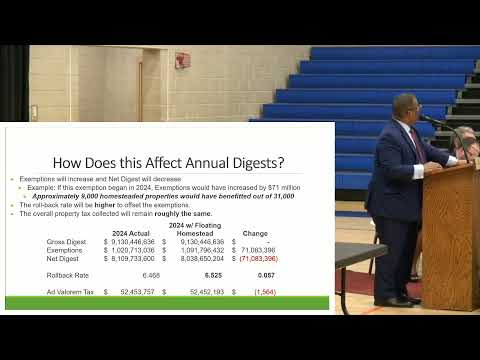
Staff said the county’s total revenue needs would not change; rather, who pays would shift. County presenters gave these figures during the session: the county’s annual budget is roughly $1.4 billion, the general fund is about $206 million, and the sheriff’s office consumes about $80 million of the general fund, leaving roughly $140–$146 million for other operations. Staff said that, using the 2024 digest as an example, had HB 581 been in place the county’s rollback (millage) rate would have been higher because exemptions would have grown and net digest would have fallen absent offsetting revenue.
Speakers from the public raised process and fairness concerns. One resident asked, “Why didn't we have the public hearings before we voted on it, so we'll know what we was voting on?” noting that the state referendum authorizing the law passed in November with substantial support. Commissioners and staff repeatedly stressed that the constitutional amendment and state legislation originated at the Georgia General Assembly and that local governments were required to follow specified procedures to opt out. Commissioners also noted that the Augusta-Richmond County Board of Education has already decided to opt out of the homestead freeze.
Business groups were cited by staff as a prominent voice urging the county to opt out. County staff summarized the Augusta Metro Chamber of Commerce position that increases in homeowner exemptions would shift taxes onto commercial and business property, which could weaken business retention and investment; staff warned businesses might relocate to neighboring counties with different tax choices.
Staff identified key deadlines and trade-offs: if the commission remains “in” (does not opt out), the county would have the option to ask voters to approve a FLOSS (limited to a half-cent in Augusta) to make up revenue; that local sales tax is not an automatic offset and would require repeated voter approval every five years. Staff also said the current legislation offers a one-time opt-out opportunity—if the commission opts out under current law, that local opt-out cannot be reversed under the statute’s current language.
No formal commission vote on opt-in or opt-out was recorded during this session. Presenters said the commission is holding required public hearings (the law requires three) and soliciting public input before taking a final position by the state-imposed deadline. Commissioner-level speakers said they had not yet decided and wanted further public feedback.
Next steps: the commission will continue public hearings and is scheduled to reach a decision required by state procedure by March 1; if the county remains subject to the floating homestead exemption it would need voter approval for any FLOSS intended to offset shifts in property-tax burden.