Get Full Government Meeting Transcripts, Videos, & Alerts Forever!
Get email alerts on the Procurement Policy topic
No spam. Unsubscribe anytime.
El Paso officials review procurement sourcing policy, push local-supplier tools and Hire El Paso First preference
Summary
City purchasing staff presented the procurement sourcing policy, explained buying tools such as EP Marketplace and cooperative contracts, and outlined the Hire El Paso First local-preference tiers and outreach initiatives. Councilors asked about local participation, competition and timelines for policy review.
City purchasing officials reviewed the city’s procurement sourcing policy and the tools the Purchasing and Strategic Sourcing Department uses to expand supplier participation, improve oversight and support local businesses.
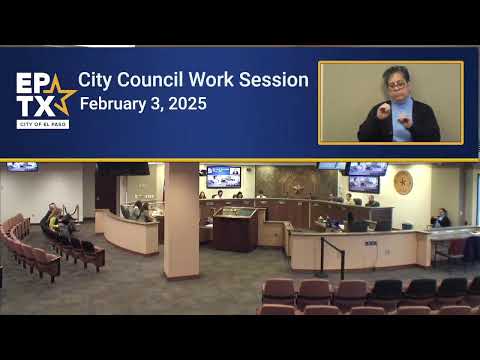
The presentation, given during the Feb. 3 work session, described the policy (amended and restated May 9, 2023), the city’s vendor platforms and cooperative purchasing programs, and the Hire El Paso First local-preference program. Nicole Cody, managing director for purchasing and strategic sourcing, told council the department’s core functions include centralized purchasing, contract administration and vendor outreach and that “we have to have that professionalism and that integrity in the process.”
Why it matters: procurement is how the city spends hundreds of millions of dollars each year. City staff framed the presentation as both a compliance briefing (federal, state, local rules) and an effort to increase local contracting opportunities through outreach, technology and preference policies.
What staff described - Procurement thresholds and delegations: contracts and contract modifications above $50,000 must be brought to council; the purchasing director is authorized to execute contracts and purchase orders under $50,000 (and multiyear aggregate limits set as required by state statute). City staff noted the threshold derives from current state law and that some legislative proposals may change it. - Solicitation process: user departments draft scopes of work; purchasing publishes solicitations through the city’s IonWave portal; suppliers may ask questions during the solicitation period; evaluations use methods (low-bid, best value, design-build, etc.) matched to the work. - Cone of silence and protests: staff emphasized the city’s “cone of silence/anti-lobbying” policy applies once a solicitation is advertised and ends when a recommendation reaches the council agenda, and noted a formal protest process exists for bidders that responded to a solicitation. - EP Marketplace and cooperative contracts: Veronica Gomez demonstrated EP Marketplace — a city portal that aggregates competitively procured cooperative contracts (about 14 cooperative programs and more than 300 suppliers loaded) to let departments shop online and request quotes. Staff said the marketplace expedites purchases and supports comparative shopping. - Online bidding and regional sign-on: purchasing uses an IonWave bidding portal for solicitations. Staff said IonWave now supports single sign-on across regional agencies, allowing suppliers to link registrations across local agencies to see more opportunities. - Hire El Paso First local-preference program: the program has two tiers. Tier 1 requires a headquarters inside city limits, at least 10% of full‑time employees residing in the city, and not being a temporary site; Tier 2 requires at least one year of operations in the city, ownership or lease of property in the city and other criteria. Tier 1 gives a 5% threshold preference in applicable procurements; Tier 2 provides a 2.5% threshold. There is a vendor registration and verification process (including submission of documentation); the Hire El Paso First registration carries a $150 administrative fee. - Supplier support and outreach: staff described Supply El Paso, a multi-partner initiative and board established to improve local supplier capacity, and outreach programs such as Winning Wednesday and the annual Cooperative Expo (12th annual event planned for April). Purchasing staff also described technical assistance, QR-coded business cards for vendors, and in-person workshops.
Questions and council concerns Council members asked about low competition for some procurements, whether local bidders were being sufficiently encouraged to compete, and whether certain certifications (for example HUB certification) or insurance must be in place prior to award. Staff said certification requirements depend on each solicitation, insurance is typically required for work on city property and that some requirements apply after award (for example, construction insurance). Council members also asked how the Hire El Paso First program accounts for modern remote-work startups; staff said the program is under review and that changes are being considered to reflect post‑pandemic work arrangements.
Staff follow-ups and next steps Staff said they are reviewing the Hire El Paso First ordinance and other procurement resolutions (including how wages or medical benefits are treated in scoring) and will return with recommendations. Purchasing continues to promote outreach events and the EP Marketplace and to verify local-preference applications.
Ending Council did not take a vote on procurement policy changes at the session; staff will return with recommendations and ordinance updates for council consideration.