Get Full Government Meeting Transcripts, Videos, & Alerts Forever!
Get email alerts on the Solid Waste topic
No spam. Unsubscribe anytime.
Burleson staff recommends switch to once‑weekly pickup with 95‑gallon carts; council asks for contract amendments
Summary
City staff recommended a move to once‑weekly residential pickup in 95‑gallon carts, a $1/month citywide household hazardous‑waste curbside program and closing the commercial collection market; council asked staff to return with a contract amendment and more rate detail.
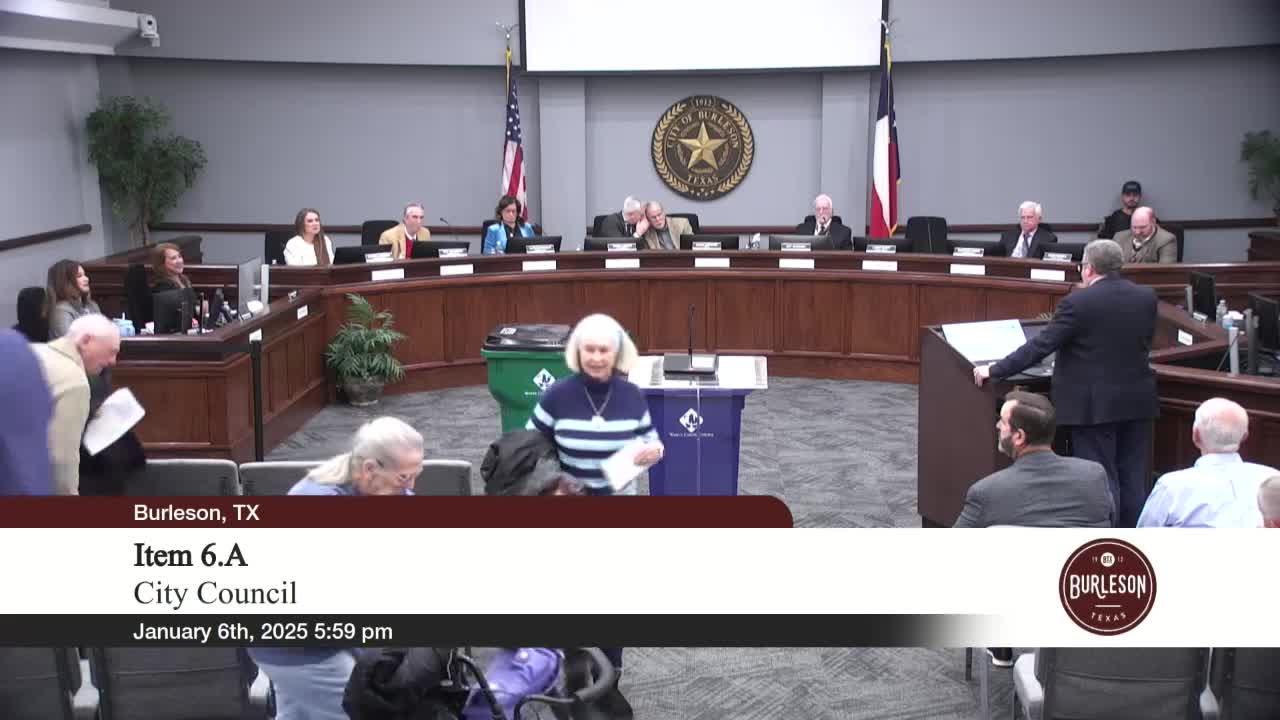
Burleson — City staff presented options to change the city’s residential and commercial solid‑waste service, recommending once‑weekly trash collection in 95‑gallon carts and a closed commercial market, and asked the council to direct staff to return with a draft contract amendment.
The recommendation, presented by Richard Abernathy, administrative services director, offered three residential options: keep current twice‑weekly bag or cart pickup; move to a twice‑weekly 95‑gallon cart; or move to once‑weekly collection using a 95‑gallon cart paired with a 95‑gallon recycling cart. Staff recommended the third option and proposed adding a household hazardous waste curbside pick‑up billed at $1 per household per month.
That option, staff said, would reduce the Waste Connections base charge to about $13 per household before city administrative and franchise fees; after adding the city’s overhead, the estimated resident bill would be about $16.70 per month under a closed commercial market. Staff recommended a $7 monthly charge for an extra cart, a 5% cap on annual contract price increases, and penalties for service lapses.
Why it matters: staff framed the change as a way to lower per‑household cost while maintaining service and freeing savings that could help offset other city fees under discussion. Council members repeatedly raised storage, wind, brush and outreach concerns during the discussion.
Details of the proposal and council concerns
Abernathy said the current contracted rate with Waste Connections is $20.49 (the resident bill, including city fees, is about $24.23 before sales tax). He said Waste Connections’ proposal for the recommended option would reduce the vendor component of the monthly charge to roughly $13, producing about a $16.70 total monthly cost after city fees; adding the household hazardous program to that calculation would raise the resident cost by roughly $1 plus associated franchise and sales taxes.
Staff proposed the new residential service be implemented in the fourth quarter of 2025 and — if the council approved closing the commercial market — to transition commercial service in the first quarter of 2026, giving businesses about a year to change vendors. Waste Connections’ current contract runs through September 2029, staff said.
Council members and residents raised practical questions. Councilmember Adam (first name used in the meeting) and others asked how leaves and bulky brush would be handled; staff said the small‑brush program would remain (three cubic yards cut and bundled) and the once‑monthly large bulk collection would continue. Several council members and residents said three cubic yards may not be enough, and homeowners who routinely generate more vegetative debris worried about enforcement and overflow.
Storage and appearance were also discussed. Abernathy and Waste Connections representatives said carts should be stored behind the building line per current code; council members urged a flexible, common‑sense approach during the transition to allow residents time to adapt. The city manager and staff emphasized outreach and education would be part of any transition plan.
Waste Connections officials discussed cart sizes on the council dais to show capacity: the proposed trash cart is 95 gallons and the current recycling cart is 64 gallons; Waste Connections said keeping 64‑gallon recycling and moving trash to 95 gallons could yield a modest additional savings (an estimated $0.20–$0.40 per month), and staff said Waste Connections would provide a firm rate if council wanted that option refined.
Household hazardous waste and billing
Abernathy described the household curbside hazardous waste option as a scheduled, once‑a‑month collection that would not be opt‑in: the $1 monthly fee would be assessed to all residences, he said. Councilmembers noted that adding the fee, franchise charge and sales tax brings the all‑in monthly bill closer to $19 per household when that program is included.
Council direction and next steps
Council did not adopt the service changes or sign a contract at the meeting. Instead, members signaled general support for staff’s recommendation and asked staff to return with a contract amendment and more precise rate options (including the 95/64 cart mix), customer‑service details, and an outreach plan. Richard Abernathy said staff would bring back a draft amendment for council review.
Quotes
"The presentation tonight is a proposal option for a solid waste and recycling, contract program," Richard Abernathy, administrative services director, said.
"This is a standard 95 gallon," said Brad Wainscott, division vice president for Waste Connections, while demonstrating cart size to the council.
Ending
Staff will return with a proposed contract amendment and detailed rate comparisons for council review and public outreach materials for the planned transition. No formal change to service or rates was adopted at the meeting.