Get Full Government Meeting Transcripts, Videos, & Alerts Forever!
Get email alerts on the Zoning Land Use topic
No spam. Unsubscribe anytime.
San Angelo ZBA tables appeal of planning director interpretation on vape, tobacco shops in neighborhood commercial zone
Summary
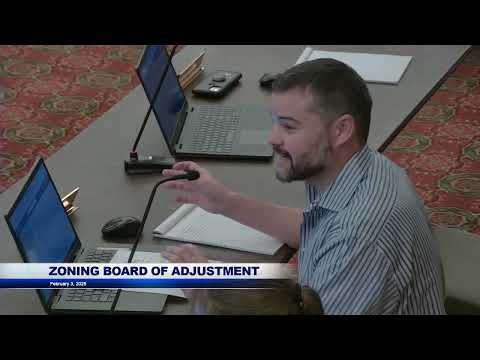
The San Angelo Zoning Board of Adjustments on Feb. 3 heard an appeal of the planning director's written interpretation that vape- and tobacco-only retail is not a permitted use in the city's neighborhood commercial (CN) zoning district, then voted to table the case for further review.
The San Angelo Zoning Board of Adjustments on Feb. 3 heard an appeal of a planning director's written interpretation that vape- and tobacco-only retail is not a permitted use in the city's neighborhood commercial (CN) zoning district, then voted to table the case for further review.
The board's chairman asked that the case be delayed "until we have more information and a legal opinion from either the city or the state on this," citing short notice and the novelty of vaping as a land-use question.
The appeal challenges a November interpretation by planning staff that a stand-alone vape-and-tobacco retail operation does not meet the CN district's purpose statement, which is intended to allow low-intensity commercial uses that meet the routine needs of nearby residents. Planning staff presented sections of the San Angelo zoning ordinance (including the ordinance purpose statement and Sections 3.04, 3.15 and 3.18) and argued the use's hours, signage and focused customer base make it more appropriate for higher-intensity commercial districts.
Planning staff said in their presentation that while "retail sales and service" is a listed category, the ordinance is silent on vape-specific uses and staff concluded vape-and-tobacco-only stores are not compatible with neighborhood commercial objectives. "I do not believe that it meets the intent statement for neighborhood commercial as a need for the neighborhood," Planning Department staff member Aaron Benoit told the board during the presentation.
The applicant's attorney, Hillary Bueker, representing the property owner, said the proposed use falls squarely within "retail sales and service," which is an allowed use category in CN. Bueker told the board staff's rationale singled out a new business type rather than a recognized land-use category and said other vape or tobacco retailers already operate in areas zoned CN or in nearby commercial zones. "This is retail sales and service," she said. "Retail sales and service is allowed in neighborhood commercial."
Board members pressed staff and the applicant on several points: whether the building's prior uses (convenience or auto-related uses) created legal nonconforming rights, how vacancy affects nonconforming status, whether signage and advertising could be enforced under the sign code, and whether a modified application describing a broader set of retail goods (for example, adding general merchandise) would change the zoning determination.
Several board members said they were uncomfortable making a final, precedent-setting interpretation under the ordinance at that meeting without additional legal research or fuller packet materials. The board discussed procedural issues, including that some members did not receive the planning director's written interpretation with their meeting packet until shortly before the hearing.
After the applicant's presentation and public discussion, the board considered motions. A motion to support the city's recommendation to deny the appeal (i.e., to uphold the planning director's interpretation) was moved and seconded but did not carry. Board members discussed the ordinance standard for overturning a director's interpretation, which requires the ZBA to modify or reject the interpretation only if it is not supported by substantial, competent evidence or is contrary to the intent of the comprehensive plan, the zoning ordinance, or the official zoning map.
Following further discussion, a motion to table the appeal until the board's March meeting passed. The chair instructed staff to include the planning director's written interpretation and any relevant supporting documents in the March meeting packet so members could review them before deliberation.
Votes at a glance: - Approval of minutes (regular meeting of December 2024): motion passed (board approved minutes; one member abstained because he was not present at the December meeting). - Motion to recess for 15 minutes (to allow staff to make copies of the interpretation): motion passed. - Motion to support the city's recommendation to deny the appeal (uphold the planning director): motion failed (the board did not reach the supermajority required by the ordinance to reverse the director's interpretation). - Motion to table the appeal until the board's March regular meeting: motion passed; the item will return to the ZBA agenda with the written interpretation included in the packet.
The board heard no public comment on the item. The next regular Zoning Board of Adjustments meeting is scheduled for 1:30 p.m. March 3, 2025, at City Hall East Mezzanine; staff said materials for this appeal will be included with that packet.
Context and immediate implications: The dispute centers on whether a stand-alone vape-and-tobacco retail operation constitutes a permitted form of "retail sales and service" in CN zoning or represents a distinct land-use incompatible with the low-intensity, residential-compatible purpose of neighborhood commercial districts. Staff told the board the city's zoning ordinance and the current comprehensive plan predate the recent proliferation of vape-specific stores and that ordinance updates or a council-level zoning review could be the appropriate long-term fix. The board's tabling vote means the ZBA will revisit the matter after members have had more time to review the written interpretation and any supplemental legal analysis or comparative examples.