Get Full Government Meeting Transcripts, Videos, & Alerts Forever!
Get email alerts on the Migration Policy topic
No spam. Unsubscribe anytime.
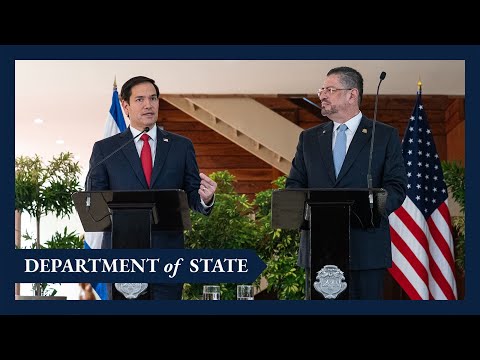
Rubio says U.S. will expand biometric sharing with Costa Rica; no U.S. position yet on Nicaragua’s CAFTA status
Summary
U.S. Secretary of State Marco Rubio said the United States will build on biometric data sharing and intelligence cooperation with Costa Rica to address migration and security concerns. On questions about Nicaragua’s participation in CAFTA, Rubio said the administration had not formed an official position and needed more time for study.
U.S. Secretary of State Marco Rubio said his office will strengthen biometric data sharing and real‑time intelligence coordination with Costa Rica to identify migrants and individuals who might pose security risks.
"We wanna build on that because...we are seeing...elements from all over the world...that have links to terrorism...stopped through our biometric sharing programs and identified and prevented from moving forward," Rubio said. He characterized biometric sharing as an "important partnership" he wants to expand.
Rubio described Costa Rica as both a transit and destination country for migrants, and said the nation has absorbed large numbers of foreign nationals. "But the cost, 20% of the population at this point here is, from from another country," he said, describing substantial migration pressures.
On a separate question about the Central America Free Trade Agreement, a reporter asked whether the United States would pursue removing Nicaragua from CAFTA. "The administration has not taken a position on exactly what role Nicaragua will have within an agreement that existed to reward democracy," Rubio said. He added that determining a policy would take longer than the two weeks he had been in office.
Reporters also asked about deportations of Nicaraguans who are not accepted by their home government. Rubio said the administration regards the governments of Nicaragua, Cuba and Venezuela as contributing to regional migration crises, but did not announce new deportation procedures or legal changes at the press event.
Rubio and press questioners discussed legal and policy constraints for any change in migration or trade policy; Rubio said such matters require study and review before a formal U.S. position is announced.