Get Full Government Meeting Transcripts, Videos, & Alerts Forever!
Get email alerts on the Drug And Law Enforcement Cooperation topic
No spam. Unsubscribe anytime.
Costa Rican president and U.S. secretary of state pledge closer anti‑narco cooperation, joint investigations
Summary
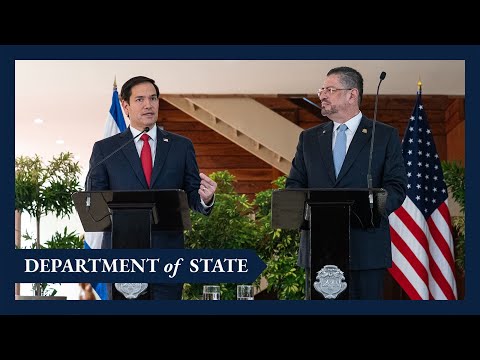
President Rodrigo Chavez and U.S. Secretary of State Marco Rubio said the two governments will deepen law‑enforcement cooperation on drug trafficking, including joint investigations and expanded DEA and FBI involvement, while discussing waivers to U.S. aid for interdiction programs.
President Rodrigo Chavez and U.S. Secretary of State Marco Rubio said during a joint press appearance that the two countries will strengthen cooperation against organized crime and drug trafficking, including steps to involve U.S. law‑enforcement agencies in joint investigations.
Chavez offered condolences for a slain investigator and said Costa Rica will continue to “fight with all of our strength and with support from the United States of America.” He told the press that the killings underscore a need for tighter laws against paid assassins and international drug trafficking. "My deepest condolences to mister Gaynor's family," Chavez said.
The U.S. secretary of state, Marco Rubio, said Washington will support Costa Rica’s investigations and explore ways to deploy U.S. agencies to work with Costa Rican security forces. "We will collaborate with you. We will investigate to see how we can involve the DEA and the FBI from the United States working under your security teams here so that they can investigate cases that are around drugs that are to be sent to United States and other places," Rubio said. He added, "we will support you 100%."
Rubio discussed U.S. assistance policy in the same context, saying waivers to a recent aid freeze are being used to allow programs that help trusted partners intercept drugs and terrorists. "If this is life saving programs... you're not included in the freeze," Rubio said, describing a blanket waiver for emergency life‑saving assistance and targeted waivers for programs that further U.S. national security interests.
The officials described Costa Rica primarily as a transit country for traffickers because of geography; Rubio said Costa Rica has taken measures to prevent exportation of drugs and called for continued collaboration on intelligence and operational support. The officials did not provide specific new operational deployments, budgets, or timelines during the appearance.
The discussion included references to joint technical assistance and criminal investigations, but no formal bilateral agreement or new, specific funding allocation was announced at the press event. Questions from reporters touched on operational details and the scope of U.S. agency involvement; Rubio said legal and constitutional considerations would be evaluated before any change in the scope of cooperation.
The exchange concluded with both leaders describing the relationship as a partnership on security and rule of law; Chavez and Rubio framed the cooperation as building on shared interests rather than announcing immediate new commitments.