Get Full Government Meeting Transcripts, Videos, & Alerts Forever!
Get email alerts on the Hb581 Floating Homestead Exemption topic
No spam. Unsubscribe anytime.
Public comments favor statewide floating homestead exemption; council to vote on opt-out after three hearings
Summary
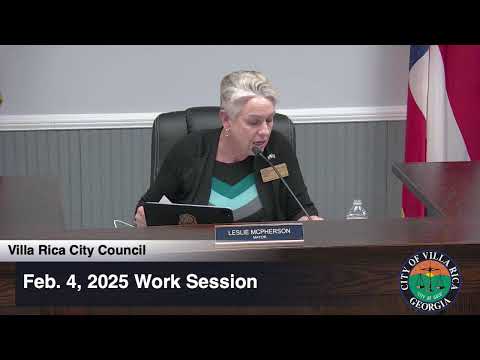
Interim city manager Diana DeSanto summarized House Bill 581 and the optional FLOST sales-tax process during a Feb. 4 public hearing; several residents and neighboring officials urged council not to opt out and to preserve the homestead exemption and the option for a FLOST referendum.
Diana DeSanto, the city's interim manager, summarized House Bill 581 (2024) and the implementation steps Villa Rica must follow to opt out of the statewide floating homestead exemption or to remain in and possibly pursue the related floating local option sales tax (FLOST).
What HB 581 does: DeSanto explained the bill implements a statewide floating homestead exemption that caps the annual increase in a homesteaded property's taxable value at a rate tied to inflation (the state revenue commissioner will set the inflation measure, expected to be CPI). The exemption freezes increases in taxable value for qualifying homestead properties by offsetting annual taxable-value growth based on the set inflation measure. The law does not apply to debt-service (bond) millage but does apply to maintenance-and-operations ad valorem taxes and to special service districts (including Tax Allocation Districts) where applicable.
FLOST and local choices: HB 581 also authorizes an optional local sales tax (a "floating local option sales tax" or FLOST) of up to 1% to help recoup lost property-tax revenues created by the floating homestead exemption; the FLOST requires a referendum and both the county and every city in a county that levies property tax must have adopted the floating homestead exemption (or equivalent) to be eligible to place FLOST on the ballot. DeSanto explained the county/city opt-out deadline and the local process: three public hearings, specific advertising and posting rules, and a final council resolution filed with the Secretary of State by March 1, 2025, if the jurisdiction chooses to opt out.
Public comment: Several residents and local officials spoke at the hearing and most urged the council not to opt out of the statewide exemption and to preserve residents' right to the homestead protection and to keep FLOST as an option to offset revenue loss. Key speakers included Ken Carey (Villa Rica resident), Eric Robinson (Mayor of Mount Zion, speaking in support of honoring voter intent), Greg Roberts (Villa Rica resident), and Alita Dobs Farmer (Ward 1 representative). They said voters approved the statewide referendum last November (DeSanto and commenters cited county-level vote totals showing a roughly 64% “yes” result) and urged Villa Rica to follow the public's will. Commenters also asked for clear public education on how the exemption and any local sales tax would affect bills and local services.
Council and staff clarifications: City attorney Kevin Drummond clarified that all jurisdictions are automatically in under the statewide exemption and must take affirmative legislative steps to opt out; DeSanto and staff said the city has already advertised and scheduled the legally required three public hearings (the Feb. 4 hearing at 10 a.m., a second hearing at 6 p.m. the same day, and a final public hearing at 6 p.m. the next Tuesday) and the council will vote after the hearings whether to adopt a resolution to opt out. Staff also presented an example analysis showing a cumulative, illustrative reduction in tax digest revenue of just under $1 million over a six-year retrospective period if the floating homestead had been in place during recent years; speakers and councilmembers noted those prior years included unusual housing-market inflation and cautioned about interpreting backward-looking numbers as actual realized losses.
Timing and process reminders: DeSanto reiterated the legally prescribed steps, advertising requirements, and filing deadlines for the opt-out process and explained that if any city in Carroll County chooses to opt out, the county and other cities cannot use FLOST as a revenue source for that county. The council did not vote on an opt-out at the Feb. 4 meeting; the scheduled hearings were intended to satisfy the required public-notice steps prior to any final council action.
Ending: The council will hold the additional hearings as advertised and consider a resolution on the March 1 timetable; staff and speakers asked for clear public outreach to explain how the exemption and possible FLOST revenue would work locally.