
City consultants recommend consumption-based increase, council backs staff on option focused on conservation
Get AI-powered insights, summaries, and transcripts
Sign Up Free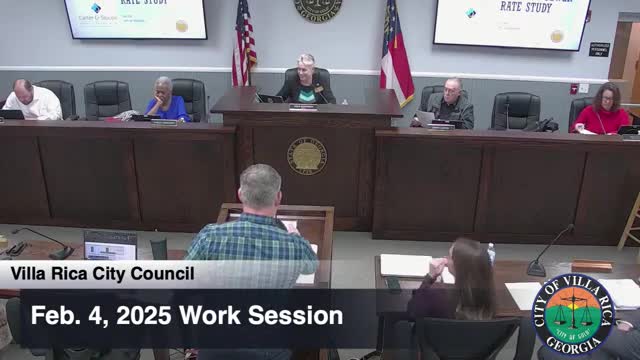
Summary
Consultants from Carter & Sloop presented a water and sewer rate study showing rising expenses and recommended simplifying tiers and raising rates; staff recommended Option 2 (increase consumption charges only) and council members expressed support, with a formal vote yet to be recorded.
Consultants from Carter & Sloop presented a review of Villa Rica's water and sewer rate structure on Feb. 4, recommending a simplified tier structure and one of three rate increase packages to keep the utility fund solvent as expenses rise.
The report, led by consultant Chrissy Garrison with backup from Mark Hain of Carter & Sloop, reviewed 2023 customer usage and the water and sewer fund's recent revenue and expense history. Garrison said residential customers account for about 56% of consumption and 59% of revenue, while commercial and industrial accounts together provide most of the remainder. She recommended simplifying residential and nonresidential tiers and using a targeted rate increase to ensure debt-coverage requirements are met through 2025 and 2026.
Carter & Sloop offered three packaged options to close a projected shortfall: Option 1 would raise base fees 20% and consumption 12%; Option 2 would leave base fees unchanged and raise consumption charges by 20%; Option 3 would increase both base and consumption by 15%. The firm estimated the average combined residential water and sewer bill would rise by roughly $11 under Option 2 and a little over $12 under the other two options. The consultants recommended Option 2 as the staff and consultant preference because it emphasizes conservation by charging higher per-thousand rates while leaving the fixed monthly base fee unchanged.
Why it matters: The consultant said operating expenses grew at about a 7.75% annual average from 2019'23, and the city faces higher costs to purchase water as suppliers raise rates. Carter & Sloop modeled a conservative $20 million in new capital borrowing over 20 years to estimate future debt service. Under the firm's assumptions, modest rate changes would restore positive net revenues in fiscal years 2025 and 2026 but leave a projected deficit again in 2027 unless rates or revenues are adjusted again.
What was discussed: Consultants walked the council through customer usage breakdowns and how the current tier breaks leave most residential customers in lower tiers (only about 4% of households hit the highest residential tiers). They showed how commercial meter-size-based tiers currently give large-meter customers disproportionately large first-tier volumes and recommended a consolidated nonresidential tier structure so similar users pay comparably and higher users face stronger price signals to conserve.
Council reaction and next steps: Deputy Finance Director Amanda Long told the council staff's recommendation is to adopt Option 2, the consumption-only increase, because it better promotes conservation as the city purchases more wholesale water. Council members asked for more detailed bill-impact examples for low- and high-usage households and emphasized public education about how the percentage increases translate into dollar changes for customers with small bills. No formal council vote was recorded at the Feb. 4 meeting; staff said the recommendation will proceed toward implementation and that revenues and expenses should be reviewed annually or semiannually.
Details and context: The consultants used 2023 consumption as a baseline, projected growth tied to approved developments, and included purchase-water price increases reported for Douglasville/Douglas County and the Carroll County Water Authority. They also modeled debt-service coverage requirements (a 1.05 coverage ratio) and presented the simplified tier structures they recommended.
Council members and staff said they expect to provide the public clearer examples, a one-page comparison of bill impacts at common usage levels, and an ongoing schedule for future adjustments.
Ending: Staff plans to proceed with the consumption-focused increase (Option 2) as its recommendation and will return with implementation details and public communications; the council signaled support but had not recorded a formal vote during the meeting.