Get Full Government Meeting Transcripts, Videos, & Alerts Forever!
Get email alerts on the Land Use topic
No spam. Unsubscribe anytime.
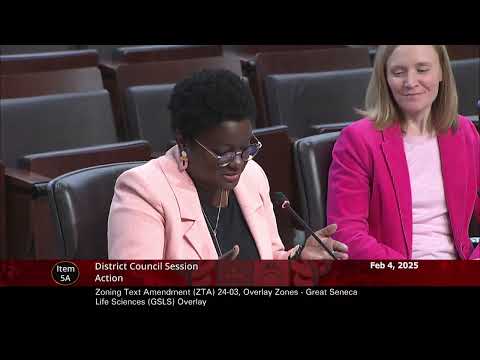
Council approves Great Seneca Life Sciences overlay; keeps hospital exemption for BLT requirement
Summary
The Montgomery County Council approved Zoning Text Amendment 24‑03 to create a Great Seneca Life Sciences overlay zone and adopted committee amendments, including carrying over an existing exemption that spares hospitals from a building‑lot termination (BLT) purchase tied to optional‑method incentive density.
The Montgomery County Council voted to approve Zoning Text Amendment (ZTA) 24‑03, establishing a Great Seneca Life Sciences overlay zone and adopting several committee amendments, including a retained exemption that spares hospitals from purchasing building‑lot terminations (BLTs) when using incentive density.
The overlay, introduced as part of implementing the Great Seneca Plan, standardizes land uses and review standards in the area, seeks to incentivize housing production, allows opportunities for additional building height and density, and aims to promote people‑centered urban design. "This ZTA 24‑03 establishes a new Great Seneca Life Sciences overlay zone," said Chair Andrew Friedson, chair of the Planning, Housing and Parks (PHP) committee, describing the item as an implementing document for the plan the council adopted last year.
The council adopted several technical and substantive amendments the committee had recommended. Planning staff read a package of changes into the record that included (1) clarifying treatment of existing surface parking so existing lots would not be made nonconforming, (2) a carve‑out to allow incidental storage for medical, scientific, manufacturing and production uses while prohibiting standalone storage facilities, (3) a clarification of how floor‑area‑ratio (FAR) is counted for optional‑method density (allowing commercial or residential FAR to be used to achieve incentive density), and (4) renumbering fixes tied to a separate ZTA that had passed earlier.
One of the more contested changes at committee concerned BLTs and whether hospitals in the overlay should be required to provide them as an optional‑method public benefit. Under the draft overlay, optional‑method projects would be required to purchase BLTs equal to 7.5% of the incentive density floor area (a reduction from the 50% rate historically used in the LSC zone). Adventist Hospital asked for an exemption on the grounds that hospitals had been previously exempt. The PHP committee recommended not reinstating the exemption (a 2–1 committee vote), saying the 7.5% figure was set after consultant analysis and was intended to be financially feasible for projects.
Councilmember Fannie Gonzalez argued for consistency across the overlay: "If the...standardized land use for the overlay zone [is set], well then, let's have it standardized, let's have it to be the same. The hospitals are currently exempt—why would that be changed now?" Planning supervisor Jessica McVerry and other staff explained that planning had modeled feasibility and that the 7.5% BLT requirement had been chosen as a reasonable amount; staff also noted parallel work on an incentive‑zoning update and a separate BLT/TDR review that could address exemptions later.
During the district council session, members moved to carry over the hospital exemption rather than require a 7.5% BLT for hospitals. The motion to carry over the exemption passed by consensus (11 in favor). After that amendment was read into the record, the council voted to approve ZTA 24‑03. Councilmember Friedson moved approval and Council Vice President Giwando seconded; a roll‑call vote recorded yes votes from a quorum of members and the measure was approved.
What passed: ZTA 24‑03 as amended (creates the Great Seneca Life Sciences overlay; includes the committee technical amendments; retains hospital BLT exemption by carrying over prior exemption language). The planning staff and the council noted that related items — an incentive zoning update and further BLT/TDR policy work — remain pending and may lead to future ZTAs or cleanup language.
Why it matters: The overlay implements directives in the Great Seneca Plan to support life‑sciences growth while attempting to balance new housing incentives and public benefits. The retained hospital exemption narrows the immediate BLT obligations for hospitals in the overlay and sets the stage for further countywide conversations on BLT/TDR policy.
Votes at a glance: Amendment to carry over hospital BLT exemption — passed by consensus, 11 in favor. Final approval of ZTA 24‑03 — approved by roll‑call (yes votes recorded).