Get Full Government Meeting Transcripts, Videos, & Alerts Forever!
Get email alerts on the Traffic Calming topic
No spam. Unsubscribe anytime.
Nashville transportation committee reviews NDOT changes to neighborhood traffic‑calming program
Summary
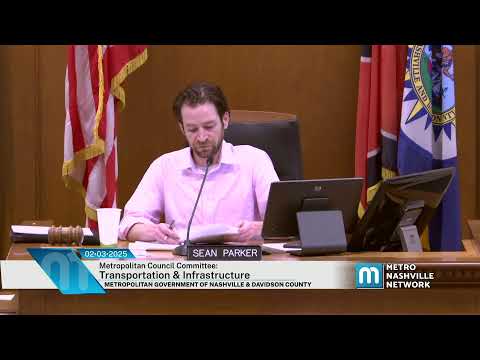
At a meeting of the Metropolitan Government of Nashville and Davidson County Transportation & Infrastructure Committee, NDOT staff presented an update on the Neighborhood Streets Traffic Calming (NSTC) program and asked the committee for feedback on proposed changes.
At a meeting of the Metropolitan Government of Nashville and Davidson County Transportation & Infrastructure Committee, NDOT staff presented an update on the Neighborhood Streets Traffic Calming (NSTC) program and asked the committee for feedback on proposed changes.
The presentation, led by Chris Augustinos of NDOT, summarized the program and recent performance: "The neighborhood streets traffic calming program is aimed at improving the quality of life in our neighborhoods," Augustinos said, listing tools such as striping, speed cushions, radar feedback signs and traffic circles.
NDOT showed that installations rose from 45 to 81 between 2023 and 2024, an 80% increase, and that resident balloting has produced strong support where used: staff reported more than 1,400 votes across projects and roughly an 80% approval rate. Augustinos also said the program received "almost 400 applications in 2024," and staff later gave several other backlog figures during the discussion (see clarifying details).
Why it matters: committee members raised equity, emergency access and program‑delivery concerns as the program scales. Vice Chair Horton pressed NDOT on whether renters can vote on traffic‑calming proposals; Director Alarcon said renters are invited to meetings and engaged in design but that "legal has asked us to stay with the property owner because they're the ones paying the taxes," and that the department will revisit the legal question with Metro Legal. Horton framed the issue as a fairness concern: she asked how to ensure "we're not valuing the safety concerns of renters any differently than we are property owners."
Program changes discussed
- Proximity evaluation: Scott Kibbe, multimodal design group lead at NDOT, described a proposed prioritization change that would award extra points when a street applying for NSTC sits near an existing NSTC project. NDOT said that would help target parallel or diversion streets that receive cut‑through traffic after nearby calming measures are installed, but acknowledged that it could decrease geographic diversity of annual installations and could deprioritize some higher‑volume streets.
- Use of radar feedback signs and impact studies: NDOT described deploying radar feedback signs on nearby streets to collect speed data and to inform later interventions. "They provide early indication for further traffic calming," Kibbe said, and staff said the signs are relatively inexpensive and useful for community engagement and evaluation.
- Time frame, contractors and in‑house staffing: Scott Kibbe and Director Alarcon said installation speed improved after adding a second contractor and that NDOT has requested additional in‑house staff for speed cushion installation in the upcoming budget cycle. Director Alarcon said bringing work in house would make delivery faster and less expensive and would let NDOT do more than the current 25‑street selection per window.
Enforcement and safety priorities
Derek Hagerty, who leads NDOT's traffic group, said the NSTC program was developed to complement enforcement by Metro Nashville Police Department (MNPD). "Our traffic calming program was really developed with MNPD to be complementary to enforcement," Hagerty said, adding that NDOT wants MNPD to focus enforcement on the highest‑injury corridors while NSTC focuses on lower‑volume residential streets where residents report quality‑of‑life concerns.
Council questions and concerns
Council members asked for comparisons of different traffic‑calming techniques. Council member Dreffel asked why the city uses speed cushions rather than speed tables; NDOT staff said speed tables are used in some places but are more costly and may take more materials, while speed cushions allow wide‑track emergency vehicles to pass without delay. Council member Cash pressed NDOT on backlog numbers and whether cheaper measures such as radar feedback signs could be used more widely to address more streets sooner; staff said a mixed approach is under consideration and that radar signs are being considered for parallel/diversionary streets.
Data and evaluation
NDOT said the program uses a scoring methodology that considers vehicular speeds, volume, active transportation and proximity to trip destinations (schools, libraries and transit), and currently applies a 10% supplemental safety score if a pedestrian‑involved crash has occurred; staff said they are exploring expanding that supplemental score to include bike crashes. NDOT also said it selects the top 25 highest‑priority streets in each of two windows each year and provides preliminary designs and neighborhood meetings before balloting.
Ending: Next steps
NDOT asked for committee feedback on the proximity evaluation, expanded use of speed‑feedback signs and the proposed in‑house staffing request. Staff said they will continue outreach to council members and neighborhoods, refine prioritization rules, and return with additional data and budget materials during the next operating/budget cycle. The committee left the matter open for further discussion; no formal action was taken during the meeting.