Get Full Government Meeting Transcripts, Videos, & Alerts Forever!
Get email alerts on the Public Safety Compensation topic
No spam. Unsubscribe anytime.
Monroe County sheriff's deputies urge council to raise pay to retain officers amid regional competition
Summary
Deputies and supervisors told the Monroe County Council that low starting pay and open vacancies hinder operations and public safety, asking the council to consider a salary amendment. Councilors said they will present the request to the Long-Term Finance committee and FSG for analysis before deciding.
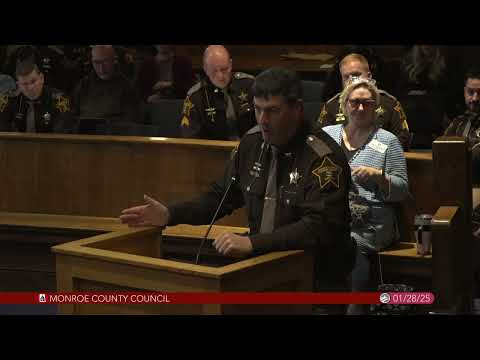
Dozens of Monroe County Sheriff’s Office deputies and supervisors addressed the county council Jan. 28, urging pay increases to recruit and retain patrol officers and to prevent further operational strain.
Detective Sergeant Nathan Peach opened the deputies’ presentation, saying recent pay changes at neighboring agencies leave the sheriff’s office “at a distinct disadvantage” and that the county’s ability to respond to emergencies depends on attracting and keeping qualified officers. Patrol supervisors and training coordinators described a thinning hiring pool, lateral candidates choosing higher-paying nearby agencies, and the operational effects of vacancies.
Key points deputies made: - Recruitment and retention: Corporal Josh Fuller and other training staff described a recent hiring round in which 54 applicants produced only 15 attendees for tests and interviews; by the time candidates moved through training and merit board approval, some accepted lateral offers from Bloomington Police Department (BPD) and Indiana University Police Department (IUPD). Deputies said the time and cost to train an entry-level officer (academy and field training) is substantial, and a newly hired officer may be roughly a year from producing full operational value. - Operational staffing impacts: Sergeant Kyle Malden described minimum staffing levels for patrol shifts and said vacancies limit the office’s ability to handle concurrent in-progress calls, perform proactive enforcement, and maintain specialized investigative or warrant teams. He gave examples where limited staffing constrained follow-up investigations and suspect searches. - Lateral hires and experience loss: Deputies and a recently hired lateral, Jeff Brown, explained that experienced officers who transfer bring training and certification that reduce cost and accelerate readiness; losing lateral candidates to other agencies slows casework and drains institutional knowledge. - Officer safety and experience: Presenters linked experienced staffing to improved officer safety and decision-making, asserting that pairing newer deputies with experienced officers reduces risk on high-threat calls.
Sheriff (identified in materials as Sheriff Marte) thanked the council for a prior 2022 compensation increase and asked the council to treat the request seriously. Deputies requested the council define a clear compensation scenario so the Long-Term Finance Committee and Financial Solutions Group (FSG) can analyze funding options.
Council response and next steps: Councilors thanked deputies for their service and said they took the presentation seriously. Several council members asked for additional, specific data — hire/attrition destinations, average seniority and rank-by-rank comparisons, and the packet that maps county salary bands to peer agencies. County staff committed to produce a compact “what we are asking for” package and requested FSG review; the council’s Long-Term Finance Committee has been asked to take up the matter at a February meeting and then return recommendations to the full council.
No formal vote was held at the Jan. 28 meeting; councilors said they will seek budget scenarios, FSG analysis and legal/fiscal guidance before acting.