Get Full Government Meeting Transcripts, Videos, & Alerts Forever!
Get email alerts on the Septic Systems topic
No spam. Unsubscribe anytime.
DEQ proposes broad rewrite of Idaho septic-system rules, including new definitions, riser requirement and reduced setbacks
Summary
The Department of Environmental Quality presented proposed updates to IDAPA 58.01.03 (docket 580-103-2301) to simplify language, move technical guidance into rule, change definitions, require risers to surface, reduce certain setbacks and remove seepage pits. No committee votes were taken.
The Department of Environmental Quality on Wednesday presented a package of proposed changes to Idaho’s septic and subsurface sewage rules that would reorganize definitions, simplify permitting and change several construction and setback requirements.
The update to IDAPA 58.01.03 (docket 580-103-2301) is intended as a 0‑based review, Mary Anne Nelson, Surface and Wastewater Division administrator for DEQ, told the House Environment, Energy and Technology Committee. "This rule follows legislative intent outlined in Idaho code 39102," Nelson said, and DEQ "removed outdated language and cut more than 1,100 words from this rule."
DEQ said the rewrite moves some material out of the Technical Guidance Manual (TGM) and into rule where it belongs, clarifies multiple definitions and reorganizes installation and approval procedures so technical requirements sit in guidance while definitional and enforcement items remain in rule. The agency also described changes intended to encourage service providers for advanced treatment systems while reducing duplicative licensing barriers.
Key changes described by DEQ include adding or consolidating definitions (for example, ‘‘absorption bed,’’ ‘‘bedroom,’’ ‘‘drain field’’ and ‘‘septic tank’’), clarifying that treatment products designed to treat more than 2,500 gallons per day must be reviewed under the wastewater rules (580-0116), and combining multiple definitions for proprietary products into a single definition. Nelson said DEQ "added the definition of minimum tank capacity" to clarify that capacity refers to the sum of all tanks in a system, not each individual tank.
On construction and inspection matters, DEQ proposed that septic tank risers extend to the surface to aid pumping, inspections and property transfers; removed allowances for fully buried tanks with no surface access; and removed seepage pits (historically allowed only in Health District 7), which DEQ said are substandard and rarely permitted in the last 20 years. The agency also proposed removing some large‑tank design specifications that it called outdated and unnecessary because modern tanks do not match the old dimensions.
Setbacks and system limitations were adjusted. DEQ said it reduced the vertical separation from downslope cut or scarp from 25 feet to 10 feet based on health district experience and alignment with Oregon practice. The rules add prohibitions against dumping substances detrimental to biological operation of systems (for example, certain chemicals and formaldehyde) and move granular installation details into the TGM where variances can be considered.
On provider and product oversight, DEQ proposed removing the requirement that service providers be licensed complex installers so as to increase capacity for operations and maintenance of extended treatment package systems (ETPS). DEQ also proposed raising bond requirements for installers and service providers (the last bond update was in 1993) and adding language requiring product and tank submittals be prepared or submitted by an Idaho‑licensed engineer for preauthorization review by the technical guidance committee.
Committee members asked about end‑user cost impacts, the length of DEQ product reviews and why some definitions were adapted from neighboring states. Nelson said DEQ consulted Oregon, Washington, Montana, Utah and Wyoming when consolidating definitions and that the DEQ review focuses on plans and specifications for products rather than each individual installation. Representative Bruce asked whether DEQ considered cost impacts to cities and counties; Nelson said health district staff and installers participated in rulemaking and that DEQ considered those impacts during negotiations.
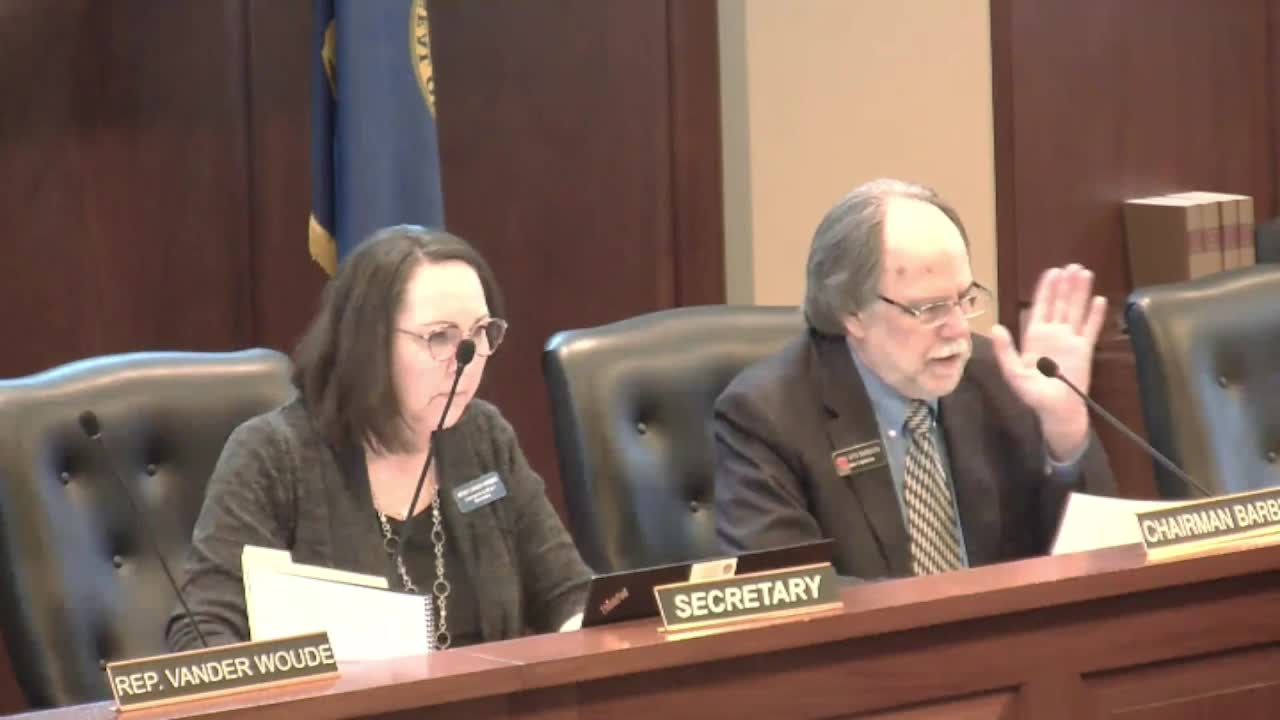
DEQ said it held two negotiated rulemakings with participants from health districts, DEQ, the attorney general's office, industry service providers and the public, and that the board of environmental quality approved the rule as presented to them on Nov. 14, 2024. The committee did not take a vote; the chair reminded members that no votes would be taken at the hearing and that any votes would occur February 18.
The agency noted one substantive cross‑reference: treatment products that remove more than 2,500 gallons per day are outside this chapter and must be reviewed under IDAPA 58.01.16 (wastewater rules), which DEQ plans to bring for review next year.
If adopted as proposed, the changes would tighten some construction requirements (risers to surface), relax some installation barriers (service provider licensure to encourage more maintenance providers), and update technical references, DEQ said.
DEQ emphasized the changes were developed with input from the technical guidance committee (which includes health district environmental health professionals, a licensed installer, a professional engineer and DEQ representation) and that the manual will continue to supply design and installation guidance while rule language covers enforceable requirements.
The committee heard the presentation and technical questions but did not vote on the docket during the hearing.
The Department of Environmental Quality will return for further rulemakings on wastewater rules next year, DEQ staff said.