Get Full Government Meeting Transcripts, Videos, & Alerts Forever!
Get email alerts on the Cdbg Radon Mitigation topic
No spam. Unsubscribe anytime.
Council approves CDBG amendments to fund radon mitigation at two nonprofit facilities
Summary
Council approved amendments to CDBG grant agreements increasing funding for radon mitigation at Safe Passage and Saint Vincent de Paul after certified testing found radon at or above HUD’s 4.0 pCi/L threshold, per an April 2024 HUD policy notice.
The Coeur d'Alene City Council on Jan. 21 approved amendments to two community development block grant (CDBG) funding agreements to cover radon mitigation at Safe Passage and Saint Vincent de Paul.
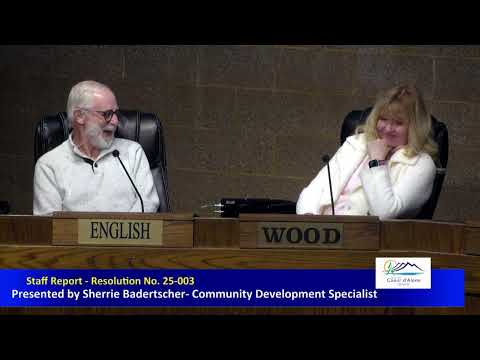
Sherry (last name not specified), presenting for Community Development, said the changes follow a U.S. Department of Housing and Urban Development (HUD) policy notice issued in April 2024 that requires radon mitigation when testing shows levels of 4.0 picocuries per liter (pCi/L) or higher in occupied buildings. Certified testers measured levels at or above that threshold at both nonprofit locations during the environmental review phase, triggering the mitigation requirement before project closeout.
The council approved an amendment to Safe Passage’s grant for $25,100 and an amendment to Saint Vincent de Paul’s grant for $5,000. Sherry said both amounts would be drawn from the city’s CDBG plan-year 2022 remaining funds. She explained that certified testing typically cost about $200 for a multi-day, instrumented test; the state also offers free do-it-yourself home radon tests for single-family homeowners.
Council members asked procedural questions and praised staff for using grant funds to address a health risk. Sherry clarified that radon is a naturally occurring gas that can concentrate indoors, that basements more commonly test higher, and that mitigation typically involves installing a venting pipe and fan to redirect soil gas outside the building.
The motion to approve Resolution 25-3 passed on a roll-call vote recorded in the transcript with Miller, Gabriel, English, Wood and Evans voting yes.