Get Full Government Meeting Transcripts, Videos, & Alerts Forever!
Get email alerts on the Public Health Budget topic
No spam. Unsubscribe anytime.
JFAC hears request to restore public health programs, fund data modernization and rural physician incentives
Summary
Idaho Department of Health and Welfare officials told the Joint Finance Appropriations Committee that the Division of Public Health Services seeks to restore multiple ongoing programs cut in prior years, fund one-time data and systems modernization, and continue a rural physician loan-repayment incentive amid an overall slimmer budget request.
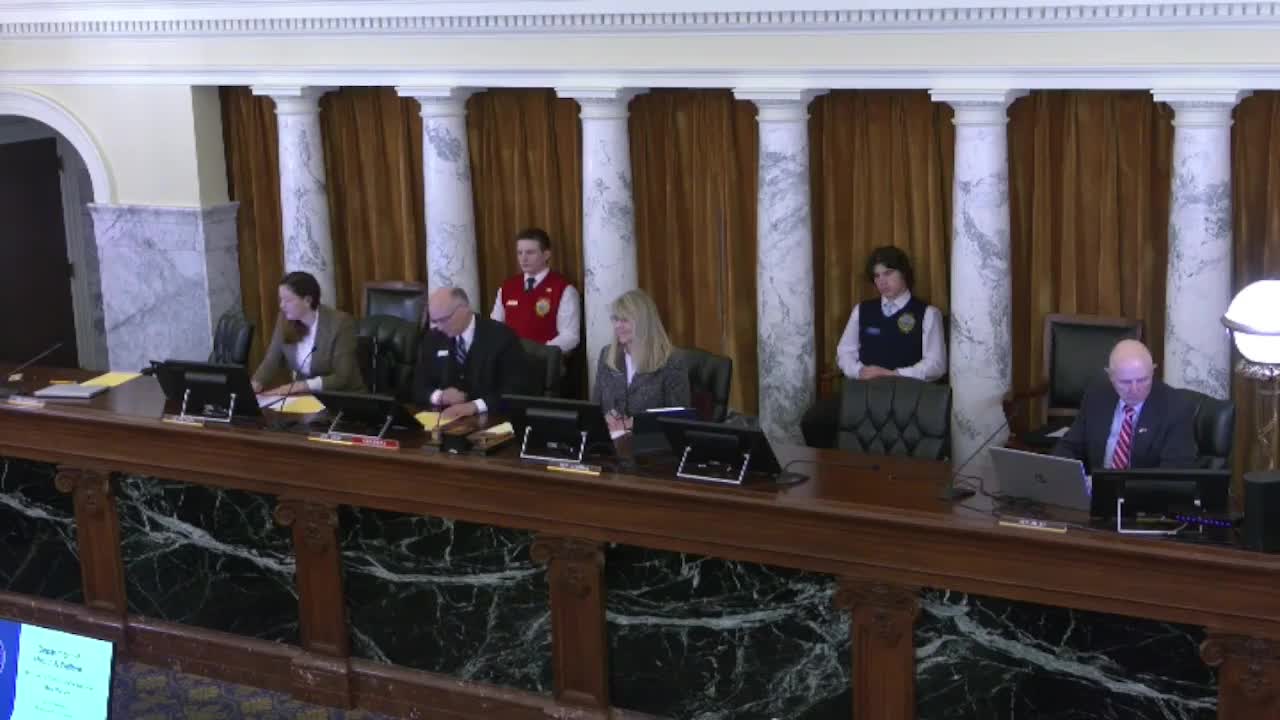
The Joint Finance Appropriations Committee on Monday reviewed the Department of Health and Welfare’s request to restore multiple ongoing public health programs, fund one-time data modernization projects and continue a rural physician loan-repayment incentive program.
Division of Budget Policy Analysis manager Keith Bybee summarized the Division of Public Health Services budget, saying it covers five programs that include immunizations, laboratory services, emergency medical services, suicide prevention and health care policy initiatives. “Public health services is a big one,” Bybee said, noting the material is on page 2-57 of the committee’s budget book.
The department characterized last year’s changes as largely structural: several programs were moved from ongoing funding to one-time appropriations, producing a drop in the ongoing base. “This was the result of several of the division’s programs being removed as ongoing programs and brought back in as one-time appropriations,” Bybee said, and the department is asking the committee to restore many of those ongoing amounts.
Why it matters: committee members were shown that the division’s original FY2025 appropriation was about $164 million and that the governor’s FY2026 recommendation reduces the aggregate public-health request on a year-over-year basis in order to reflect the end of CARES Act and ARPA flows. Restoring ongoing funding would return programs that committees and the department consider core to steadier baselines for public-health delivery across Idaho.
Director Alex Adams, who represents the Department of Health and Welfare, framed the reductions and restorations as part of a “healthy exercise” of re‑examining programs. “If you just look at the raw numbers … we got about $10 million out of the budget or a 6% reduction year over year,” Adams said, adding the department had also reduced its full‑time equivalent positions in the exercise.
The committee heard both one-time and ongoing requests. One-time federal and ARPA-linked enhancements include a public-health infrastructure grant to support workforce and local public-health districts, a Data Modernization II request to automate vital‑records systems and improve data exchange with CDC systems, a Women, Infant and Children (WIC) modernization request, and a communicable‑disease prevention grant that would fund 4.4 limited‑service positions. Committee materials list roughly $8,752,500 in total one‑time requests the governor recommended.
On ongoing restorations, the department asked the committee to restore funding across many programs that had been moved to one‑time previously. Examples and amounts presented to the committee included: suicide prevention ($1,807,700 ongoing general fund and $195,000 federal), the Drug Overdose Prevention Program (restore 4.0 FTE and $2,820,200 ongoing), refugee health screening ($991,000 ongoing and 1.5 FTE), Alzheimer’s and dementia‑related program ($275,200 ongoing), Fit and Fall Proof ($140,000 ongoing), diabetes population health work ($1,063,700 ongoing), HIV prevention activities ($957,300 ongoing), oral‑health workforce support ($379,600 ongoing), integrated hepatitis work ($599,200 ongoing) and a substantial restoration for the Women, Infant and Children Nutrition Program (approximately $6,944,600 ongoing). The committee packet also lists a $2,250,000 ongoing request from dedicated funds for an immunization assessment fund and a $150,000 ongoing request for the Vital Records Receipt Authority.
Committee members pressed the department on program placement, oversight and measurable results. Representative Ben Adams (Representative Price in the transcript) asked whether programs such as Alzheimer’s services and the Fit and Fall Proof program might be moved to other agencies, such as the Commission on Aging, to consolidate like services. Director Adams and Elke Shaw Tullock, the division administrator for public health services, said the department’s focus is prevention and that some programs target populations not traditionally served by other agencies; Adams said the department was open to discussions about transferring programs if other agencies could do them better.
Senator Wendy Wintrow asked about the effect of the division’s organizational changes and whether the rebaselining affected federal grants. Adams said the department had paused some federal draws during a federal funding freeze that was later rescinded and described the rebaselining as a “healthy” zero‑based look at programs.
Senator Cook asked for a follow‑up summary of what prior ARPA and data‑modernization investments produced before approving additional funding. Adams said the department would provide a three‑page summary describing outcomes and progress on data modernization, WIC upgrades and related IT projects.
On workforce, the governor’s recommended initiative to make the rural physician incentive ongoing was noted: $500,000 from the general fund to support loan‑repayment for physicians who practice in federally designated Health Professional Shortage Areas. Elke Shaw Tullock told the committee the department’s loan‑repayment programs have a high retention rate for participating providers, “Almost 91% of the providers that receive these loan repayments stay in the state and practice in the state.”
What the committee directed: in the hearing, members were encouraged to follow up with analysts and department staff on technical questions. Adams and staff asked members to work with analysts to develop trailer‑bill language and said they would circulate documentation on the status of data modernization work and ARPA spending.
The department did not present formal motions or votes during the hearing. Committee members repeatedly emphasized the need for clearer performance measures and requested follow‑up material from staff and the department.
Staff and speakers: Keith Bybee, division manager of budget policy analysis; Alex Adams, director of the Department of Health and Welfare; Elke Shaw Tullock, division administrator, Division of Public Health; Misty Lawrence, chief financial officer; and multiple JFAC members who questioned the department.
Looking ahead: committee members said they appreciated the department’s effort to re‑examine programs and asked for specific performance and IT‑modernization updates before taking final appropriation action.