Get Full Government Meeting Transcripts, Videos, & Alerts Forever!
Get email alerts on the Industrial Commission Budget topic
No spam. Unsubscribe anytime.
Industrial Commission seeks staff, IRIS maintenance and vehicle replacements in 2026 budget
Summary
The Industrial Commission asked the Joint Finance Preparation Committee to fund staff reclassifications, ongoing maintenance for its IRIS case-management project, vehicle replacements and other enhancements for fiscal 2026, citing higher caseloads and reverted trustee/benefit balances in its dedicated funds.
Noah Peterson, budget and policy analyst for the Legislative Services Office, presented the Industrial Commission’s 2026 budget request to the Joint Finance Preparation Committee on Jan. 23, outlining staffing requests, maintenance for the commission’s IRIS modernization project and vehicle replacements.
The Industrial Commission’s director, George Gutierrez, told the committee the agency needs additional ongoing personnel and one-time support to handle larger caseloads created in part by IRIS, the agency’s multi-year effort to digitize formerly paper-based workflows. "This is a project that began in fiscal year 2021 that essentially sought to automate and digitize processes that were previously very paper dependent," Peterson said.
Peterson said the commission has three budgeted programs—compensation, rehabilitation and crime victims compensation—and that the agency is funded through dedicated funds rather than the general fund. He told the committee the commission had 130.25 FTP allocated, with 12 vacancies as of August. Peterson said the commission reverted $4,555,000 last year, driven largely by trustee and benefit payments ($3,000,000) and that $2,400,000 of the reversion came from the Crime Victims Compensation Fund.
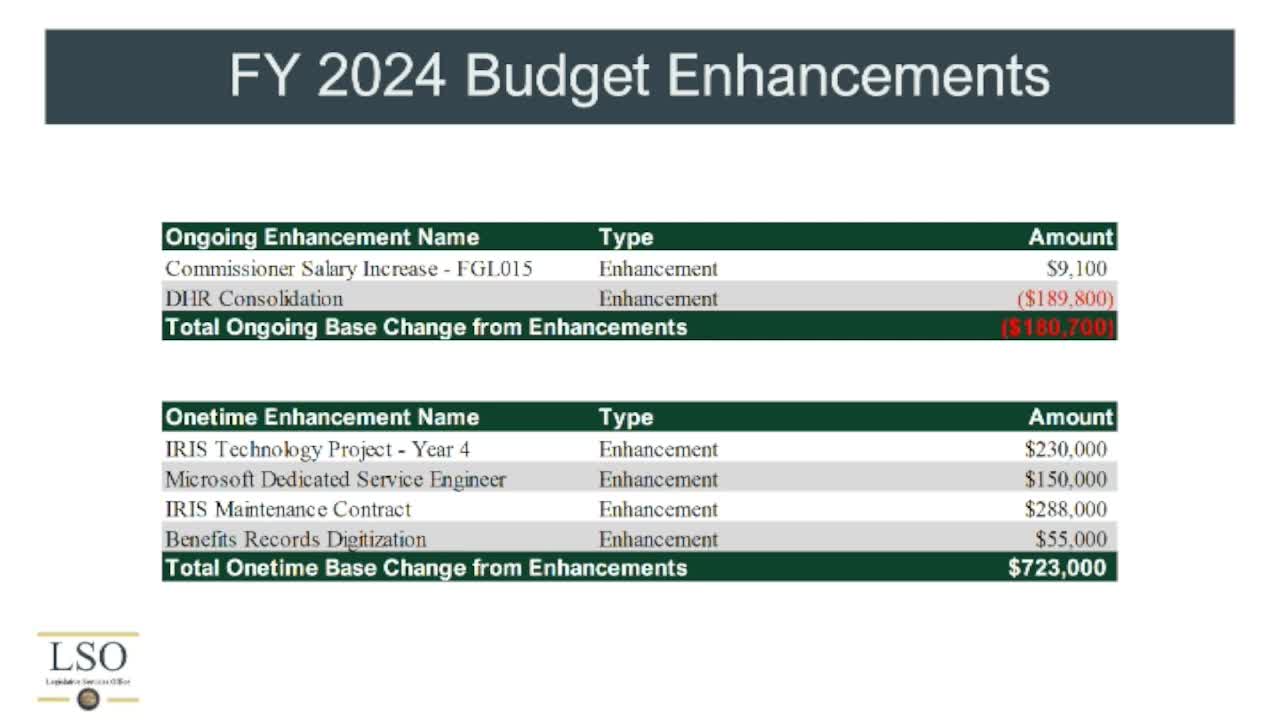
The commission’s 2026 requests include 10 enhancement requests funded from the Industrial Administration Fund. Notable items are a $288,000 one-time request for a contractor to provide long-term technical support for IRIS because the state Office of Information Technology Services (OITS) cannot provide that support now; a request to fund a senior financial technician (about $66,500 ongoing) to reduce payment turnaround for the crime victims compensation program; a rehabilitation field consultant for Twin Falls and Burley (about $32,300 ongoing); and a referee (hearing officer) position (about $111,600 ongoing) to reduce hearing backlog. Peterson said the IRIS program received $12,874,000 in one-time appropriations between FY2021 and FY2025 and that $3,500,000 one-time was included in FY2025 to continue development and contracted engineering support.
Director George Gutierrez said IRIS improved electronic access but shifted some duties and increased throughput, producing higher volumes of data and more cases for legal and compliance review. "We are now identifying nearly 60% more cases," Gutierrez said, explaining the need for additional compliance and records staff and for a technical records specialist to prepare cases for outside litigation counsel. Gutierrez also said referee workloads have grown since one referee retired around 2020 and that the commission’s time-to-decision rose from a target of 90 days to about 110 days.
Lawmakers pressed the agency on several points. Representative Petzke asked whether reverted funds could be repurposed to fill vacancies; Peterson said the legislature would need to decide and the director noted most reversions were trustee and benefit payments and would require special approval to reallocate. Senator Cook questioned the $288,000 IRIS maintenance request and whether it represented new functionality; Peterson and Gutierrez explained it is contracted maintenance and support until OITS can assume responsibilities. Representative Mitchell asked for details on vehicle replacements; Peterson said the agency would provide a fleet list but noted several field vehicles have very high mileage (82,000–98,000 miles) and older model years (2006–2011).
Peterson and Gutierrez described workload metrics: the crime victims payment backlog reached 872 payments with an estimated 12-week turnaround at one point versus a 30-day goal; the rehabilitation/Twin Falls area handles about 35% more cases than the five-year state average in its region; and fiscal year reversion details included $644,000 in personnel cost reversions and $835,000 in operating expense reversions.
The governor’s recommendation, Peterson said, included a 5% CEC placeholder for commissioners ($22,400) but did not recommend the contingency request for IRIS enhancements. Gutierrez closed by stressing the commission’s enhancements are prioritized to improve timeliness for injured workers and crime victims and to provide reliable field transportation for staff working across Idaho.
The committee did not take formal votes during the presentation; members requested additional written breakdowns of IRIS expenditures and a fleet inventory.
Ending: The committee asked the Industrial Commission to provide supplemental detail on IRIS contracts, a complete fleet list and clarifications about the use and legal constraints on reverted trustee/benefit funds. The department will return information to the committee for further consideration in budget deliberations.