Get Full Government Meeting Transcripts, Videos, & Alerts Forever!
Get email alerts on the Military Division Budget topic
No spam. Unsubscribe anytime.
Military division seeks supplemental funding for communications, vehicle backlogs and hazmat response equipment
Summary
The Idaho Military Division told the Joint Finance-Appropriations Committee it needs supplemental funding to finish communications infrastructure, clear a vehicle installation backlog and modernize hazardous-materials response equipment for seven regional teams.
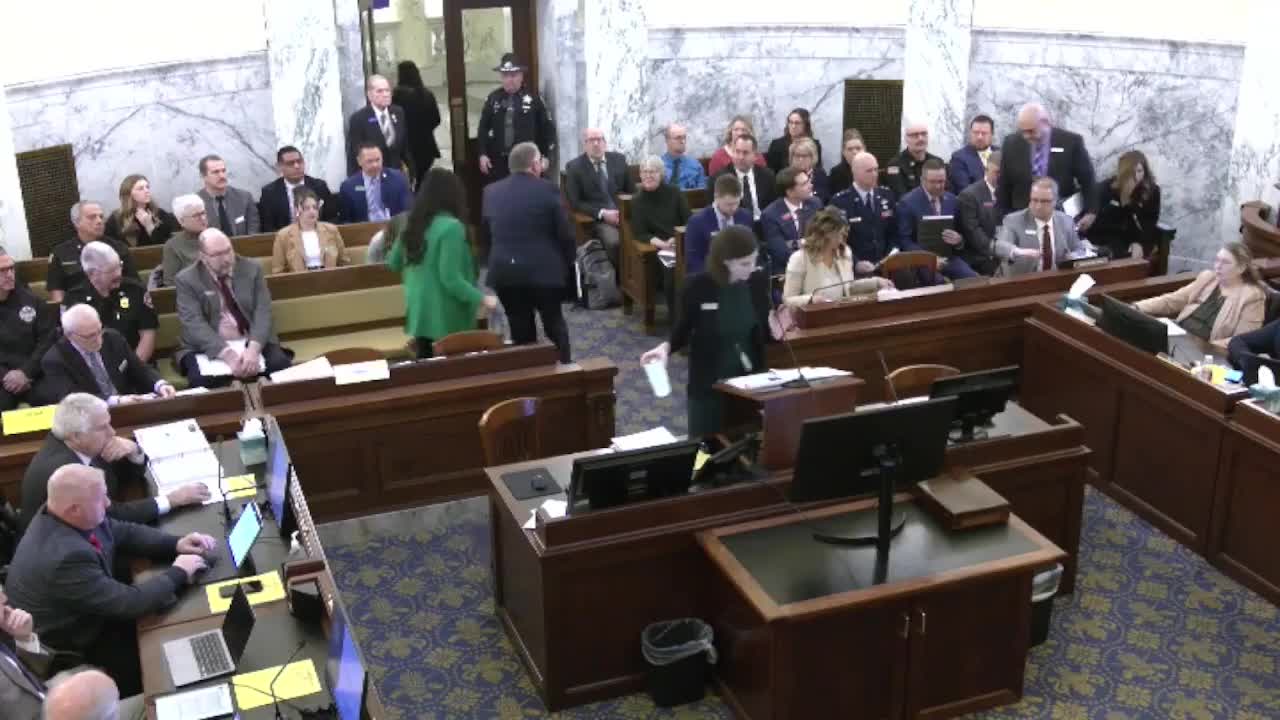
Frances Lippett, budget and policy analyst with the Legislative Services Office, reviewed the Idaho Military Division’s budget request, and Major General Tim Donilon, Adjutant General and commander of the Idaho National Guard, answered committee questions about execution and timing.
The nut graf: the division asked for supplemental funding to address an immediate vehicle- and equipment-installation backlog, to modernize public-safety communications and to provide $860,000 through a cash transfer for regional hazardous-materials response teams to replace aging gear.
Lippett summarized the division’s statutory authority under Title 46 of Idaho Code and noted the division is organized under three budget programs: federal-state agreements (the largest), military management and the Office of Emergency Management. She said the division is authorized about 429.8 FTE and that federal appropriations frequently drive appropriation and expenditure swings.
Lippett described governor-recommended supplementals that include funding to complete communications installations in 40 Idaho State Police Dodge Durangos, funds for IT infrastructure and licensing to create an independent public-safety communications network, and a supplemental cash transfer of $860,000 to the Office of Emergency Management to allow regional hazardous-materials teams to purchase updated equipment.
Major General Donilon told the committee the supplemental requests respond to a backlog that arose because manufacturers could not deliver vehicles with necessary components during recent years. "We do need to get those vehicles," Donilon said, adding the division expects to use a private contract to clear the current backlog while expanding in-house installation capacity to avoid future bottlenecks.
On the public-safety communications work, Donilon described two components: modernization of servers and hardware to keep the network secure, and a separation of the division’s microwave-based public-safety network from the state ITS network. He said the separation has hardware and installation costs and that the Office of Information Technology Services does not manage the microwave network.
Representative Petzke asked why the $860,000 transfer for hazmat equipment was placed in a supplemental instead of the FY2026 enhancement request. Donilon said the equipment had not been updated since the early 2000s and that the funding was not originally requested because it would have exceeded the 3% budget-cap threshold; the governor submitted the supplemental to allow urgent replacement for first responders across seven regional teams.
Donilon also described the regional organization of hazmat response teams, saying the seven teams are associated with local fire departments and "respond on a regional basis." He said the division will execute the cash transfer through the Idaho Office of Emergency Management, which will procure and distribute equipment.
Ending: Committee members pressed the division on timing and implementation. Donilon said the division believes it can execute the vehicle and IT work quickly and will expand installation bay capacity; for hazmat equipment, he said the division and the office of emergency management will manage procurement and distribution to regional teams.