Get Full Government Meeting Transcripts, Videos, & Alerts Forever!
Get email alerts on the Menstrual Products topic
No spam. Unsubscribe anytime.
Somerville launches pilot of free menstrual-product dispensers in six city locations
Summary
City’s Health and Human Services department told the council the late‑fall pilot has installed six dual dispensers maintained by vendor Citron; machines hold 28 tampons and 28 pads each, are refilled every 28 days, and preliminary counts show high usage. The department will share a first quarterly utilization report in March or April.
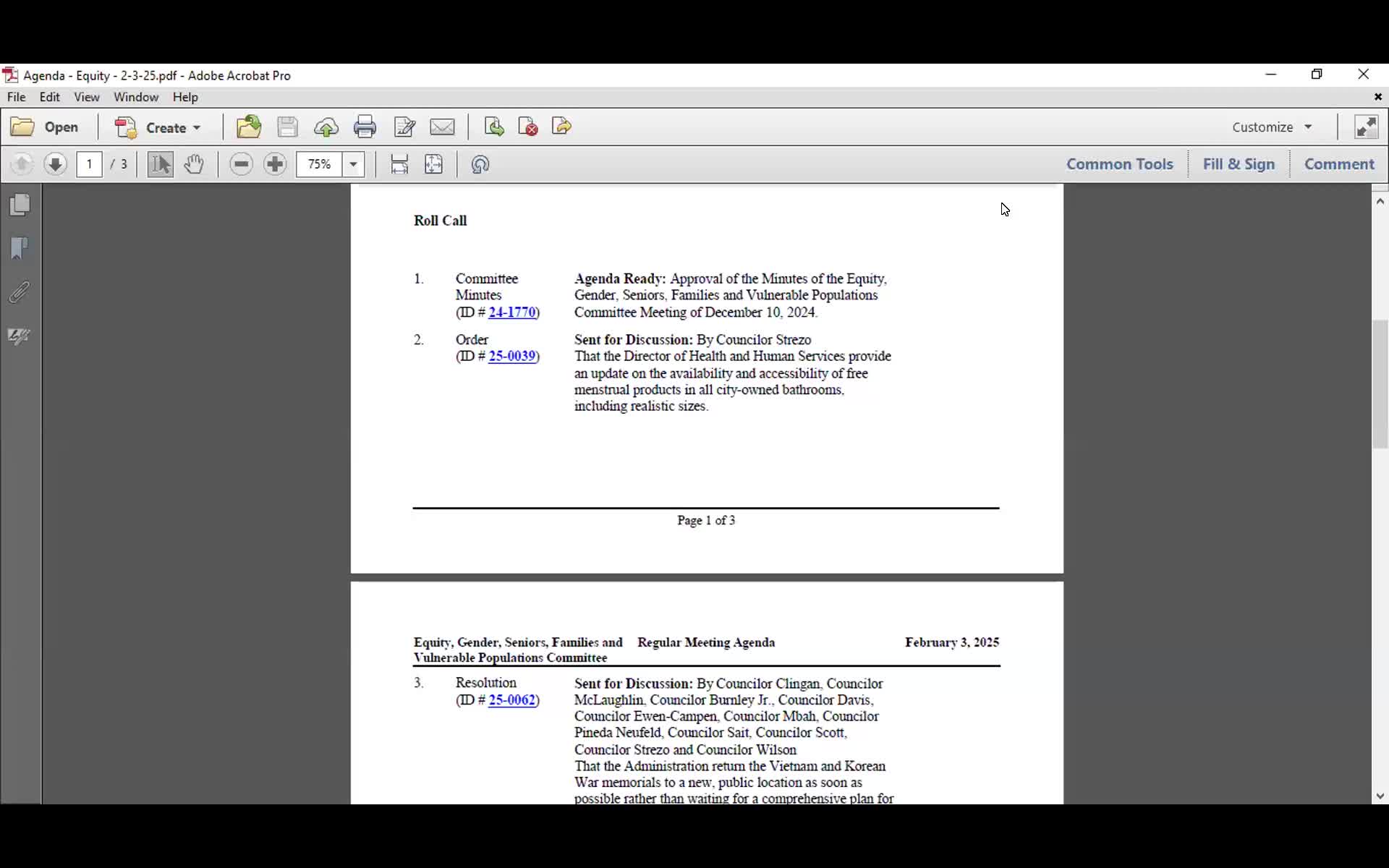
City Councilor at‑large Kristen Strezzo asked the director of Health and Human Services to update the committee on Order 250039, which requests information on the availability and accessibility of free menstrual products in city‑owned restrooms.
The pilot program, Director of Health and Human Services Karen Carroll told the committee, launched in late fall and places six dual dispensers that dispense both tampons and pads at high‑traffic sites aimed at teens and adults. “We targeted teen center activities or teen spaces,” Carroll said, listing locations as the Edgerly (teen programs), Powder House (Parks & Recreation teen activities), Soya at 42 Cross Street, the HHS annex (case management and housing services), and two dispensers at Project SEWP. Carroll said the vendor, Citron, installs and maintains the machines and refills them “every 28 days.”
Carroll told the committee each dispenser holds 28 tampons and 28 pads and that the vendor reported machines were “very low or close to empty” at refill visits so far. Based on that usage she estimated the pilot has already provided “in the 100s” of free products. She said the department will receive quarterly utilization reports from the vendor and expects to share a Q1 report in March or April.
Strezzo and other councilors raised questions about gaps, especially for younger students. Strezzo said parents reported pads and tampons distributed in some schools were adult sizes that can be difficult for middle‑school bodies to use. Carroll said the school department operates under a separate contract for school dispensers, and that HHS has been meeting with school staff to map gaps and consider sizing and placement. Carroll said schools fill their own dispensers and therefore do not automatically receive utilization data unless they track it internally.
Councilor Saeed asked whether the pilot had uncovered product quality or maintenance problems; Carroll said HHS had not received complaints about product quality but noted the pilot primarily serves teens and adults and that sizing for younger students merits further coordination with the school district. Carroll also confirmed the pilot is separate from the libraries’ longer‑standing program and that the city is exploring whether a standard citywide contract could generate efficiencies.
The committee did not take a formal vote on new policy; members thanked Carroll and marked the order complete while requesting the department send the utilization report when it becomes available.
The presentation and questions made clear the pilot is intended to identify service gaps and inform future purchasing and placement decisions, including whether school bathrooms and nurse’s offices need different sizes or dispensers that are easier for younger students to use.