Get Full Government Meeting Transcripts, Videos, & Alerts Forever!
Get email alerts on the Usm Budget And Enrollment topic
No spam. Unsubscribe anytime.
University System of Maryland warns layoffs, service cuts after proposed 5% appropriation reduction
Summary
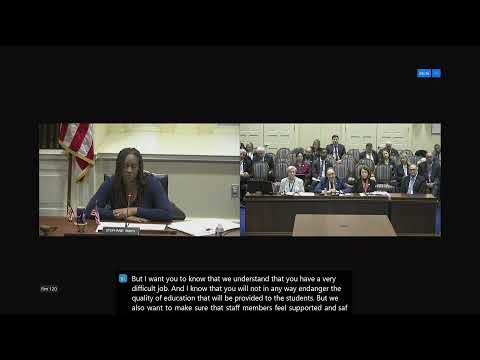
Chancellor (name not specified), testifying to the House Appropriations Committee’s Education and Economic Development Subcommittee, warned that a proposed reduction in state funding of about 5% for the University System of Maryland (USM) would force difficult choices that are likely to affect personnel, student services and campus facilities.
Chancellor (name not specified), testifying to the House Appropriations Committee’s Education and Economic Development Subcommittee, warned that a proposed reduction in state funding of about 5% for the University System of Maryland (USM) would force difficult choices that are likely to affect personnel, student services and campus facilities.
Budget analyst Sarah Baker told the subcommittee that overall fall undergraduate enrollment grew 1.6% between 2023 and 2024, and 0.9% when excluding the Global Campus; she identified University of Maryland Eastern Shore (UMES) as the fastest-growing campus (about a 10.5% increase) and Towson University as having the largest raw decline (253 students). Baker said first-time student enrollments declined by 79 when excluding the Global Campus and that, using fall 2019 as a pre-pandemic baseline, USM enrollment was down by 669 students including Global Campus and was further below the baseline when Global Campus is excluded.
The chancellor said the system must absorb the reduction while protecting students and staff. "The nearly 5% cut we're sustaining is going to be difficult for our universities, for the faculty and staff they employ, for the students they educate," the chancellor said. He summarized the system's planned responses as workforce actions (roughly 40% of the reduction, about $45 million, affecting about 400 positions), operating cuts (about 50% of the reduction, roughly $55 million) and reductions to deferred maintenance (about 10%, approximately $11 million).
The chancellor and senior vice chancellor Ellen Herbst said workforce reductions will include a mix of eliminating vacant positions and reducing filled positions, with many affected roles described as contingent or part time. They cautioned that eliminating positions could raise faculty-to-student ratios and reduce student-facing services such as advising, counseling, career services and academic support — services they said many first-generation and low-income students rely on to persist to graduation.
Baker presented data showing retention and graduation impacts tied to the pandemic: retention rates for cohorts entering after 2019 are generally 1–2 percentage points lower than pre-pandemic cohorts, with some campuses showing larger drops; six‑year graduation rates for the 2019 cohort were reported at 57%, down from 61% for the 2014 cohort. Baker also reported degree production fell 4.9% in 2024 and, excluding the Global Campus, awarded degree counts were at the lowest level since 2012.
On tuition policy, Baker summarized a revised USM tuition framework under which the chancellor, in consultation with the Board of Regents and campus presidents, establishes guidelines and presidents recommend institution-level tuition rates — a change from prior practice of systemwide automatic increases. The revised policy formalizes criteria and a reporting process for differential tuition (by program, modality, contract or geography); institutions that enact differential tuition must report baseline data, outcomes and any unexpected negative impacts.
Baker described USM’s work on prison education following federal changes that restored Pell Grant eligibility for incarcerated students. She said USM and the Maryland Department of Corrections signed a memorandum of understanding (MOU) to streamline program approvals and to allow institutions to sign university-specific agreements as addenda; Baker said the MOU is the first of its kind between a state corrections division and a state university system and that consultants found demand for prison-based higher education and that approval/startup processes are a significant barrier.
Union representative Dionne Williams, a contract administrator at the University of Maryland, College Park speaking for AFSCME Maryland, praised a recently ratified master contract for higher education workers but urged full funding of negotiated wage increases and suggested cost savings that avoid personnel and student impacts (including scrutiny of marketing budgets and outsourced contracts). "We have begun meeting regularly with the system office for the first time in our history," Williams said, and she asked the legislature to consider revenue options as well as cuts.
Committee members asked for more detail on the roughly 400 positions potentially affected; senior vice chancellor Ellen Herbst said the system’s vacancy rate as of Dec. 30 was just under 5% and that detailed breakdowns (faculty vs. staff; institution-level lists) exist but would be provided later as campuses refine trade-offs. Chad Muntz, associate vice chancellor, described student debt metrics and financial-aid practices, saying most undergraduates graduate with relatively low debt and describing microgrants and other targeted aid as interventions that improve persistence and completion.
The hearing record contains no formal motions or votes. The presenters concluded by reiterating that the system will prioritize protecting people and student access as it implements required reductions, while acknowledging the cuts will be painful and could add to deferred-maintenance backlogs and reduce direct student supports.
The subcommittee closed the hearing after public and union remarks and questions to USM leadership.