Get Full Government Meeting Transcripts, Videos, & Alerts Forever!
Get email alerts on the School Facilities Capital Funding topic
No spam. Unsubscribe anytime.
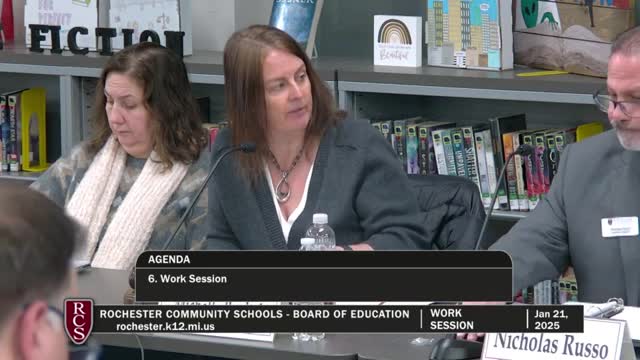
Rochester board reviews sinking fund, past bonds and options to raise capital funds
Summary
At a Jan. work session, district staff reviewed differences between sinking funds and voter-approved bonds, the district's current debt and sinking fund revenue, and options including refinancing or a future voted bond. Community members and trustees questioned the timing and fiscal priorities.
The Rochester Community School District Board of Education on Jan. 25 heard a staff presentation on capital-funding mechanisms — including the district's sinking fund, past voter-approved bonds and options for future voted or nonvoted financing — and received public comment urging fiscal restraint before seeking new revenue from taxpayers.
The presentation opened with Mr. Russo, district staff, who said the purpose of the session was "to make all board members aware of what the differences are between sinking funds and bond capital raising projects" and to explain "the options we have moving forward should we need to." Mr. McDaniel, a district presenter, told the board the session would cover "current status, where we've been, a little bit of history, what's outstanding right now and then delve into seeking funds, a voted bond, unlimited tax, general obligation."
Why it matters: The board's briefing framed potential future requests to voters and budget choices for district facilities. Presenters reviewed historical election results, millage impacts and how bond debt differs from the district's sinking fund — information trustees said they wanted before any decisions about pursuing additional capital revenue.
Key points from staff presentation
- Sinking fund: The district's sinking fund was approved by voters at 1.5 mills and currently generates roughly $9,000,000 per year; the presenter said the millage has rolled back to about 1.4561 mills because of statutory rollback and property-value effects. The sinking fund expires in December 2029 (the 2030 tax year).
- Past bonds and debt structure: Staff reviewed the district's past bonded debt, including a 2015 bond package the presentation identified as $185,000,000. The district sold that total in multiple series (presenters described roughly $108,000,000 and $56,000,000 series issued at different times) so the district could extend expenditure timelines. Staff said bond proceeds are spent up front and are repaid over roughly 20 years; the district levies whatever millage is necessary to cover debt-service payments for the bonds.
- Millage versus proceeds: Presenters explained that a bond provides a large sum up front and can be structured as a "no increase" bond when older levies roll off, meaning taxpayers' current mill rate would remain similar even as the district obtains new borrowing. Staff noted that 1 mill in the district raises on the order of $6,000,000 (presenter approximation), and that sinking-fund revenue is "roughly $9,000,000" annually.
- Refinancing opportunity: Staff said there may be an opportunity in 2026 related to a call/refinance date on one series that could reduce the district's mill levy; one slide cited a 0.29-mill potential saving under certain refinancing scenarios.
Board discussion and requests
Trustees asked procedural and substantive questions about timing, prioritization and how a future needs list would be developed. One trustee asked whether questions should be saved until the end of the presentation or taken slide-by-slide; presenters said they would cover history and current status first and take questions afterward. Staff said they would "come back and give you a list of priorities" and produce a district needs list for board and public review before decisions about pursuing voter approval.
Public comment and trustee concerns
Two members of the public and several trustees used the public-comment period to press the board on fiscal priorities and transparency. Andrew Weaver, a parent, asked, "Why are we having a presentation on raising capital funds?" and said he saw no projects in the district strategic plan that, in his view, required new capital funding. Trustee Gupta said "Fiscal responsibility should come first," arguing the district should identify cost savings and unresolved issues (she named Caring Steps and the old administration building) before discussing asking voters for additional revenue. Trustee Gupta also said she did not yet have an updated financial report for Caring Steps and questioned its subsidy and underused capacity.
Other notes
Secretary Blake told the board five communications had been received and placed in the meeting packet for reference; one email from Mary Ward with concerns about a trustee's behavior was raised during board communications. A member of the public referenced a recent federal court ruling on a Title IX rewrite and said law firms were advising districts to review policies; that issue was mentioned during public comment but was not part of the capital-funding presentation.
Votes at a glance
- Motion to approve the meeting agenda: moved by Trustee Gupta with support from Trustee Allspa; vote 7-0, motion passed.
No other formal board actions or votes on bonds, millages or facility projects were taken at the meeting; the presentation and discussion were informational.
What comes next: Staff said they will return with a prioritized list of facility needs and additional context, including the results of a statewide needs assessment noted in the presentation. The board scheduled a retreat and a future work session; no date for any bond or millage proposal was set.