Get Full Government Meeting Transcripts, Videos, & Alerts Forever!
Get email alerts on the Mental Health Crisis Response topic
No spam. Unsubscribe anytime.
Finance committee backs one-year, no-cost extension for Elm City Compass contract with Yale
Summary
The finance committee voted to recommend a one-year, no-cost extension of Yale University’s contract to operate the Elm City Compass community crisis response pilot through June 30, 2026, citing continued service delivery and additional time for evaluation and sustainability planning.
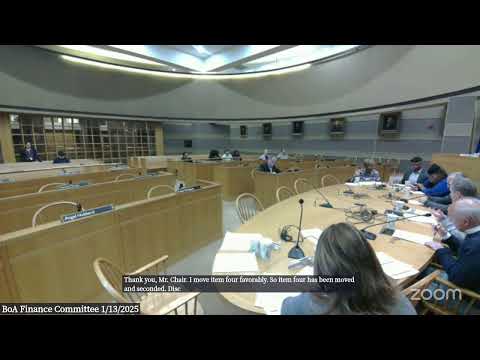
The New Haven Finance Committee on Jan. 13 recommended a one-year, no-cost extension of the city’s multi-year agreement with Yale University to continue operating Elm City Compass, a community-based crisis response team embedded in the city’s 911 system.
The extension would push the contract end date from June 30, 2025, to June 30, 2026, using residual funds from earlier contract years so the city would incur no additional cost this fiscal year. Committee members voted to forward the item with a favorable recommendation to the full Board of Alders.
The Elm City Compass team pairs a social worker and a peer with lived experience with emergency dispatchers so responses to mental-health, substance-use and housing-related crises can be led by social-service professionals rather than police in appropriate cases. Committee members heard that Compass responds to calls from 911 and also performs outreach, training for downtown merchants and transportation to shelters and warming centers when needed.
City presenters told the committee Yale (the Consultation Center) was chosen through a competitive process in May 2022. The program’s scope will not change under the extension; officials said the extra year is intended to allow more time to implement the pilot fully, gather evaluation data and plan for long-term sustainability. Committee members were told a data-use agreement between the city and Yale had been finalized on the day of the meeting.
Committee members pressed for more evaluation reporting. A presenter said Yale would analyze a dataset comparing outcomes for people served by Compass with a control population not served by Compass to assess effectiveness over time. The presenter described that work as high-level research to inform future decisions.
Committee members also asked about geographic coverage and staffing. Officials said Compass has expanded beyond the downtown “grid” and is responding across wards, naming Fair Haven, Grand Avenue and the Hill near Wilson Library as frequent service areas. Presenters said Compass currently operates seven days a week from roughly 8 a.m. to 3 a.m., with three teams and some overlap in evening hours; each field team includes a clinician (social worker or APRN) plus a peer support worker.
Alder Jeanette Morrison, who said she helped select the program during the COVID period, praised the expansion of Compass hours and urged continued support. Multiple committee members asked staff to return with follow-up reporting during the budget process or in a workshop to show results and funding options.
The committee moved and seconded a favorable recommendation; the item will go to the full Board of Alders for final action.
The committee record shows no public speakers testified on the contract extension during the public-comment portion.
What’s next: city staff and Yale are expected to continue monthly reporting through the Elm City Compass dashboard and provide evaluation findings to the committee as they become available, and the committee indicated it will revisit program funding during the March budget cycle if a longer-term funding request is proposed.