Get Full Government Meeting Transcripts, Videos, & Alerts Forever!
Get email alerts on the State Of City topic
No spam. Unsubscribe anytime.
Mayor outlines housing, safety and bioscience growth; alderry approves extension for Elm City Compass program
Summary
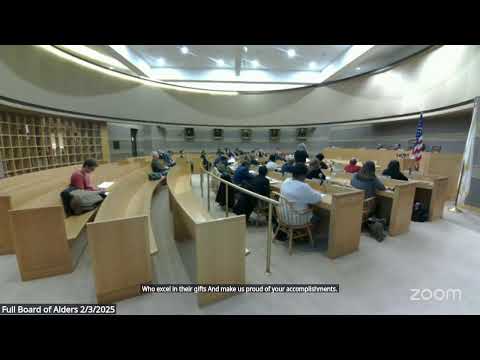
At a New Haven Board of Alders meeting, Mayor (name not specified) delivered a State of the City address stressing housing production, public safety investments and bioscience development, and the board approved an extension of the Elm City Compass program contract while taking up several personnel and procurement items.
Mayor (name not specified) delivered a State of the City address to the New Haven Board of Alders that emphasized housing growth, public-safety investments and the local economic impact of new bioscience construction while the board moved several administrative and contract items, including an extension for the Elm City Compass program.
The mayor said New Haven has “over 7,000 new units in the pipeline,” with “over 25% of those affordable,” and set a municipal goal “to build 10,000 new units of housing with at least 30% of those units affordable — 10,000 units in 10 years.” The speech credited expanded code enforcement, higher fines for serious health and safety violations, and changes to a local tenants’ union ordinance that lowers the organizing threshold from 10 units to 5 units per property.
The address also outlined public-safety measures: the mayor said violent crime and gun violence have declined and highlighted continued installation of public-safety cameras, noting more than 300 cameras already in place and a goal of 500 citywide. He described a joint regional task force on auto theft that the city helped create and said the city has recovered stolen vehicles and made arrests since the task force launched.
On economic development the mayor cited large private projects: he referenced an $838,000,000 neuroscience center and a planned $200,000,000 bioscience lab building, and said the city has launched a new neighborhood bio-education program at 101 College Street with local higher-education partners. He also described steps to expand career pathway programs in New Haven Public Schools, and announced a cell-phone restriction policy the address said will make elementary and middle schools cell-phone free beginning this spring (the school-district implementation was described by the mayor as forthcoming from district leadership).
Votes at a glance: the board approved an extension of the Elm City Compass program contract through 06/30/2026 by voice vote; other procurement and personnel items were introduced and recommended by the finance committee but a roll-call vote is not recorded in the provided transcript.
Key administrative items discussed or introduced to the board during the meeting included: - Elm City Compass program contract extension: staff said the extension would not increase city costs because surplus bond funds exist; a 10% local contribution figure of $118,136.36 and a federal amount of $1,181,363 were cited during discussion. The board called the question and approved the extension by voice vote. - Board of Education contract authorization: the board of education sought authorization to enter into a contract described in the transcript as with “eBay online” for pricing/expert assistance at a cost of $105,000 over multiple years; finance committee staff recommended approval. No final roll-call vote is recorded in the provided transcript fragment. - Position reclassifications and replacements: the purchasing department requested reclassification of two positions; the Department of Public Safety Communications requested replacing a position with a supervisor title; the engineering department requested reclassifying an obsolete role to reflect current technical needs. These items were presented to the finance committee and were seconded; the transcript records committee recommendations but does not show final roll-call outcomes for all of them in the provided excerpt.
Discussion and context The mayor framed housing production as a tool to keep prices from rising and cited the pipeline of projects across neighborhoods. He warned that statewide supply shortages would push prices up and argued for local and state action to increase housing supply. On tenant protections he cited a recent change to the city’s tenants’ union ordinance that lowers the property-size threshold for organizing from 10 units to five, a change the mayor said affects roughly 24,000 units citywide.
On public safety the address credited a combination of community-based programs, technology and partnerships for recent declines in shootings and vehicle thefts; the mayor specifically noted reductions in car thefts and described the camera program as contributing to investigations. He also said the city is pursuing additional enforcement tools at the state level to address illegal dirt-bike and ATV street takeovers.
Economic-development claims and stated figures appear in the mayor’s remarks as presented to the board; the transcript attributes the dollar figures and project descriptions to the mayor’s address. Where the address included large dollar figures and tax-impact claims (for example, a comment that a single building would pay “over $5,600,000,000 in taxes a year”), those figures are reported here as stated by the mayor in the transcript; the board transcript does not provide supporting documentation in the excerpt provided.
Next steps and follow-ups Several items received favorable recommendations from the finance committee and were placed on the floor for approval or further consideration; where final roll-call tallies are not recorded in the excerpt, the article notes the committee recommendation and whether a voice vote or further action was recorded. The mayor’s stated housing and camera goals remain directives from the executive branch; any statutory or budgetary steps to implement them will require further action by the alderry, bond or budget processes.