Get email alerts on the Student Attendance Truancy topic
No spam. Unsubscribe anytime.
Legislative study group, pilot districts press for clearer attendance definitions, earlier interventions
Summary
A bipartisan Student Attendance and Truancy Legislative Study Group and participating pilot school districts told the Minnesota Senate Education Policy Committee that inconsistent attendance definitions, limits on data sharing and low acceptance of county services are major barriers to reducing chronic absenteeism across Minnesota.
A bipartisan Student Attendance and Truancy Legislative Study Group and participating pilot school districts told the Minnesota Senate Education Policy Committee that inconsistent attendance definitions, limits on data sharing and low acceptance of county services are major barriers to reducing chronic absenteeism across Minnesota.
Nonpartisan research analyst Nick Nigro, who staffed the study group, told the committee the group narrowed its recommendations to maintain broad bipartisan support and identified eight areas for legislative or administrative work, including consistent definitions for attendance, better interagency coordination, more and timelier attendance data, and reexamining transportation rules. "The study group ultimately agreed there were 8 areas the legislature and committees like this one should explore for possible legislative action," Nigro said.
Why it matters: chronic absenteeism is linked to lower achievement and graduation rates, and witnesses said local schools are often best placed to intervene early. Committee members pressed presenters about how referrals to county programs work and what happens when families decline services.
The study group's recommendations and pilot-district reports Nick Nigro, a nonpartisan research analyst with the Legislative Coordinating Commission, said the study group surveyed state agencies, tribal officials, county attorneys, school boards, administrators, parents and students. The group recommended — among other things — a statewide effort to standardize how absences are defined and counted, improved coordination among state and local agencies, expanded data from the Minnesota Department of Education (MDE), clearer statutory language to enable earlier county intervention while protecting student privacy, and exploring staff roles focused on attendance.
On definitions, Nigro said differing local rules "make it very hard to talk about how precisely bad truancy rates are across the state" and recommended the pilot program work with the Minnesota School Board Association on greater uniformity. The group also recommended compiling existing statutory language that touches attendance into a single location; Nigro said the appendix A draft bill in the group's report would not create new law but would gather related statutes together.
Student testimony and mental health Nigro said students who testified repeatedly raised mental health as a key reason for missing school. "The big takeaway I had from students was dealing with depression and anxiety," he told the committee, adding students asked for more mental health professionals in schools and described a barrier when parental consent is required for services.
Pilot districts: Minneapolis and Burnsville examples Colleen Bridal, director of student retention and recovery for Minneapolis Public Schools, described the district's pilot work across 14 schools. Minneapolis uses a tiered approach: universal, schoolwide "student-led attendance teams" for prevention (tier 1); targeted mentoring and personal outreach for students at 80–85% attendance (tier 2); and intensive, year-long student engagement specialist support for the most chronically absent students (tier 3). Bridal said pilot districts reported benefits from early intervention, mentoring, culturally appropriate outreach and partnerships with community agencies and AmeriCorps Promise Fellows.
Bridal and Minneapolis staff also mapped referrals to county services. Using Hennepin County "Be at School" data, Bridal said Minneapolis reported 1,797 students to the county system; 707 were referred to an agency and 149 accepted services. "Our overall agency service referral rate for the 1,797 students was only 8.2 percent," she said, noting staff perception that referrals sometimes disrupt trust between schools and families.
When asked what happens if families decline county services, Bridal replied bluntly: "What happens is nothing." She and other presenters said that low acceptance of county services, differences in how districts code absences, and limited real-time data systems reduce the effectiveness of county referrals.
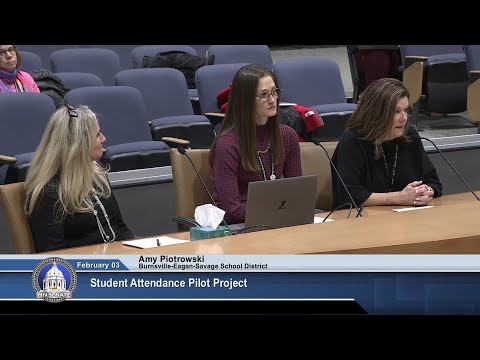
Burnsville Eagan Savage Schools' approach Amy Petrowski, director of student support services in Burnsville, and Morgan McDowell, a teacher on special assignment, described their district of about 7,500 students. They emphasized a multi-pronged approach: stronger family engagement, prevention-focused messaging (including "nudge letters" and culturally appropriate communications), training for staff, and using multi-tiered systems of support (MTSS) to target interventions.
Petrowski said pilot sites disaggregated absenteeism by grade, race, disability status and housing stability and identified kindergarten and upper high-school grades as areas of concern. She listed common barriers as inconsistent coding, weak communication channels to families, and uneven early-warning systems.
Questions from committee members Senators pressed presenters about the statutory thresholds that trigger district and county steps. Presenters said state statute mandates a letter after three unexcused absences and a county referral after seven cumulative unexcused absences; referral stages in Hennepin County include a first report with an online informational video and a later report that can trigger voluntary agency services. Committee members expressed concern about county referrals being perceived as linked to the criminal legal system and asked for alternatives that would make families more likely to accept help.
Next steps and limits Presenters asked MDE and local districts to work on common attendance coding and suggested pilot districts continue their convenings and data work. Nigro said the study group's draft bill in appendix A would consolidate statutes dealing with attendance ‘‘into a single home’’ but would not itself impose new mandates. Several senators encouraged additional outreach and wanted future hearings to include county staff to clarify referral processes.
No formal votes or actions were taken at this meeting. Committee members indicated interest in follow-up hearings and further work on data sharing, standardized definitions and programs that reduce the perception that referrals are punitive.
Ending Committee members thanked the presenters and said the legislature and pilot districts would continue to explore ways to standardize attendance reporting, expand early interventions in schools, and identify alternatives to low-uptake county referrals that preserve family trust.
AI generated
The text on this page is AI generated. Summaries, highlights, analysis, and video transcripts are all produced from the original source material.
AI can make mistakes, so if you spot one, and we will fix it for everyone.
Note: the source content is unaltered by us. Any content source we link to, be it a video, an audio recording, or a document, is presented exactly as its publisher released it. That publisher is usually a government body, sometimes an individual official or another organisation.