Get Full Government Meeting Transcripts, Videos, & Alerts Forever!
Get email alerts on the Department Of Corrections Budget topic
No spam. Unsubscribe anytime.
Corrections commissioner outlines $9M operating request, pilots and reforms; committee questions STS funding change
Summary
Minnesota Department of Corrections Commissioner Paul Schnell briefed the Senate Judiciary and Public Safety Committee on the agency’s staffing, facilities and budget priorities, requesting a $9 million operating deficiency to close FY2025 and detailing pilots and statutory changes.
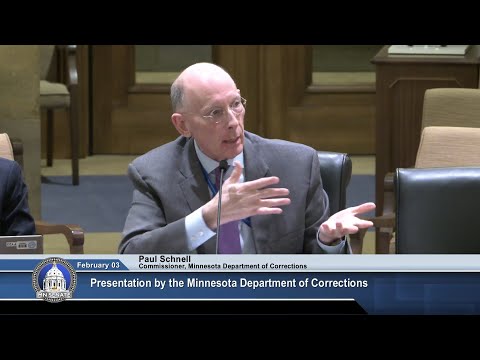
Paul Schnell, commissioner of the Minnesota Department of Corrections, presented the agency’s overview and budget priorities to the Senate Judiciary and Public Safety Committee and outlined requests and program changes for the coming biennium, including a $9 million operating deficiency request to close FY2025 and a proposal to stop the state's contribution to the Sentence-to-Serve (STS) program.
Key takeaways
- Staffing and facilities: The Department of Corrections (DOC) reported approximately 4,300 employees and operates 11 prisons with a combined bed capacity of 9,522 (reflecting double-bunking); the state currently houses roughly 8,300 individuals in those facilities. The agency also supervises about 20,000 people in the community through 13 district supervision offices.
- Operating deficiency: The DOC requests $9,000,000 to close out FY2025. Commissioner Schnell said the request results in part from faster-than-expected hiring and retention after compensation increases, which increased payroll costs but reduced forced overtime and improved staffing levels.
- Sentence-to-Serve (STS) state funding: The governor’s proposal included sunsetting the state's contribution to STS at the close of the current fiscal year. The DOC said the number of individuals completing STS dropped from about 5,600 in 2019 to a much lower number (less than one-third of that figure), and that county participation and crew sizes have declined; the state currently covers 25% of STS costs. Ending the state contribution would reportedly save roughly $1.8 million annually, though the committee heard questions about whether counties would continue programs without state support.
- Pilots and reforms: The DOC is piloting body-worn cameras at select facilities (funded by the 2023 Legislature) and is implementing MRRA (Minnesota Rehabilitation and Reinvestment Act) policies, with an estimated full implementation for new admissions by fall of this year and ongoing retroactive review pilots in the short term. The DOC also plans a customizable off-the-shelf replacement for a 30+ year legacy data system; the commissioner said a vendor contract was finalized and implementation will take multiple years.
- Mental-health pilot and other statutory fixes: The DOC seeks to extend a 2023 mental-health pilot that allows counties to transfer people with serious and persistent mental illness to an Oak Park Heights mental-health unit; proposed changes would permit referrals from licensed mental-health professionals (rather than requiring voluntary consent) and would extend the pilot through Aug. 1, 2027. Additional proposals would amend how the Interstate Compact Unit costs are shared, streamline tribal supervision fund distribution, repeal or codify portions of obsolete Rule 2940, and expand the definition of correctional employee in emergency-felony statutes to include certain supervision agents.
Committee questions and context
Members asked about bed impacts if the state ends STS funding and whether counties would absorb costs or cease participation. Commissioner Schnell said some counties would likely continue STS on their own; others have seen crew sizes shrink to one or two people, increasing the cost-per-client and raising questions about return on investment. Senators also asked about MRRA implementation, the shortage of programming space, mental-health bed availability and whether the mental-health pilot would expand bed capacity. Schnell said DOC is using existing and creative program-delivery options to expand access to programming while capital projects proceed.
On fraud-related sentencing proposals in the governor’s package, the commissioner said fiscal impacts were estimated conservatively (showing small average-daily-population bed impacts in the near term) and that detailed projections are complex because prosecutions and sentence lengths vary. The commissioner acknowledged a slide labeling bed counts as "individuals" contained an error and asked staff to correct related materials.
Outcome and next steps
No committee vote was taken on DOC requests during the presentation. Committee members requested follow-up materials, including updated data on MRRA implementation, more detail on the fiscal assumptions behind the $9 million request and STS savings, and clarification on the bed-impact estimates for fraud-related proposals. The commissioner offered to provide additional data and to meet individually with members.