Get Full Government Meeting Transcripts, Videos, & Alerts Forever!
Get email alerts on the School Bus Stop Arm Safety topic
No spam. Unsubscribe anytime.
Senate committee approves steeper fines for repeat school bus stop‑arm violations
Summary
Senate File 737, which raises mandatory minimum fines for repeat violations of school bus stop arms and continues support for school bus stop‑arm camera grants, was recommended to the Judiciary Committee after testimony from school bus operators and the Minnesota State Patrol.
The committee voted to advance Senate File 737, a bill that keeps the existing mandatory minimum for a first stop‑arm violation at $500 but raises mandatory minimum fines for repeat violations to $700 for a second offense and $950 for a third offense.
Senator Mary Housley, the bill sponsor, said current penalties are identical for a first or hundredth violation and that a graduated fine structure aims to deter repeat offenders. Housley cited observational data presented in committee: one study day in which bus drivers observed 1,003 stop‑arm violations, a figure she said would extrapolate to roughly 165,000 violations over a full school year.
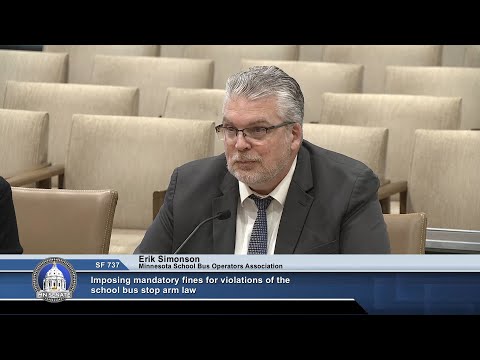
Eric Simonson, representing the Minnesota School Bus Operators Association (MSBOA), told the committee the association represents privately owned school bus contractors and that “We believe that any reasonable step that can be taken to continue reducing either initial violations of Minnesota stop arm law or reducing repeat offenses will in fact save lives of Minnesota school children going forward.” Simonson described the stop‑arm camera grant program, funded by past appropriations, as a key tool to increase prosecutions by producing video evidence.
Lieutenant Brian Ruhr of the Minnesota State Patrol testified that charges for stop‑arm violations rose to about 2,100 in 2024, double the number two years earlier, and attributed much of the increase to the placement of cameras on buses. “In 2024, there was 2,100, charges for the stop arm violations,” Ruhr said, and he told senators the conviction rate for charged stop‑arm violations has been roughly 50 to 55 percent, noting courts use a variety of dispositions.
Committee members asked detailed implementation questions: how many buses have cameras (committee testimony said over 60 percent of Minnesota school buses are equipped following an initial $14,500,000 appropriation, with an additional $1.5 million appropriated more recently and still being awarded), whether cameras automatically upload footage or require manual retrieval (answers varied by manufacturer and by bus Wi‑Fi capability), and how often repeat offenders are convicted (court research cited 23 second‑offense convictions since 2015 and one conviction for three offenses since 2015 among cases that resulted in conviction).
Several senators raised broader safety and siting concerns, including stops near intersections, mid‑block stopping to reduce cross‑traffic exposure, and whether fines or misdemeanor classifications should be increased further for repeat or especially dangerous violations. Senators also discussed statutory language that raises the offense to a gross misdemeanor in situations where a motorist passes on the right or when a child is visibly outside the bus.
Senator Farnsworth renewed the motion to recommend Senate File 737 be passed and referred to the Judiciary Committee; the motion carried by voice vote. The committee record shows the bill will proceed to Judiciary for further consideration.
Votes at a glance: Senate File 737 — recommend passage and referral to Judiciary; mover: Senator Farnsworth; outcome: approved (motion carries).