Get Full Government Meeting Transcripts, Videos, & Alerts Forever!
Get email alerts on the Agriculture Education Funding topic
No spam. Unsubscribe anytime.
Senate committee hears request to boost agricultural education grants, hears FFA officers’ testimony
Summary
The Senate Agriculture Committee heard testimony supporting Senate File 296, a request to increase state grants for the Minnesota Agricultural Education Leadership Council; the committee laid the bill over for possible inclusion in an omnibus bill. State FFA officers also addressed the committee about growing participation in ag education.
Sen. David Dames asked the Senate Agriculture and Rural Development Committee on Friday to lay over Senate File 296, a bill that would increase state grant funding for the Minnesota Agricultural Education Leadership Council (MAELC), and the committee agreed to lay the measure over for possible inclusion in an omnibus bill.
The request comes after testimony from MAELC representatives and agricultural-education advocates and was prefaced by remarks from two state Future Farmers of America officers who described expansion of ag education in Minnesota.
MAELC executive director Sarah Doornick told the committee that the council oversees a statutory grants program to start and improve agriculture, food and natural resources (AFNR) programs in schools. "My name is Sarah Doornick. I am the executive director of the Minnesota Agricultural Education Leadership Council," she said, and asked the committee to support SF 296 so the council can expand grants and teacher-recruitment work. Doornick said the council uses two grant tracks — statewide "common funds" and local "strategic initiative" grants — and that recent awards have primarily paid for classroom equipment and curriculum.
Sen. Dames described the appropriation in his opening remarks. He said past state support included a roughly $250,000 base; in the 2024–25 biennium the council’s funding level rose to $350,000 for that period. "This year, we're asking for $500,000 in fiscal year 2026 and $500,000 in fiscal year 2027," Dames said, asking members to lay the file over for possible omnibus inclusion.
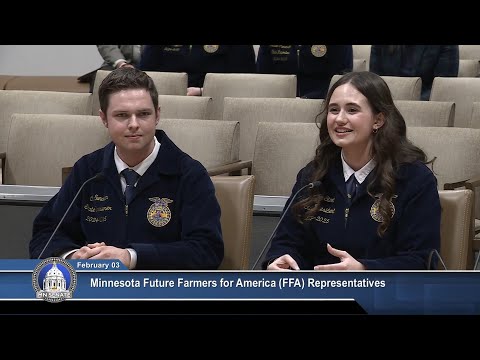
Two state FFA officers addressed the committee before the bill hearing. Lauren Stoll, identified herself as the Minnesota FFA state president, and Cole Lisonbee identified himself as the state treasurer. Stoll said she "grew up on a farm, corn and soybean farm in Southwest Minnesota, and I'm currently serving as the state president this year." Lisonbee described growth in FFA membership and programs: "Here in Minnesota, we have 15,000 FFA members. In the next 3 years... we are gonna have 40,000 FFA members here in Minnesota because we are moving to a 100% membership." Both students credited AFNR coursework and FFA activities with leadership and career development.
Supporters at the hearing included the Minnesota Association of Agricultural Educators and the Minnesota Farm Bureau Federation. AJ Duerer of the educators’ association said MAELC "has a positive impact" on instructors and students. Hunter Peterson of Minnesota Farm Bureau said investment in MAELC "has paid off" and encouraged continued funding.
Doornick said MAELC has limited funds relative to demand: she told the committee that in the most recent fiscal year MAELC supported 33 communities with approximately $300,000 and that the council is using the same base-dollar appropriation it received in 2007 despite serving more schools and students. "To help you compare, MAELC is using the same dollar amount appropriated in 2007 to now in 2025. We have 40 more schools with programs, 100 more teachers, and 21,000 more students that we're serving with the same amount of money," she said.
After questions from senators, including ones about how grant awards are decided, the chair laid SF 296 over for possible inclusion in an omnibus bill. The bill will return later in the process for further consideration.
Why it matters: MAELC grant awards and teacher-recruitment work fund classroom equipment, curriculum and internships that directly affect the number of schools offering ag education and the supply of qualified ag teachers across the state. Advocates argued additional funding would expand that access.
What’s next: SF 296 was laid over for possible inclusion in an omnibus bill; the committee did not take a final vote on the measure today.