Get Full Government Meeting Transcripts, Videos, & Alerts Forever!
Get email alerts on the Eidbi Licensure topic
No spam. Unsubscribe anytime.
DHS recommends provisional licensure for EIDBI; Somali and other community groups warn licensing could reduce access
Summary
Christy Grom, director of state government relations at the Minnesota Department of Human Services, told the Senate Human Services Committee that DHS recommends provisional licensure for early intensive developmental and behavioral intervention (EIDBI) to improve oversight, safety and program integrity while balancing access.
Christy Grom, director of state government relations at the Minnesota Department of Human Services, told the Senate Human Services Committee that DHS recommends provisional licensure for early intensive developmental and behavioral intervention (EIDBI) as a way to strengthen oversight and health-and-safety protections while balancing access.
Grom said the department’s multi‑phase evaluation — authorized by the Legislature and initiated after a 2023 governor’s request — found rapid program growth and operational inconsistencies that leave the state without adequate tools to investigate maltreatment or ensure provider qualifications. "DHS recommends that we do license this service," Grom said, and described a provisional licensure structure in the governor’s budget that would be added to chapter 245A and allow DHS to identify controlling individuals, require background studies, and suspend or revoke licenses.
The report recommended interim and long‑term steps: create provisional licensure in 2025, continue community engagement to design final standards through 2027, and aim for full licensure by July 2028 if the Legislature approves it. Grom said DHS would also seek resources to support investigations and revalidation and recommended categorizing EIDBI providers as high risk so revalidation occurs more frequently.
Why it matters
EIDBI is a Medicaid state‑plan service under EPSDT that provides therapies (for example, applied behavior analysis and several developmental modalities) to children and young adults under age 21 with autism or related conditions. Grom told the committee that participation has grown quickly: "In 2023, I think we had over 4,200 children in services, compared to about 3,322," she said, noting roughly a 30% increase and that provider agencies quadrupled between 2020 and 2024. DHS flagged operational concerns including overstretched clinical supervision, individual supervising professionals affiliated with many centers, and a rise in out‑of‑state provider addresses.
Community testimony
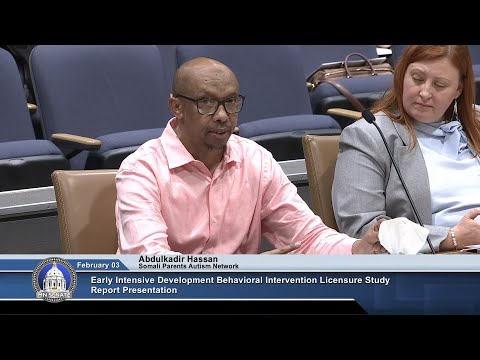
Multiple parents and community advocates urged the committee to preserve access and ensure licensure does not disproportionately burden minority‑owned providers. Najma Siad, a parent who testified about her 4‑year‑old, said her son "currently receives ABA, or Applied Behavioral Therapy, and it has been a transformative tool for my family." Anissa Hagee Mohammed, who described herself as a parent and board chair for a local community organization that works with Somali families, said community organizations "have not been contacted and have not been used as a resource" in the evaluation and urged that licensing "be done very carefully so that it does not harm communities of color." Abdi Kareem Hura, a parent and community advocate, testified that minority‑owned providers filled gaps left by large institutions and warned: "If we lose this, our children will be left without the care they need."
Key recommendations and concerns discussed
- Provisional licensure: DHS proposed provisional licensure authority (change page language referenced) to begin addressing immediate program‑integrity and safety risks and to allow time for stakeholder work to develop final standards. - Health and safety standards: DHS recommended clearer investigation authority for maltreatment (DHS would be lead investigative agency rather than deferring to local law enforcement in some cases), background checks, case‑load and supervision standards for Qualified Supervising Professionals (QSPs), and documentation and training requirements (including mandatory CPR and incident‑reporting training suggested by community respondents). - Risk classification and revalidation: DHS proposed moving EIDBI providers to a high‑risk category so revalidation would occur more frequently (for example every three years rather than five). - Community concerns: Multiple witnesses warned that additional regulation could reduce access for families if licensing requirements are too onerous, and requested culturally tailored templates, clearer health‑and‑safety guidance in areas such as emergency restraint use and medication administration, and stronger school‑provider coordination to reduce siloing with special education. - Modalities and workforce: Witnesses and committee members discussed the mix of clinical modalities (ABA and several developmental approaches). Committee members raised concerns about large increases in per‑participant spending that appear in DHS reporting and asked DHS to provide deeper data on what drove the increase in billed units and the per‑person cost trends.
What the committee asked DHS to provide
Committee members asked DHS for follow‑up data including: the detailed drivers of per‑participant spending growth, counts of enrolled provider agencies and the breakdown of provider types (CMDE providers, QSPs, level 1/2/3 workers), the number of enrolled-but-not-billing agencies, and details on DHS stop‑payment authority and how often DHS has used it for EIDBI. Grom agreed to provide more specific data and to return for additional testimony as the committee continues deliberations.
Discussion versus formal action
The committee did not vote on licensing or on statutory language for provisional licensure during this hearing. DHS presented recommendations and the governor’s budget proposal; community members and senators discussed concerns and requested additional data. No formal bill vote on EIDBI licensure occurred in this session transcript.
Ending
Senators and community members signaled ongoing work: DHS said it would continue stakeholder engagement to refine licensure standards and return to the Legislature with recommendations. Multiple parents urged the committee to center lived experience and equity in any licensing design. "Nothing about us without us," witness Maryam Osman said.