Get Full Government Meeting Transcripts, Videos, & Alerts Forever!
Get email alerts on the Financial Audit topic
No spam. Unsubscribe anytime.
Rock Hill auditors give unmodified opinion on FY2023-24; trustees press district on fund balance, ESSER spending and capital reserves
Summary
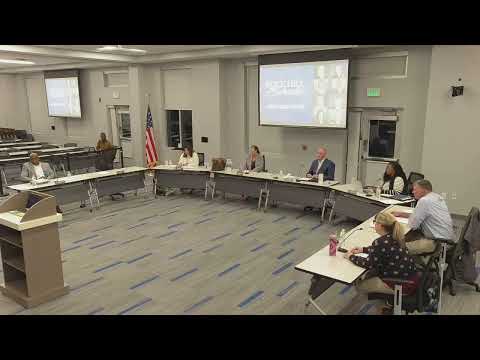
Rock Hill Schools' external auditor presented an unmodified audit opinion for the fiscal year ended June 30, 2024, and district financial staff outlined fund balances, ESSER spending and capital reserves during the Jan. 14 board meeting.
Rock Hill Schools' external auditor presented an unmodified audit opinion for the fiscal year ended June 30, 2024, and district financial staff outlined why the district's fund balance grew during the year and where restricted funds are held.
Andrew Coleman, auditor with Greenfinity & Coley, told trustees on Jan. 14 that the audit provides "reasonable assurance" that the district's financial statements are materially correct; he emphasized that the audit does not guarantee the district's financial condition and noted one finding in the single-audit procurement testing tied to federal procurement exemptions. Coleman said the district had no material weaknesses in internal control related to the financial statements.
CFO Terry Smith summarized key figures: total governmental fund balance was about $53.5 million at June 30, 2024; the unassigned fund balance was $46.1 million (about 22% of fiscal-year-24 actual expenditures). The district recorded a $10.9 million increase in its general-fund balance in the year. Smith said the district spent roughly $21.1 million in ESSER COVID-related federal funds during fiscal 2024 and that many of those ESSER-funded positions were one-time allocations that must be reconciled with the general fund now that ESSER has ended.
Capital and bond items: Trustees asked about a $19,000,000 transfer into the capital projects fund. Smith said that amount primarily represents short-term general-obligation borrowing the district issues annually (short-term bonds typically issued each September) and that most of the capital-projects fund balance is designated for the Sunset Park building project. Smith told trustees the Sunset Park project is approximately $68 million and that the district is not raising taxes for the project; the district also reported a land sale that netted roughly $1.4 million.
Single-audit and management comments: Coleman said the single-audit finding concerned procurement guidance for federal awards; the district has corrected the issue and does not expect repeat findings. He also flagged pupil-activity cash handling as an area requiring ongoing oversight in the management letter.
Trustee questions and next steps: Trustees pressed for detail on how one-time federal ESSER funds were used, how many full-time equivalent positions had been funded from ESSER and whether those positions were absorbed into the general fund. Smith said about 86 FTEs were paid from ESSER at some point and that the district used a one-time transfer of $7.4 million from fund balance and $8.4 million from capital to balance the fiscal 2024-25 budget (the district's budget included a planned one-time use of funds). Trustees asked for additional breakout data and said staff would provide deeper analysis in small-group briefings and in the next public meeting cycle.
Ending: The auditor and finance staff closed by reminding trustees of operations and compliance constraints: restricted funds (for example EIA, federal grants, food service, debt-service and capital projects) may only be used for the purposes that accompany those funds. Coleman and Smith said they would provide more detailed data at trustees' request.
"We give an opinion on the financial statements; we provide reasonable assurance that the numbers and disclosures are correct," auditor Andrew Coleman said. "The audit is not designed to detect every instance of fraud but we do consider fraud risk in our procedures."