Get Full Government Meeting Transcripts, Videos, & Alerts Forever!
Get email alerts on the Special Education Equity topic
No spam. Unsubscribe anytime.
PGCPS committee reviews equity-focused training, family survey and school examples for students with disabilities
Summary
At its Jan. 27 Academic Achievement Committee meeting, Prince George’s County Public Schools officials reported on a year-long equity focus on students with disabilities, described districtwide professional learning and family surveys, and highlighted school-level practices at Sea Pleasant Elementary and Charles Herbert Flowers High School.
Prince George’s County Public Schools officials told the Academic Achievement Committee on Jan. 27 that the district’s 2024–25 equity focus on students with disabilities has produced districtwide professional learning, school-level changes and early family feedback.
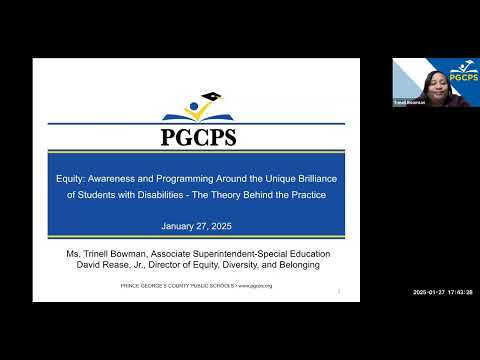
The update, led by Judith White, PGCPS chief academic officer and the superintendent’s designee to the committee, and David Reese, director of Equity, Diversity and Belonging, framed the work as part of a coordinated “theory of action” that began with optional summer learning modules and a mandatory Sept. 16, 2024, districtwide professional learning day for staff.
The committee heard data intended to give context to the effort: PGCPS has about 16,000 students identified with disabilities out of roughly 131,000–132,000 total students; approximately 74% of students with disabilities are reported to be in general education settings for more than 80% of the school day. Reese said the focus recognizes both that inclusion rates are a point of pride and that inclusion creates an imperative to strengthen general-education teachers’ capacity to teach students with disabilities.
Officials described a multi-pronged training approach. Three summer modules (June–August 2024) addressed disability labels and history, special education program experiences and adult mindsets and bias. Central-office teams then organized principal and assistant-principal sessions (November–February), monthly special-education “after school clinics,” Saturday academies (September–May) and paraprofessional cohorts (first cohort October–December; second cohort February–May). Tranel Bowman, associate superintendent for special education, said those sessions also work with curriculum and arts partners to embed inclusive practices.
District leaders reported several measurement and feedback mechanisms. A family engagement survey went live at the end of September; as of Jan. 15 the survey had 642 family responses from 146 schools and an average score of 4.5 on a 5-point scale across nine closed questions. The district uses the eDotrina learning-management system to track professional development sign-ups; presenters said roughly 11,000–12,000 staff registered for professional learning tied to the initiative and that about 5,000 participants returned a post‑PD survey.
School teams presented examples of local implementation. At Sea Pleasant Elementary, special-education teacher and school equity lead Tanika Adams and Principal Desiree Early described tangible steps: weekly newsletters with strategies for families, expanded use of the ClassDojo app to share resources with parents and community partners, an annual autism-focused event with workshops and community panels, and a template for IEP presentations aimed at leading with student strengths. “Students with disabilities play a major role in our school,” Adams said, summarizing the school’s efforts to celebrate students’ contributions, including having students lead morning announcements.
At Charles Herbert Flowers High School, equity lead Amal Dahan described staff planning and follow-up that connected school-based equity leads, central office staff and IEP coordinators to create student-centered projects and to collect follow-up feedback from staff.
Reese framed the work as anchored in the district’s mission to “make sure that the unique brilliance of every single child in PGCPS is able to flourish so that they can live their best possible life,” language he used to describe the equity focus. Officials told the committee they plan continued monitoring and follow up: central offices will share more specific participation and survey data with board staff, and the committee will get additional progress reports in subsequent meetings (data presentations are planned for February and April, with a broader update anticipated in March).
Committee members asked for more granular attendance and outcome data. The district indicated it can pull participant-level reports from eDotrina and will provide additional charts and the PD survey results to board staff. Bowman and Reese said central-office staff will continue monthly follow-up with principals and equity leads to track implementation of specially designed instruction and family‑engagement practices.
The meeting included no formal votes or motions on the topic. Committee members were invited to raise questions with central office staff and to ask principals in their districts about local implementation.
Looking ahead, presenters said the district is considering keeping students with disabilities as the equity focus for a second year because of the size and cross-cutting nature of the topic; the committee was told staff will return with more data, examples and recommended next steps.