Get email alerts on the Anti Displacement Programs topic
No spam. Unsubscribe anytime.
Mayor’s office and OPCD present anti-displacement roadmap; propose dashboard and work group
Summary
City staff presented a review of Seattle’s anti-displacement programs and recommended creating a cross-department work group, a near-real-time displacement risk dashboard, improved outreach and a preservation strategy for naturally occurring affordable housing.
City staff briefed the Seattle City Council select committee on Jan. 29 on existing anti-displacement programs and a proposed set of next steps intended to coordinate and strengthen those efforts as the city updates its comprehensive plan.
The presentation, led by Chris Tobias of the mayor’s office and Nicole Stafford and Leah Tivoli from the Innovation and Performance office, catalogued 20 city programs with displacement-mitigating potential and proposed four priority actions: create a monitoring tool and cross-department work group; increase program outreach and participation; simplify resident-facing application processes; and build a preservation strategy for naturally occurring affordable housing.
Why it matters: The city’s planning choices and rezoning will change where and how new housing is built; staff said anti-displacement measures must work in tandem with production of new housing to reduce involuntary displacement.
Key findings and proposals
- Inventory and evidence base: Staff said about 60% of the 20 identified interventions had a high-to-moderate research evidence base for mitigating displacement, citing recent reviews by UC Berkeley/UCLA and Root Policy Research. Several programs were described as “novel” and likely to need evaluation.
- Budgets and scale: The presentation reported approximately $44.7 million budgeted for anti-displacement programs in 2024 (excluding some utility-assistance estimates) and noted larger recent increases: Equitable Development Initiative (EDI) funding rising by about $1.9 million in 2025, home weatherization up $3.3 million and rental assistance up $4.4 million.
- Displacement risk dashboard and work group: Staff demonstrated a beta displacement-risk dashboard designed to track neighborhood-level indicators — rent and sale price pressure, permit activity, vulnerability measures and program take-up — and recommended a cross-department work group to review the dashboard regularly and coordinate targeted outreach and program adjustments.
- Improve access and simplify process: The presentation identified barriers to enrollment in emergency rental assistance and other programs, including fragmented application processes across departments and multiple implementing partners. Staff recommended consolidating and simplifying the resident experience through portals and consistent application practices.
- Preserve naturally occurring affordable housing: Staff recommended creating a dedicated acquisition fund, a centralized at-risk-property database, and a network of preservation partners to act when notices of intent to sell arrive; they noted the city received roughly 25 such notices last year but had not evaluated or acquired properties under that policy.
Equitable Development Initiative (EDI)
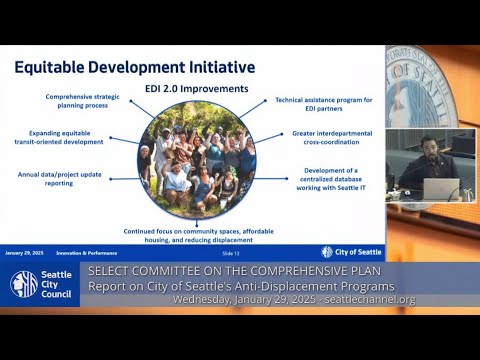
OPCD staff summarized an independent EDI evaluation and listed planned program improvements: clearer contract reporting requirements, more funding flexibility, technical assistance for community-based organizations, a centralized project database and an annual EDI report. “Many of the organizations that we’re working with don’t have the capacity to meet the requirements for reporting in the program,” said the OPCD presenter, and staff said an RFP for technical assistance is near completion.
Next steps and administrative actions
Staff proposed a timeline that would kick off the anti-displacement work group immediately, test the dashboard this quarter, and produce an implementation plan to the mayor’s office by year end. The mayor’s office indicated an intention to issue an executive order directing departments to implement the recommendations. Other department-specific milestones mentioned include FAS drafting predatory home-buying legislation, OH (Office of Housing) producing a plan for preserving naturally occurring affordable housing, and OPCD producing an annual housing report after plan adoption.
What council members asked
Council members requested more granularity on programs that help seniors age in place (property tax exemptions and home-repair assistance were discussed), the role of Office of Housing production investments, the EDI application pipeline and the evidence base for preservation strategies. Council members also emphasized outreach to non-online populations and flagged gaps such as the “cliff” in eligibility for some tax-relief programs.
Ending note: Staff said the new tools and the work group are intended to create a near-real-time decision environment for targeting limited anti-displacement resources. The committee recessed after the briefing and scheduled further consideration at subsequent meetings.
AI generated
The text on this page is AI generated. Summaries, highlights, analysis, and video transcripts are all produced from the original source material.
AI can make mistakes, so if you spot one, and we will fix it for everyone.
Note: the source content is unaltered by us. Any content source we link to, be it a video, an audio recording, or a document, is presented exactly as its publisher released it. That publisher is usually a government body, sometimes an individual official or another organisation.