Get Full Government Meeting Transcripts, Videos, & Alerts Forever!
Get email alerts on the 1 Seattle Plan Public Comment topic
No spam. Unsubscribe anytime.
Hundreds of residents urge changes to ‘1 Seattle’ plan, cite outreach gaps and displacement risk
Summary
Fifty-one people gave public comment at the Jan. 29 Seattle City Council select committee meeting on the 1 Seattle comprehensive plan, urging more district hearings, clearer outreach, stronger anti-displacement tools and protections for trees, ravines and longtime residents.
Dozens of residents urged the Seattle City Council select committee on Jan. 29 to slow parts of the proposed 1 Seattle comprehensive plan, increase public outreach and expand anti-displacement protections, saying many homeowners and renters remain unaware of rezoning maps and potential tax impacts.
The testimony — 31 in person and 20 remote speakers, the committee clerk said — covered repeated themes: requests for district-level public hearings, concerns that property taxes will be reassessed at “highest and best use,” worries about displacement of longtime and lower-income residents, and calls to preserve trees and environmentally sensitive ravines.
Why it matters: The comprehensive plan will rezone many residential areas and create neighborhood centers under state law updates. Residents say the scale of change and the complexity of maps require more in-person outreach, especially to elderly, disabled and non-online households.
Public commenters asked the council to hold neighborhood hearings before adopting non-mandated elements of the plan and to delay nonstatutory changes if needed to meet state deadlines for HB 1110 implementation. “I request that you hold a public hearing on the proposed 1 Seattle Plan in each city council district,” said Bob Morgan, a homeowner whose property abuts a proposed neighborhood center, adding that hearings should be held on Saturdays during the day to include elders and people with mobility limitations.
Speakers raised taxation and affordability concerns. “Per state requirement, property taxes are assessed at a 100% of the property value based on highest and best use,” said Eric (district 3), who asked what the council will do “to cushion the tax impact” for homeowners facing rezoning. Blair, speaking for neighbors with health and mobility limits, described a family that has held multiple homes in Madrona for generations and quoted a relative: “she hopes to die in her home,” and fears tax and displacement pressure if zoning and assessments change.
Several residents requested more targeted, mailed notification. “My neighbors never received any direct notification by mail from the city about its plans for this momentous rezoning in our neighborhoods,” said Doug Lehi of Madrona. Others said online outreach and late-season comment windows limited participation; Mary Ellen Flanagan said Maple Leaf collected more than 1,000 petition signatures seeking to remove a neighborhood-center designation.
Speakers also urged more anti-displacement tools and homeownership options. Josh Friedman, a land-use attorney with the Complete Communities Coalition, urged the council to allow homeowners “to actually build onto their homes and properties with reasonable additional residential density” so families can create space for children, aging relatives or rental income. Ryan Donahue of Habitat for Humanity said, “the density that this plan offers up is what makes affordable homeownership a possibility.”
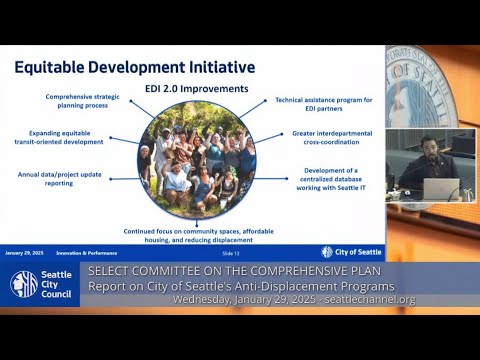
Several community organizations asked the city to deepen investments in proven anti-displacement programs. Elena Arakaki of Friends of Little Saigon urged the council to “substantially increase funding for the Equitable Development Initiative,” citing that program’s role in stabilizing small businesses and family housing.
Neighborhood design and environmental concerns also surfaced. Maggie Lewis and others cited ravines near Morgan Junction and Lohman Beach and said steep slopes, slide history and missing streets make higher-density construction inappropriate in those places. Multiple speakers pressed for stronger tree protections and higher minimum green space requirements.
Speakers representing particular communities asked to be seen in planning. John Chaney, vice president of the Lake Union Liveaboard Association, said liveaboard residents are “totally unseen” on the plan’s maps and asked the city to better account for boat-based housing. Community advocates from the Chinatown-International District and the Central District called for stronger culturally informed preservation and anti-displacement funding.
Meeting logistics and next steps were a recurring practical concern. Chair Joy Hollingsworth reminded the public that the committee will accept written public comment at an 11 a.m. Feb. 5 meeting but will hold a public hearing that evening at 5 p.m. where each speaker will get two minutes. The chair said the Feb. 5 evening hearing will be hybrid and remain open “for as long as it takes.”
Ending note: Speakers on both sides of the debate emphasized the need to expand Seattle’s housing supply while protecting current residents. Testimony repeatedly urged more local hearings, clearer mailed notice, and expanded anti-displacement funding and programs before the city finalizes rezoning maps.