Get Full Government Meeting Transcripts, Videos, & Alerts Forever!
Get email alerts on the Lake Restoration topic
No spam. Unsubscribe anytime.
Lake Logan group presents 113‑page restoration plan; seeks ODNR help finding dredge sites
Summary
Members of the Lake Logan Association summarized a 113‑page evaluation and restoration plan at the Hocking County commissioners meeting on Jan. 16, 2025, asking for county and ODNR support to carry out vegetation control, mechanical harvesting and large‑scale dredging that will require off‑site disposal sites for dredged material.
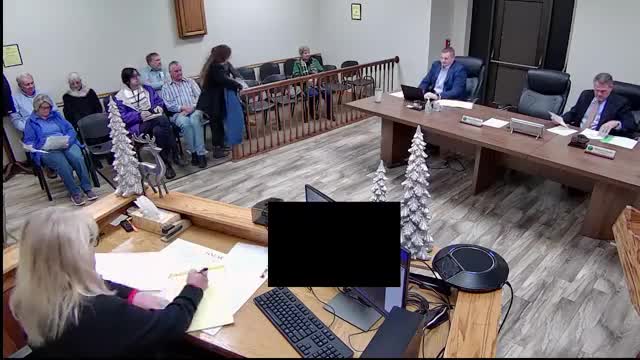
Carol Mackey, a Lake Logan Association member, and Stuart Birnie, president of the Lake Logan Association, presented a 113‑page Restorative Lake Sciences evaluation and restoration plan during the Hocking County Board of Commissioners meeting on Jan. 16, 2025.
The association said the plan — posted on lakeloganassociation.org and summarized in a Logan Daily News article — recommends prioritized actions including spot treatment for invasive Eurasian watermilfoil, mechanical harvesting of roughly 16.7 acres of lotus within a larger 75‑acre lotus growth area, and dredging about 21.4 acres in the Clear Fork and Duck Creek fingers of the lake. "This is not a sprint — it's a marathon," Mackey said, urging continued community and agency involvement.
The nut graf: Association leaders told commissioners that some remedies, such as mechanical harvesting and herbicide treatment, can occur before major dredging, but large‑scale dredging depends on finding suitable dredge material reclamation and management areas (DRMAs). Because landowner agreements for potential placement sites have fallen through, the association said it needs stronger support from state and federal partners and local stakeholders to implement the plan.
Details and local concerns
Birnie said the association met with Ohio Department of Natural Resources (ODNR) staff and that ODNR had recommended some items and provided initial review. The report, he said, found 11 native aquatic plant species and two principal invasive species: Eurasian watermilfoil and curlyleaf pondweed. The association’s top recommendations are (1) immediate spot treatment for about 12 acres of Eurasian watermilfoil, (2) mechanical harvesting of part of the 75 acres of lotus (16.7 acres to be removed, leaving a 20‑foot shoreline buffer), and (3) dredging the Clear Fork and Duck Creek fingers (21.4 acres). Birnie said mechanical harvesting "can take place regardless of whether the dredging happens," and that dredging would reduce the lake’s shallows where weeds regrow quickly.
The association emphasized that dredging produces a substantial volume of material and that the project likely requires multiple DRMA sites. Mackey said four property owners had expressed interest in hosting dredge material but the first two attempts fell through — one before the group organized and one when a prospective lessor withdrew late in negotiations because of neighborhood concerns.
Funding, coordination and next steps
The Lake Logan Association said Hocking Hills Tourism Association funded the study and that the association has reached out to multiple stakeholders: Logan City Council; Hocking County Fish and Game; Hocking County Soil and Water Conservation District; the Chamber of Commerce; Hocking Hills Lodging Owners Association; Falls Township trustees; Hocking County Health Department; Friends of Hocking Hills State Park; and Friends for the Preservation of Ohio State Parks. The group said it had requested a meeting with state Senator Wilkin and expects continued coordination with local and regional ODNR staff.
Mackey and Birnie said they want ODNR to lead or co‑lead the dredging and vegetation management, and they urged ODNR to be creative in identifying DRMA sites given the county’s terrain. Birnie recommended a watershed plan to address sediment and nutrient inflow to the lake; he said ODNR’s authority covers the lake and adjacent park land but that a watershed plan would require broader coordination and is "a heavy lift." The association noted interest in bringing Dr. Jones of Restorative Lake Sciences to a future public meeting to present findings and answer questions.
Commissioner engagement and questions
Commissioner Linton thanked the presenters and asked whether mechanical harvesting and herbicide treatments could proceed without dredging; Birnie said they can, but that dredging would slow regrowth because weeds prefer shallow, sunlit areas. The presenters said ODNR has mechanical harvesters but that equipment and annual treatment budgets are limited and may require outside funding or local partnership to secure recurring operations.
Ending
The association asked for continued county support and pledged to keep stakeholders informed as the group pursues funding and DRMA agreements. The commissioners accepted the presentation; no formal county appropriation or binding commitment to specific dredging work was recorded at the meeting.