Jacksonville Beach council pauses land development code vote, schedules workshop
Summary
After a multi-year rewrite of the city’s land development code, council members and dozens of residents pressed for more time to review the 317-page document. The council voted to continue the ordinance’s first reading to March 3 and directed staff to hold a public workshop Feb. 20.
Mayor Hoffman and the Jacksonville Beach City Council delayed the ordinance’s final push on a comprehensive rewrite of the city’s land development code on Feb. 3, 2025, after residents and several council members said they had not had adequate time to review the 317‑page draft.
The council voted to continue the first reading of Ordinance No. 2025-8220 to March 3, 2025, at 6 p.m. and directed staff to hold a public workshop on Feb. 20, staff said. Mayor Hoffman opened the discussion by describing the rewrite as a multi-year project and said, “we're at the end zone,” but that a workshop would give residents time to study the draft and raise detailed questions.
The land development code rewrite updates zoning and development rules the city says had not been comprehensively reviewed in decades. Heather Ireland, director of planning and development, summarized changes aimed at preserving neighborhood character, updating parking and landscaping rules, clarifying impervious surface and lot-coverage limits, and adding measures for accessory dwelling units (ADUs) and incentives for downtown, among other items. Ireland told the council the draft reduces some residential density measures, preserves existing zoning, and leaves charter-controlled items — such as the number of bars and certain height limits — unchanged.
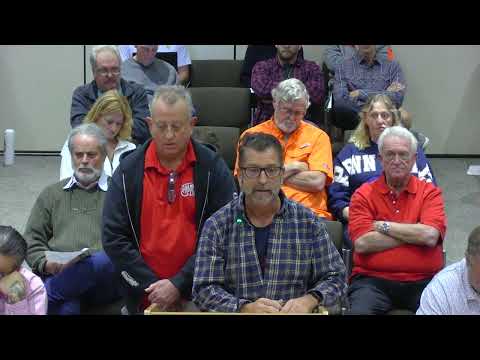
Residents and board members who spoke at the public comment portion described the document as substantial and difficult to review on short notice. Several said key provisions — including a proposed allowance for digital message signs to change messages much more frequently and a new board term‑limit provision — appeared in the written draft but had not been discussed at public workshops. Multiple speakers asked for more time to read the full draft and for a workshop that would present the most substantive changes and allow targeted Q&A with staff.
Council members expressed mixed views. Council member Golding and others argued for a workshop before any vote so the public could offer informed comment. Council member Wagner and others urged caution about delaying too long because business owners told council the old code had already been harming operations; Wagner said some local businesses were “financially impacted every day” and urged efficient next steps. Council member Horn asked about how large post‑workshop changes could be made before a second reading; the city attorney advised that state law requires two readings but that the council could choose its procedural path and that staff would flag any legal problems if they arose.
Ireland said staff will post frequently asked questions on the project website, run a dedicated public-notices page on the city website, and hold the Feb. 20 workshop to present highlights, gather concerns and return recommendations to council before the March 3 hearing. She also said staff plans training for city staff and board members before implementation, and noted the code is a “living document” that can be amended after adoption.
Residents’ questions raised specific technical points staff said would be addressed at the workshop, including how the proposed impervious surface ratio and 50% lot-coverage limits would apply to existing permits and whether lot-coverage calculations include pools, patios and driveways. Ireland said the code treats the primary structure and required driveway differently from accessory hardscape and that variances would still be possible under the new code.
The council motion to continue the first reading passed 5–1 with Council member Wouters voting no; one member, Council member Janssen, was absent (representing the city at the National League of Cities). The delay will give staff time to prepare an FAQ, present the Feb. 20 workshop, and collect follow-up recommendations ahead of the March 3 hearing.
The council indicated this is not intended as a permanent halt; staff reiterated the intent to finalize the code after public education and any technical edits the council directs.
Community members and several council members praised the amount of work by planning staff and the city’s consultant team but reiterated the need for clearer, widely distributed materials showing — in side‑by‑side comparisons — what is changing in text and numeric standards.
The Feb. 20 workshop will be in council chambers; staff said the workshop will present the draft’s major changes, accept public comment and return recommended edits to city council prior to the March 3 public hearing.
AI generated
The text on this page is AI generated. Summaries, highlights, analysis, and video transcripts are all produced from the original source material.
AI can make mistakes, so if you spot one, and we will fix it for everyone.
Note: the source content is unaltered by us. Any content source we link to, be it a video, an audio recording, or a document, is presented exactly as its publisher released it. That publisher is usually a government body, sometimes an individual official or another organisation.