
Committee pauses ‘missing middle’ land‑use overhaul, asks staff and subcommittee to refine maps and criteria
Get AI-powered insights, summaries, and transcripts
Subscribe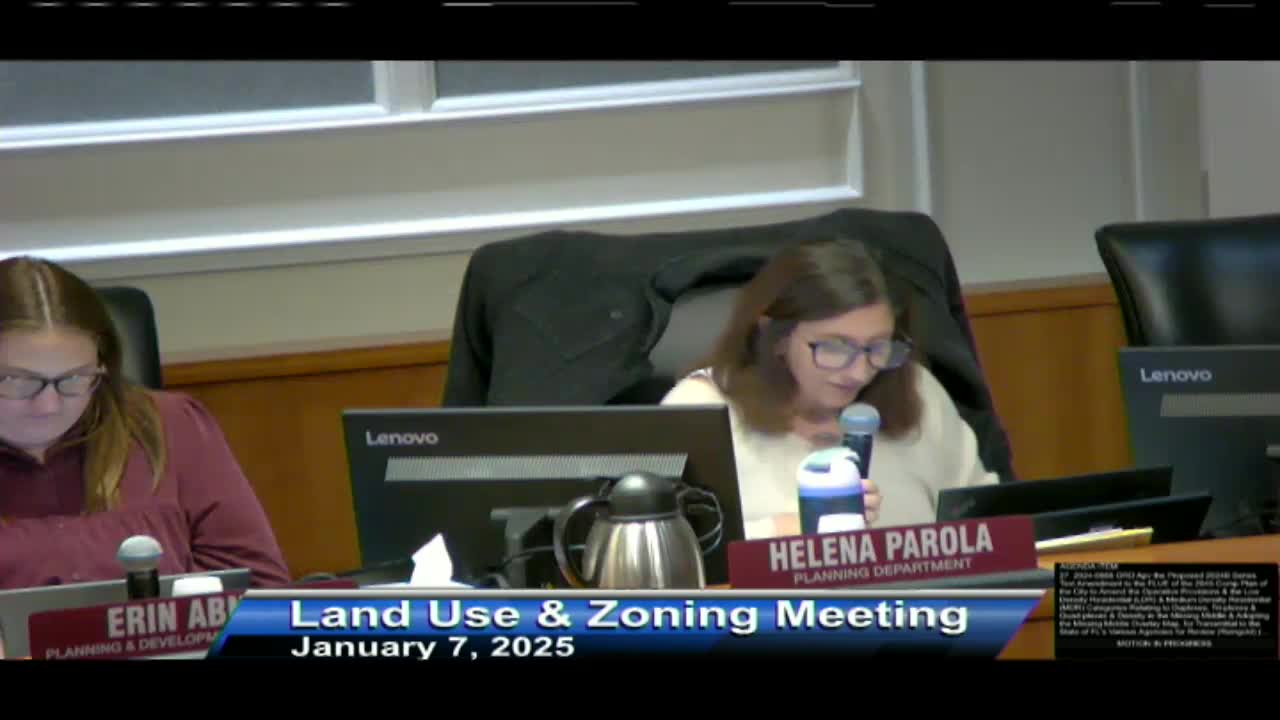
Summary
After hours of testimony for and against a proposed "missing middle" overlay that would increase allowable densities in portions of Jacksonville, the Land Use and Zoning Committee continued the public hearing and asked the LDR update subcommittee and planning staff to produce a revised, targeted map and additional technical edits.
Jacksonville’s Land Use and Zoning Committee on Jan. 7 did not take a final vote on a proposed amendment to the comprehensive plan (2024‑0868) that would create a “missing middle” overlay to allow higher residential densities in selected parts of the city.
Instead the committee asked staff and the Land Development Regulations (LDR) update subcommittee to refine the map and ordinance language, and continued the public hearing for additional review. Committee members said they want a more targeted approach and more time for district council members and CPACs to review proposed boundaries and text changes.
Why it matters: The proposal would change allowed maximum densities for eligible low‑density residential parcels inside an overlay (up to 25 units per acre in the urban priority area and up to 20 units per acre in the urban area), and add a map into the 2045 Comprehensive Plan. Proponents said it will expand owner‑occupied and for‑sale housing choices; opponents warned it risks undermining single‑family neighborhoods, increasing flood risk and straining infrastructure.
Key developments at the Jan. 7 meeting: Planning staff described refinements recommended by the LDR committee, including narrowing the overlay to exclude coastal high‑hazard zones, areas already subject to adopted zoning overlays, and — in the planning department’s preferred version — restricting the overlay to urban priority and urban areas (removing the suburban band). Staff pointed committee members to a science‑based modeling map developed during the LDR update and made a GIS link available to council members and the public.
Public testimony was extensive and polarized. Builders and industrial, port and development representatives urged the committee to adopt a targeted overlay to increase housing choice and provide clarity for developers and employers. Dozens of residents, civic groups and neighborhood representatives urged the committee to slow the change, saying the map was released too close to the meeting and that the proposal could permit tall buildings next to longstanding single‑family blocks, worsen flooding, and worsen parking and traffic congestion. Several speakers suggested alternative approaches, including targeting only arterial corridors and commercially zoned areas or focusing development on downtown and city‑owned parcels.
Committee direction: Committee members largely agreed that more work was needed. The chair proposed and members supported a workshop approach: (1) planning staff and the LDR subcommittee will prepare a GIS‑based “target areas” map that prioritizes transit corridors, proximity to multimodal nodes and low‑flood‑risk locations; (2) district council members and CPACs will be asked to review proposed target areas for their districts; and (3) staff will return the map and revised exhibit language for further committee review. The committee scheduled follow‑up work and said it would take additional committee sessions before any adoption vote; the public hearing was continued to allow more time for outreach and revisions.
What to watch next: The planning department said it will circulate a revised exhibit and the GIS map (the committee posted a link to the map in the legislative gateway), and the LDR subcommittee will meet to further refine boundaries. Committee members requested briefings in the districts and additional technical detail on septic versus central water/sewer limitations, flood‑risk screening and potential infrastructure costs.
The committee did not take a final vote on 2024‑0868; instead it continued the public hearing and directed staff and the subcommittee to return with a narrower, more targeted proposal and supporting technical analysis.