Get Full Government Meeting Transcripts, Videos, & Alerts Forever!
Get email alerts on the Homelessness And Treatment topic
No spam. Unsubscribe anytime.
Grants Pass panel says treatment beds, coordination and housing must expand to ease homelessness
Summary
City staff and local service providers told the Grants Pass City Council on Feb. 4 that the city lacks treatment beds and long-term housing and urged a coordinated, data-driven effort — including the Build for Zero model — plus permitting changes and private funding to speed projects.
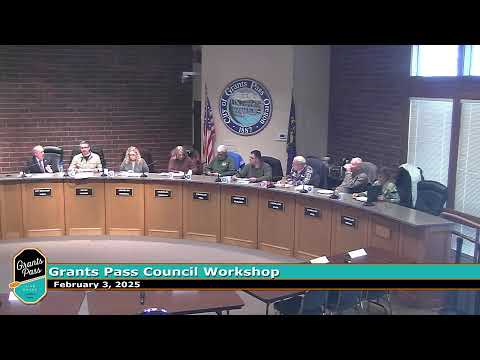
Grants Pass City Manager Aaron Kubik told the city council on Feb. 4 that the meeting was the first of several workshops intended to build a coordinated response to homelessness in Grants Pass. Kubik said the panel would describe current services, gaps and measures of success and that council would have time for questions after the panel finished speaking.
Panel members representing nonprofit service providers said the region has broad service activity but acute shortages in treatment capacity, transitional and permanent housing, and staff to run higher-level clinical programs. The shortages mean people who are ready for treatment often wait on long lists, providers said, and that attrition during wait periods undermines outcomes.
The lack of residential treatment beds drew repeated attention: "We have 330 people on the wait list for residential treatment right now, and that's for 47 beds," said Summer Walcott, executive director of OnTrack. Walcott said the agency’s emergency lodging work has moved 139 chronically unhoused people into treatment so far, a 68 percent success rate for the emergency-lodging pathway into withdrawal management or residential care.
Providers emphasized that shelters and outreach produce improvements but are not a substitute for the full continuum of care. "Everybody that stays at the Gospel Rescue Mission leaves in better condition than they came," said Brian, a representative of the Gospel Rescue Mission, who described last year’s outcomes including more than 50,000 hot meals served and at least 388 individuals assisted through mission programs in 2024. On top of meals and shelter, he listed service outcomes such as drug- and alcohol-treatment admissions, primary-care connections, and help obtaining IDs and documents.
Counselors and social-service leaders described practical barriers that reduce the effectiveness of current capacity: inconsistent funding rules, narrow eligibility tied to state programs, long licensing and workforce gaps for clinical staff, and a limited supply of affordable housing for people leaving treatment and for the health-care workers who would staff expanded programs.
Panel recommendations and possible next steps included: - Adopt a coordinated, data-driven model such as Build for Zero (Community Solutions) to get all stakeholders, funders and service providers on a single, name-based tracking system and to focus resources on people who are ready for housing and treatment. "It'll work if we do it together," Jeremy, a counselor with U-turn for Christ, said of Build for Zero. - Expand the number of residential-treatment and withdrawal-management beds and the workforce to run them; panelists said staffing shortages make adding beds difficult even where space might exist. - Create or designate a permanent navigation or stabilization center where multiple agencies co-locate intake, case management, peer support and short-term shelter to keep people engaged until treatment beds or housing are available. Multiple speakers identified the navigation-center model as a gap and an immediate priority. - Streamline permitting, system development charges and other local barriers to make it faster and less costly for nonprofit and private developers to build low-income, transitional and workforce housing; several speakers urged the city to review building code and SDC policy to accelerate projects. - Increase support for peer-program models and recovery housing (for example, Oxford Houses and Recovery Cafe–style peer supports) as an important route to stabilization that complements clinical care. - Pursue mixed funding sources, including private philanthropy, to support projects and pilot programs that can demonstrate outcomes and attract further investment.
Panelists described several quantifiable outcomes and program data points during the session: Hearts of the Mission described intensive assessment and case-management practices for youth, with expectations that residents meet weekly with case managers and complete 36 hours a week of productive time; UCAN reported sheltering about 465 people across Josephine and Douglas counties last year, helping about 530 households into affordable housing and preventing roughly 1,800 evictions; the Gospel Rescue Mission reported helping at least 388 individuals in 2024 and arranging 91 treatment placements.
Council members asked clarifying procedural and policy questions. Councilor Kathleen asked OnTrack about bed counts and workforce; Walcott confirmed OnTrack’s total of 47 residential beds and a roughly 90–120 day residential length of stay, and said the organization runs three outpatient clinics. Councilor Victoria asked for a short summary of Build for Zero and was told a community meeting about the model was scheduled for Thursday, Feb. 6 at Calvary Chapel Grants Pass. Multiple councilors asked staff for follow-up on topics raised during the workshop.
City Manager Aaron Kubik told the council staff would prepare follow-up materials and said staff could provide a memo about the Firewise program after questions during agenda review. Several councilors asked the manager to convene future workshops and joint sessions with the county to discuss housing, the city-owned Washington Street property and other development options for housing and stabilization projects.
What happened next: the council closed the panel discussion and moved to agenda review and other council business. Panelists and council members agreed to continue the workshop series and to pursue several near-term steps — including the Feb. 6 Build for Zero informational meeting, a staff memo on the Firewise program, and discussions about easing permitting and clearing obstacles to housing projects.
The workshop recorded detailed program metrics and service examples from every agency present; providers asked that the city lean on both public and private funding and streamline local permitting to speed new housing and treatment programs. Several panelists urged the council to prioritize staffing, beds and a permanent navigation center as the most immediate needs to reduce attrition from wait lists and to improve the chances that people who want treatment actually get it.