Get Full Government Meeting Transcripts, Videos, & Alerts Forever!
Get email alerts on the Private Roads topic
No spam. Unsubscribe anytime.
Jacksonville council member convenes residents to weigh fixes for deteriorating private roads in District 14
Summary
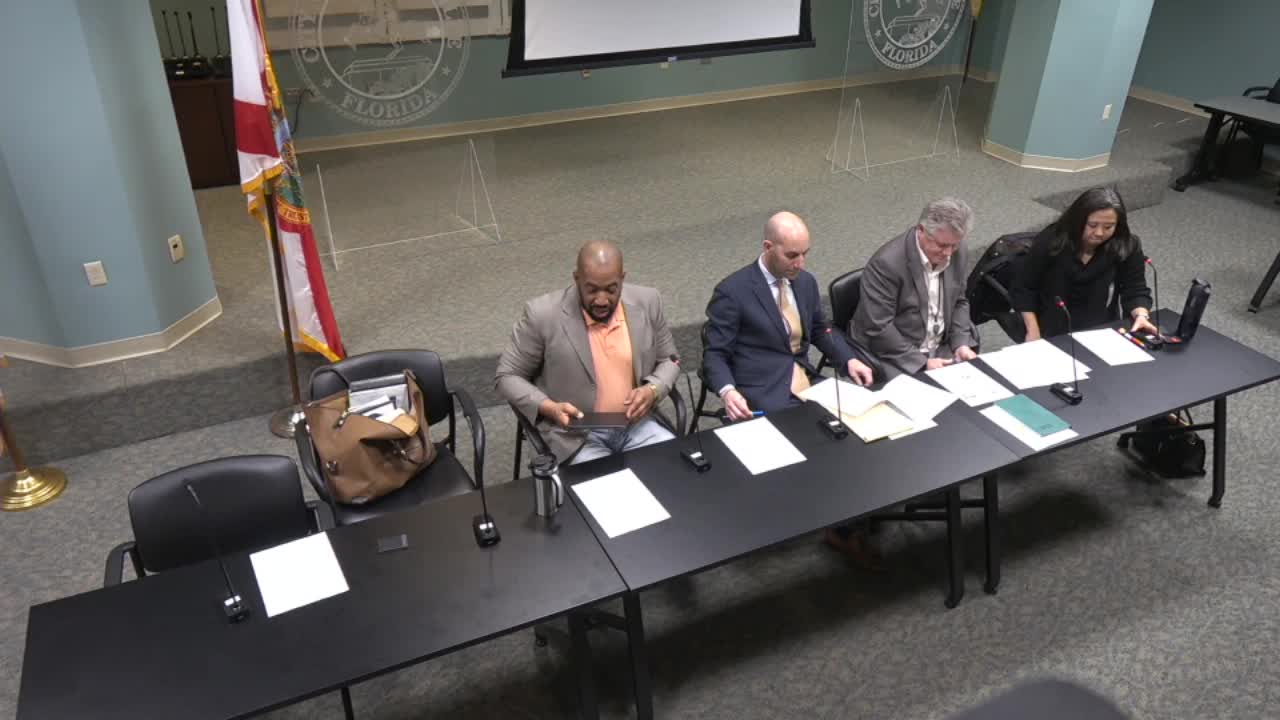
Council Member Rahman Johnson convened a community meeting Thursday evening for residents of Maple Lane and Sheryl Ann Lane to discuss persistent safety and access problems on privately owned roads that the city does not maintain.
Council Member Rahman Johnson convened a community meeting Thursday evening for residents of Maple Lane and Sheryl Ann Lane to discuss persistent safety and access problems on privately owned roads that the city does not maintain.
Residents described deep potholes, broken vehicles, and blocked ambulance access. "So the purpose of this meeting, today, of course, is to talk about ... Maple Lane and Sheryl Ann Lane," Johnson said as he opened the session and invited city staff to outline legal and technical constraints.
City staff told residents the central legal obstacle is that the roads are private: parcels were platted decades ago as "lots of record" and the frontage and roadways were never built to city standards or dedicated to the city. Dylan Bridal of the Office of General Counsel explained that local governments generally cannot use public dollars to improve private roads unless owners grant dedication or agree to an assessment or special district. "If we don't have 100% of that buy in from the owners, then we're not really able to go on and legally go do the improvements," Bridal said.
Public Works Operations Director Steve Long and a city staff member identified as Nina described technical and financing alternatives. The most comprehensive option — rebuilding the subbase, drainage and paving to city standards so the roadway could be dedicated and maintained by the city in perpetuity — carries a large price tag. Staff cited a planning estimate in the high range (about $10,000,000) to meet full city standards for the affected roadways. "When we're talking about our estimate, it's actually to completely rebuild a road, the sub base, the base, the asphalt, along with drainage improvements," the staff member said.
Residents and some contractors described much lower-cost work. Lorenzo Fuller, a long-time resident and group-home operator, said neighbors had previously recruited contractors and received a quote from Duval Asphalt for roughly $44,000 to pave two segments; Fuller said that price did not include drainage work and would not meet city acceptance standards. "We took it upon ourselves to contact Duval Asphalt ... we were quoted, I wanna say, $44,000," Fuller said.
Staff described intermediate options that do not require city takeover. Nina noted properly maintained graded (lime-rock or crushed-stone) roads can be much cheaper and, when regularly regraded, provide durable, drivable surfaces. She said motor-grader maintenance could cost a fraction of paving and could be funded through local assessments or a community-managed special district. "There are plenty of graded roads, dirt roads out there that can have compacted lime rock ... The cost of maintaining it through a motor grader is a fraction of the cost of paving," she said.
Officials outlined two common financing paths discussed at the meeting: - Special assessment or petition program: the city can run an assessment project that typically splits costs (histor examples discussed by staff were roughly one-third city / one-third adjacent owner / one-third adjacent owner when petition thresholds are met). The process requires neighborhood petitioning and owner buy-in; staff said the petition threshold for assessment programs can require support from a large share of owners (staff described the practical requirement as roughly two-thirds). Assessment amounts are collected on tax rolls as non-ad valorem special assessments and are normally repaid over a term (staff said this is often done over about 10 years in comparable projects). - Special taxing district / community association: residents could create a special district or community association that raises funds and manages improvements without dedicating the road to the city. The city said it can assist setting up such an entity and help with administration and compliance, but the road would remain private and not be accepted into the city's maintenance program unless upgraded to city standards.
Residents raised operational concerns: ambulance access had been hindered by rutted surfaces, group-home operators reported repeated vehicle damage and disabled residents requiring wheelchair-accessible transport said drives and pickups were disrupted. "The ambulance had to reverse ... If it really was to the point in that, say, it was a heart attack ... getting through is a problem," said resident Foletta McNeil.
City staff and Council Member Johnson said they would continue to pursue grant and program options that might reduce homeowner costs, and stressed the legal limits on how the city can act without owner dedication or a statutory mechanism. Johnson told the group the city would pursue multiple tracks of assistance: identifying potential grants, helping form a neighborhood association, and outlining assessment or district options. "We'll have you some options within 30 days," Johnson told the meeting.
Next steps the city described included: staff gathering parcel ownership records and past permit history, returning with three financing and construction options (including lower-cost interim fixes), and offering neighborhood-formation help through the Neighborhoods Department.
Residents will decide whether to pursue a community-organized solution, petition the city for an assessment program, or pursue the longer and costlier path of raising the road to city standards and dedicating it for city maintenance. The city emphasized it will not accept roads unless they meet required right-of-way widths, base and pavement thickness, and drainage standards necessary for long-term maintenance.
The meeting closed with an agreement by staff to provide written options and contacts for neighborhood assistance and to follow up with residents who signed comment cards.