Get Full Government Meeting Transcripts, Videos, & Alerts Forever!
Get email alerts on the Budget Reserves Cap topic
No spam. Unsubscribe anytime.
Council adopts 1.25% reserve cap on mayor's proposed nonrecurring spending; critics say it could hamstring future budgets
Summary
The council passed an ordinance (2024‑0990) limiting how much of the city’s reserves the mayor may propose to draw for nonrecurring items in the proposed budget, capping it at 1.25% of reserves. Supporters framed it as fiscal discipline; opponents said it constrains future administrations. The administration said it does not oppose the measure.
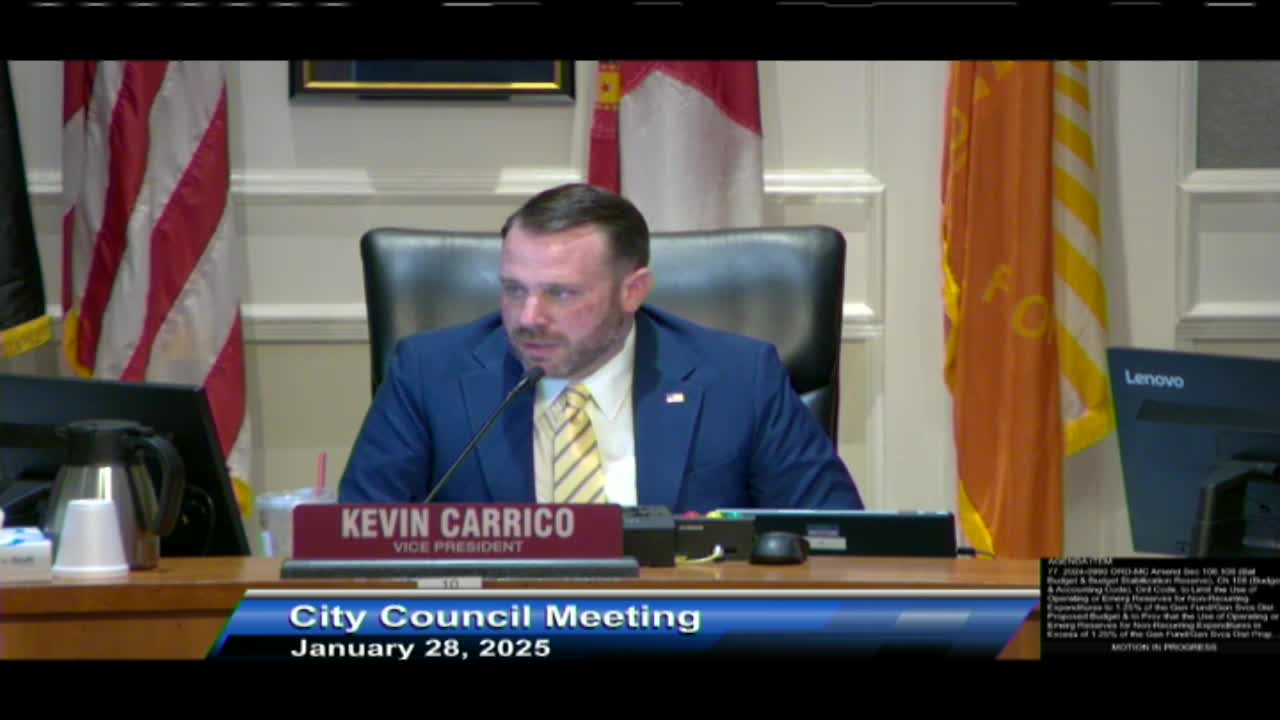
Jacksonville City Council on Jan. 28 approved an ordinance limiting the mayor’s proposed budget to draw no more than 1.25% of the city’s reserves for nonrecurring items, a policy the ordinance drafters said would prevent large one‑time draws and promote fiscal prudence.
Council Member Lannon, who introduced the ordinance, said the limit is a targeted guardrail for nonrecurring spending only and cited past use of reserves (roughly $24 million in the cited comparison years) as the basis for the 1.25% figure. He said the measure is meant to prevent the city from starting a fiscal year with a large structural shortfall that requires major midyear adjustments.
Supporters, including Council Members Diamond, Carlucci and Arias, argued the measure imposes discipline and protects the city’s long‑term fiscal health. “This is our regulation to make sure that that doesn't happen again,” Council Member Carlucci said, referring to previous sizable reserve draws and an imbalance in a prior proposed budget.
Opponents — including Council Members Boylan, Beluso and Johnson — argued the ordinance risks unnecessarily shackling future mayors and the council’s discretionary budget authority, noting that the council retains the power to change budget decisions later in the process. Council Member Boylan said a cap implies a lack of trust in the council’s and finance chairs’ judgment and expressed concern about limiting flexibility for emergencies or future priorities.
Administration representatives told the council they were not taking an official position of opposition and that they remained committed to producing a balanced, fiscally responsible budget. City staff also noted the ordinance applies to the mayor’s proposed budget only; the council retains authority to approve or adjust appropriations during budget deliberations.
The council approved the ordinance in a recorded vote, 14‑2. Supporters said the measure creates a predictable guardrail; critics said it could unnecessarily constrict future administrations’ ability to present major policy proposals that require one‑time funding.
The ordinance will be incorporated into the city’s budget procedures; council and staff said they will monitor its effects during next year’s budget process.