Get Full Government Meeting Transcripts, Videos, & Alerts Forever!
Get email alerts on the School Construction Carthage Elementary topic
No spam. Unsubscribe anytime.
Public hearing: Moore County staff, teachers and residents back new Carthage Elementary on new site; staff favors K–5, 600‑student core
Summary
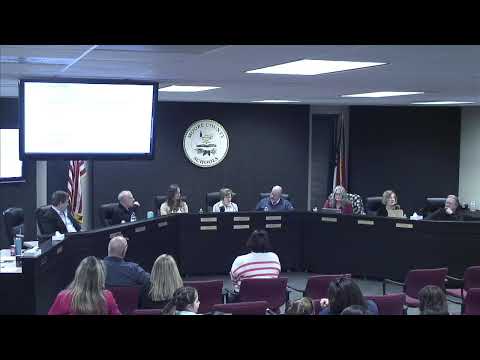
Moore County Schools held a public hearing on Feb. 3 to gather community input on a proposal to replace Carthage Elementary with a new building on a new site with a core capacity of 600 students.
Moore County Schools held a public hearing on Feb. 3 to gather community input on a proposal to replace Carthage Elementary with a new building on a new site with a core capacity of 600 students.
The superintendent’s recommendation — introduced at the hearing by district staff — would place a new Carthage Elementary on a new site, with classrooms initially fitted to 450 students but designed for a 600‑student core to accommodate projected growth. Miss Purvis, a district staff member presenting background, said the district’s construction committee and an updated capacity review of the area supported the recommendation.
Why it matters: Carthage Elementary, built in 1950, sits on a constrained 7.6‑acre parcel; presenters said the existing campus has building problems beyond cosmetic repair. Staff and community speakers said a new site would provide safer drop‑off and play spaces, room for future expansion and long‑term cost savings compared with repeated repairs or constrained renovations.
Staff and community testimony
Several Carthage teachers and staff summarized a staff survey and urged the board to follow the superintendent’s recommendation. Lisa Moore, a 24‑year teacher at Carthage Elementary, said the staff surveyed 33 members and that 97% opposed splitting the campus into two smaller schools. "Our data shows we have a clear vision for one school in Carthage," Moore said.
Christina Harrison, a Moore County teacher for nine years, said 97% of staff preferred a K–5 model over a K–8, and she emphasized developmental and scheduling reasons: "Younger students may feel safer when they are with kids their own age," Harrison said.
Rayona Cash, an administrative assistant with 15 years at the school, said staff favored planning for growth: "Our staff believes a 600‑student school would be better for the growing community of Carthage," she said.
Jennifer Blake, a 14‑year Carthage teacher, delivered a list of specific facility priorities staff want in a new building: a closed campus with secure gates and key‑fob access, adjoining classroom doors for flexibility, separate playgrounds for younger and older children, adequate storage, age‑appropriate furniture, climate control, accessible EC rooms and a library as a learning hub. "Safety is paramount," Blake said.
Outside educators and residents, including Molly Capps (principal of McDeeds Creek Elementary) and Tommy Phillips (community organizer who helped build local interest), urged prompt action to replace the aging building and noted the benefit a modern facility could bring to recruiting families and staff.
Discussion points and technical details
- Site size and capacity: Presenters said the current Carthage site is about 7.6 acres. The district indicated a new elementary would typically need about 20–25 usable acres; building a K–8 would require additional athletic space and substantially more acreage (speakers cited figures around 40–45 acres if middle‑school athletic facilities were required).
- Capacity planning: The construction committee’s updated area review (conducted by a consultant from North Carolina State) projected that the area’s growth would require additional capacity within approximately 10 years; the committee prioritized a replacement with the ability to accommodate 150–200 additional students as priority No. 2 on the December 2023 master facility list.
- Feeder implications: Staff noted that a K–8 configuration would change feeder patterns; presenters said building a K–8 in Carthage could leave roughly 300 unused seats at New Century Middle School and about 50 unused seats at Cranes Creek, producing about 450 unused middle‑school seats countywide under one forecast.
- Survey data: The staff survey presented at the hearing reported that 97% opposed two separate small schools, 97% supported a new school on a new site (75.8% explicitly), 97% preferred K–5 over K–8, 93.9% expressed concerns about a K–8 model, 87.9% opposed a 450‑student capacity, and 84.8% favored a 600‑student capacity. The district said classrooms might initially be built out for 450 students even if the core is designed for 600.
- Building design concerns: Staff asked for functional, durable classrooms, sufficient storage, private changing areas for exceptional children, and attention to noise issues reported at some newer roofs (several speakers noted roof creaks and thermal movement causing distracting noises).
Board discussion and next steps
Board members thanked speakers and said they intended to move the planning process forward. Several board members and the superintendent’s team said the construction committee would meet and that the district plans a defined, inclusive planning process with stakeholder input. No formal board vote adopting the superintendent’s recommendation occurred at the hearing; board members described the meeting as one step in a broader planning schedule and said they would coordinate with county and town officials about the disposition of the existing campus once a new site is chosen.
Old campus disposition
Speakers and board members repeatedly raised the future of the existing Carthage campus. Residents and staff suggested possible community uses — including a park or preserving auditorium or gym space — but also noted the facility’s multiple repair needs (leaks, HVAC and accessibility problems). Board members said the timing is appropriate to begin community conversation about reuse but gave no formal directive at the hearing.
Votes at a glance
- Approval of agenda as modified — voice vote; outcome: approved (no roll‑call tally provided).
- Motion to clarify speaker time so that each speaker has six minutes dedicated to remarks, with questions and answers to follow — voice vote; outcome: approved (no roll‑call tally provided). The board returned to the agenda with that clarification in place.
- Motion to adjourn — voice vote; outcome: approved.
What the board did not decide
The board did not take a formal vote to adopt the superintendent’s recommendation at this hearing. The hearing collected public comment and staff input to inform next steps in site selection, design and planning; board members said the construction committee and superintendent’s office will continue concurrent planning and stakeholder engagement.
Context and history
Carthage Elementary was built in 1950 and has undergone multiple additions. The district commissioned a comprehensive facility assessment in spring 2022 that documented significant needs; in December 2023 the district placed Carthage replacement (with added future capacity) as a high priority on a master facility list. The public hearing followed stakeholder meetings involving staff, PTO, town officials and the Carthage Centennial Committee.
Looking ahead
Board members said the district’s construction committee will meet to incorporate public feedback into planning and to coordinate with town and county officials about the new site and the disposition of the existing campus. Several speakers urged the district to move quickly; others asked the board to involve the community in decisions about reuse of the old campus.