
Hanover school committee sets FY26 budget at $41.08 million, committee members urge larger override
Get AI-powered insights, summaries, and transcripts
Subscribe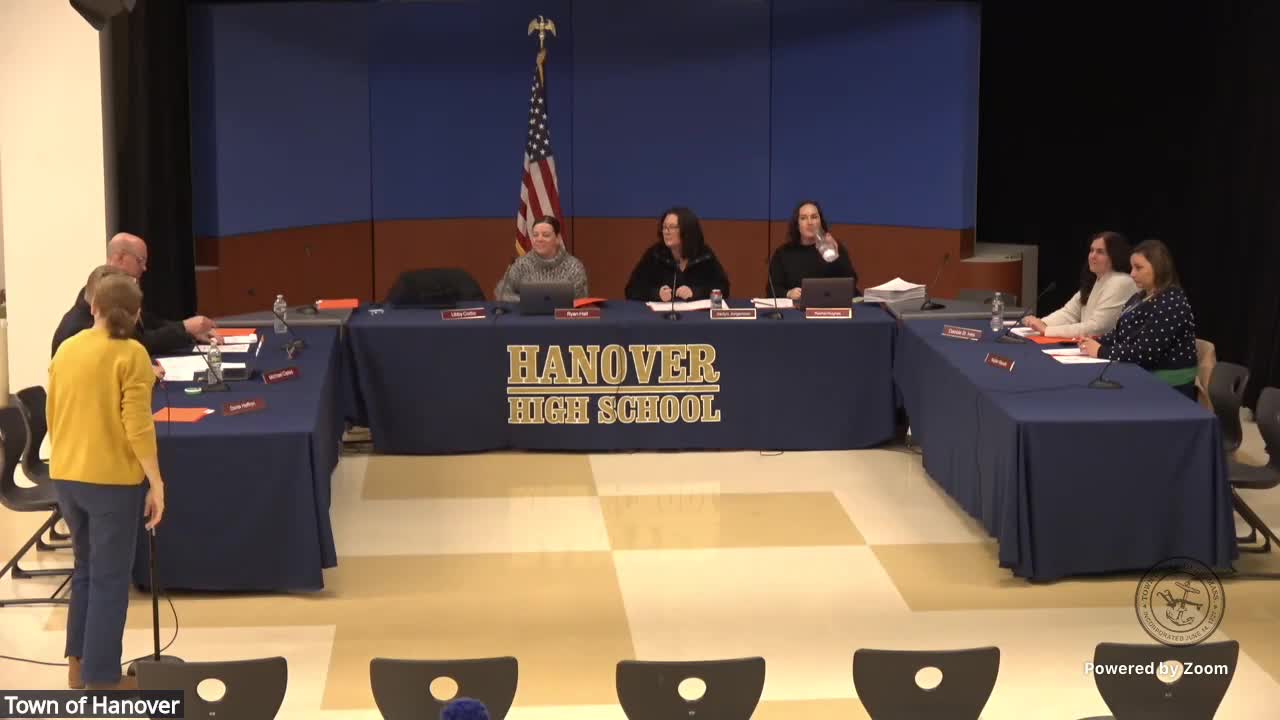
Summary
The Hanover Public Schools School Committee voted to set a fiscal year 2026 budget of $41,083,046 after extended discussion about a requested $4.3 million “full restoration” override. Committee members and public speakers urged the Select Board and town manager to consider a tiered override option and greater transparency on town allocations.
The Hanover Public Schools School Committee voted to set its fiscal year 2026 budget at $41,083,046 during its meeting, approving the school department’s preferred funding level after a lengthy public discussion and committee deliberation.
Committee members and public commenters framed the vote as the committee’s formal statement of what it considers an “educationally sound” budget. Several school committee members and parents continued to press the town for a larger override than the town manager’s $3.5 million placeholder, saying the district needs roughly $4.3 million to restore positions cut in prior years.
School leaders and committee members said the $4.3 million “full restoration” request represents returning the district to its staffing level in fiscal 2024. Superintendent Farren (presenting the update) and finance staff detailed three budget scenarios: a level-services base, a $3.5 million override proposal, and the $4,298,791 full-restoration model the schools have advocated. In explaining the models, finance staff said the “full restoration” total is primarily personnel costs and that adjustments may occur over the coming months based on enrollment and special-education needs.
Public comment pushed both for full restoration and for alternative override structures. Resident Libby Korbo, who identified herself during public comment, described a proposed “pyramid” or tiered override that would give voters several funding options, saying the approach “provides the residents with a choice of funding” and could allow voters to choose a lower or higher funding level. Korbo said she shared guidance from the state and cited a precedent in Cohasset’s 2006 override.
Several committee members said their role is to advocate for an educationally sound budget. One member said, “I’m not even convinced that 4.3 is educationally sound for our students. But I certainly don’t think anything less would be.” Other members urged continued collaboration with the Select Board and town manager to seek a compromise while also warning that endorsing a lower number could be interpreted by voters as the district accepting lesser funding.
Online and in-person public commenters urged clearer, side-by-side displays showing what the district would lose at each funding level and how the schools’ staffing cuts compared with other town departments. John Geary, an online commenter, asked whether fees (parking, sports, clubs) would roll back if an override passed; committee staff said fee decisions had not been incorporated into the current projections and would be considered if funding changes.
Before the vote, the committee requested that publicly posted materials explain that “Restore 24” specifically meant restoration of positions. After discussion, a committee member moved to set the fiscal year 2026 budget for Hanover Public Schools at $41,083,046. The motion passed on a roll-call vote.
The committee and superintendent said they will use the coming days — after the town manager presents his budget and the Select Board deliberates — to refine messaging to voters and to coordinate with the town on allocations and potential reallocations. The town manager’s budget presentation and a Select Board meeting to discuss override options were scheduled in the days after the school committee meeting.
Votes at a glance: The committee approved the FY26 budget at $41,083,046 by roll call. Four named members voted in favor; one committee member recorded a “no.”
The committee asked staff to post explanatory material about tiered overrides and to continue to provide detailed, side-by-side documents showing the staffing and program impacts at each funding level so residents can compare the outcomes of different override choices.