Get Full Government Meeting Transcripts, Videos, & Alerts Forever!
Get email alerts on the Human Services Funding topic
No spam. Unsubscribe anytime.
Yakima County staff explain how state ‘inflation’ funds will be offered to human-services contractors
Summary
County Human Services staff told commissioners Jan. 23 that additional state inflation funds will be offered proportionately to subgrantees, with agencies able to accept, decline or shift awards so the money can be spent by the June 30, 2025 contract deadline.
Yakima County Human Services staff told the Board of Yakima County Commissioners on Jan. 23 that additional state “inflation” funds will be offered to subgrantees proportionally and that some agencies may accept different amounts or reallocate funds between their county contracts.
Esther, a Human Services staff member, said the county receives the additional money as a modification to existing grants and then offers each subgrantee a proportionate share of that increase. "When we receive funding for a mod, what we'll generally do is reach out to all of our subgrantees and offer them a proportionate amount of that additional funding," Esther said. She explained staff then work with each agency to confirm they can spend the money within the contract period and to determine allowable uses.
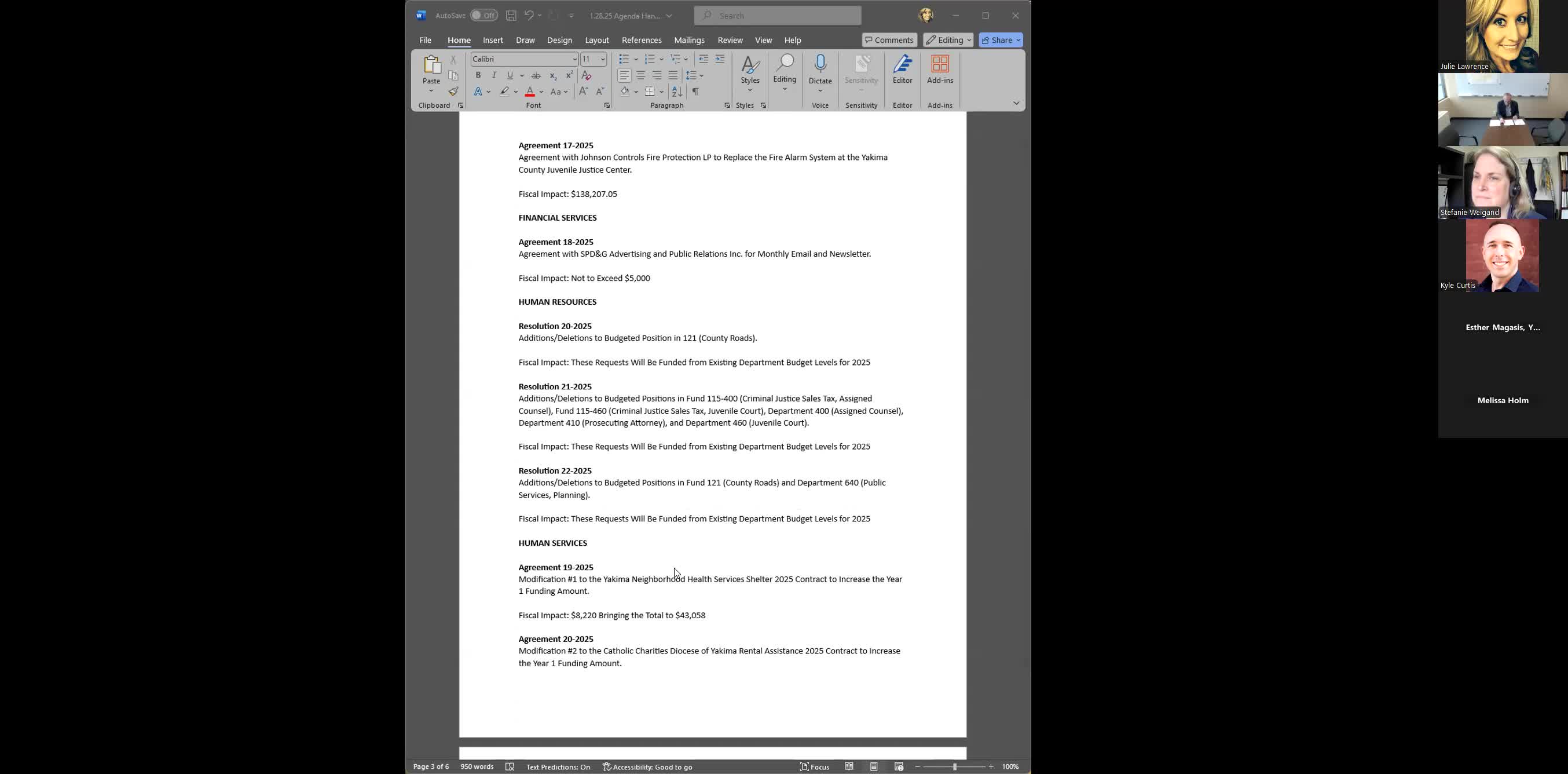
The discussion followed an agenda review in which Human Services staff noted multiple contract modifications that increase year‑one funding for 2025. County staff identified the affected contractors as Yakima Neighborhood Health Services; Catholic Charities Diocese of Yakima; YWCA of Yakima; Generating Hope; Triumph Treatment Services; and The Lighthouse. Staff said the increases differ by contract because some agencies voluntarily decline part or all of the offered increase, or request that an offered increase be moved from one county contract to another so the funds will be spent.
Esther said staff typically spend up to a month consulting with subgrantees about whether they can accept and use the additional funding before finalizing allocations. "A lot of times, folks will say, I wouldn't be able to spend x amount of money before the end of the contract period, but I could take a lesser amount and spend that out," she said. When agencies decline funds, staff recalculate the remaining dollars and redistribute them so the majority is used before the contract ends.
Commissioner Lindy asked about an apparent outlier: some Neighborhood Health contracts showed a larger percentage increase than most other vendors. Esther said that was likely tied to program- or project-specific limits (for example, the HEN contract) and the fact that only a few agencies run certain programs, meaning those agencies could legitimately accept a larger share of the additional funds.
Staff noted the county’s objective is to ensure the funds are spent by the contract period end; they said the current spend‑down deadline for these contracts is June 30, 2025. Commissioner Curtis thanked staff for coordinating the revisions and noted the process has many moving parts.
The county did not provide itemized dollar increases for each contract during the Jan. 23 discussion; staff said individual increases vary and some were adjusted downward at the subgrantee’s request. The county also said some subgrantees asked to move money between multiple county contracts they hold so the increased amount would support programs able to expend the funds.
County staff indicated they will finalize the modifications after the back-and-forth with subgrantees and then present the updated contracts for the board’s routine approval on the upcoming consent agenda.