Get Full Government Meeting Transcripts, Videos, & Alerts Forever!
Get email alerts on the Transit Safety topic
No spam. Unsubscribe anytime.
King County leaders, transit union and agencies press for immediate actions on operator safety after fatal attack
Summary
At a Jan. 13 special meeting, King County Council members, Amalgamated Transit Union Local 587 leaders and transit and public-safety agencies outlined short- and longer-term steps — including more officers, behavioral health outreach, enclosed operator cabins and reinstated fare enforcement — after the January murder of Metro operator Sean Yim.
KING COUNTY, Wash. — At a special Jan. 13 meeting of the King County Council Committee of the Whole, elected officials, union leaders and transit and public-safety agencies laid out steps they say are needed to improve security for transit operators and riders following the fatal January attack on Metro operator Sean Yim.
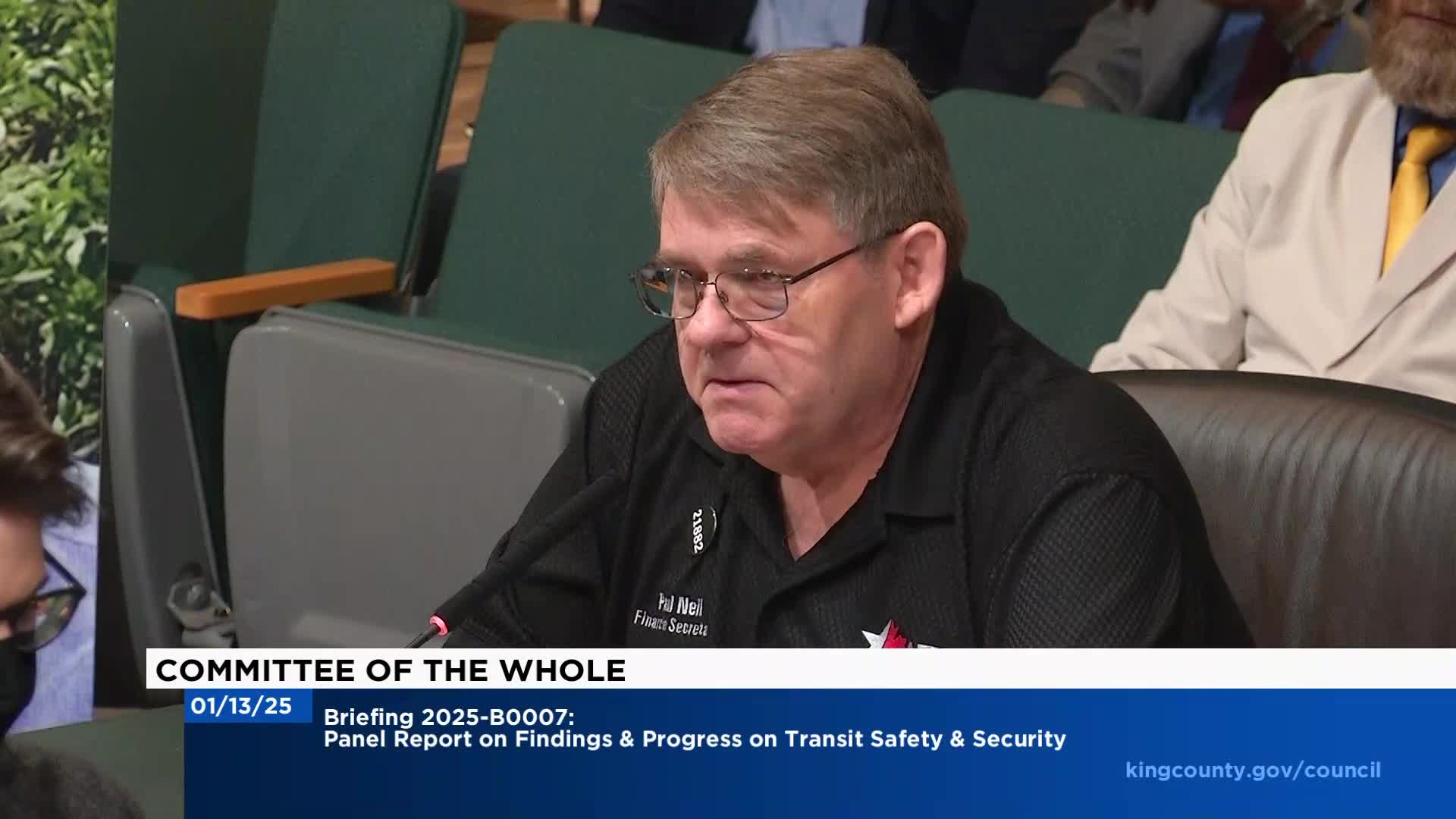
The meeting, called by Committee Chair Claudia Balducci, opened with union and rider testimony pressing the council for quick, tangible changes. "Action take place this year," said Patrick Brady, a Metro operator and former union treasurer, summarizing calls from a January memorial that drew more than 3,000 people. "The time for action is now."
The union representing operators, ATU Local 587, told the council the county must restore expectations that disruptive passengers will be removed and face consequences, increase law-enforcement presence, and make engineering changes to protect operators. "We will not sit idly by any longer while our members and your employees are assaulted and are suffering from PTSD and anxiety," ATU President Greg Woodfield said. "Please act now."
Why it matters: County and regional officials said the problem stretches beyond transit: illegal drug use, homelessness and gaps in behavioral-health services are visible in public spaces and on vehicles, and agencies must coordinate responses. Transit officials said improvements in presence, cleanliness and response can lower incidents; union leaders and some council members said those efforts must be paired with accountability and faster law-enforcement response to change rider and operator expectations.
What agencies said they are doing now
- Metro General Manager Michelle Allison said Metro has more than doubled contracted transit security officers (TSOs) over recent years, is expanding behavioral-health outreach teams and has launched Metro Safety Ambassadors and mandatory de-escalation training. She confirmed Metro will pilot operator-compartment prototypes this year, has ordered four test buses with protected operator designs, and plans a retrofit program and specifications for future new coaches. "Our frontline workforce is the reason we exist," Allison said.
- King County Sheriff Patty Cole-Tindall described "Operation Safe Transit," a regional emphasis effort that allows deputies to book people for misdemeanor offenses occurring on transit and that opened a booking pathway in May. The sheriff's office reported roughly 400 arrests from the operation since it began and said it recently reinstated a lateral hiring bonus to boost staffing. "Operation Safe Transit...allows for bookings for individuals who are creating an unsafe or an illegal environment in the transit system," she said.
- Sound Transit Deputy CEO Russ Arnold said the agency is expanding security officers, piloting discreet passenger text reporting tools and moving fare ambassador work to platforms in coordination with security staff. "Safety for our passengers, operators, and broader community is our number one priority," Arnold said.
- King County Department of Community and Human Services Director Kelly Ryder described investments in behavioral-health outreach and mobile crisis teams. Ryder said the county spends about $2.5 million per year on outreach programs, with the Metro-focused outreach team funded at about $890,000 per year; the county has expanded mobile crisis teams to 27 teams and invested roughly $22 million in those teams, with an additional $3.5 million recently targeted to expand capacity. Ryder summarized the county’s approach as "someone to call, someone to respond, and third, a place to go."
Union and operator priorities
ATU Local 587 leaders and rank-and-file operators pressed several near-term priorities: 1) immediate enclosure of operator compartments, 2) more deputies and security presence on buses and at transit centers, 3) faster response times from law enforcement, 4) better monitoring and performance oversight of contracted security officers, and 5) changes to how operators are disciplined so they are supported when they act to protect themselves and passengers. "We need to make safety number one," said Latrell Gibson, recording secretary, describing how operators feel they lack support.
Data and reporting
Council staff and agency speakers noted limitations in incident reporting: Metro’s dashboard showed lower counts than operators report experiencing in the field. Mary Berginon of council central policy staff explained the federal Public Transportation Agency Safety Plan and National Transit Database reporting requirements and said the council certified Metro’s safety plan last year. Metro and the sheriff's office acknowledged reporting and staffing gaps and emphasized both improving operator reporting and broader interagency data sharing as priorities.
Commitments and next steps described at the meeting
- Metro: pilot two operator-compartment prototypes; order four new buses with protected operator designs; begin a retrofit plan; reinstate fare inspection and enforcement procedures with warnings beginning in March and enforcement in May; continue to expand TSOs and behavioral-health teams.
- King County Sheriff’s Office: continue Operation Safe Transit emphasis operations, surge operations in targeted corridors (including Third Avenue and 12th/Jackson), and a $25,000 lateral signing bonus for experienced officers to address vacancies.
- DCHS: continue and expand outreach teams (Metro Safe team, city-hall neighborhood outreach and Sound Transit outreach) and move forward on crisis care center procurement and 'place to go' sites; Kirkland site opened and additional crisis-care RFP awards expected this spring.
Distinguishing discussion from formal action
There were no formal council motions or votes recorded at the special meeting. Most of the items discussed were agency commitments, budgeted programs, or proposed coordination steps. Council members and union leaders urged specific, timebound actions and the formation of a regional task force; Councilmember Jaime Dunne said she is drafting legislation to call for such a task force.
What council members said they will do
Council Chair Claudia Balducci and other members asked for a rapid action plan with items the county can implement immediately and a sustained regional response effort. Members said they will press for clearer response-time goals, better data aggregation and more public accountability for enforcement and behavioral-health investments. "We need to focus on things we can do right now," Balducci said, urging visible surges and coordinated emphasis operations to reset expectations on public behavior.
Ending
Agencies, union leaders and council members agreed on the need for coordinated briefings and follow-up. Speakers asked the council to pair immediate, visible enforcement and protection measures with investments in behavioral health and shelter services so the county can both deter criminal behavior and reduce the underlying drivers that push people into crisis on public transit. The Committee of the Whole closed without formal votes and with plans for follow-up coordination and possible legislative requests from the council.