Get Full Government Meeting Transcripts, Videos, & Alerts Forever!
Get email alerts on the Forest Conservation topic
No spam. Unsubscribe anytime.
Committee advances two reports on mature forests, maps 153,870 acres and highlights trade‑offs of harvest restrictions
Summary
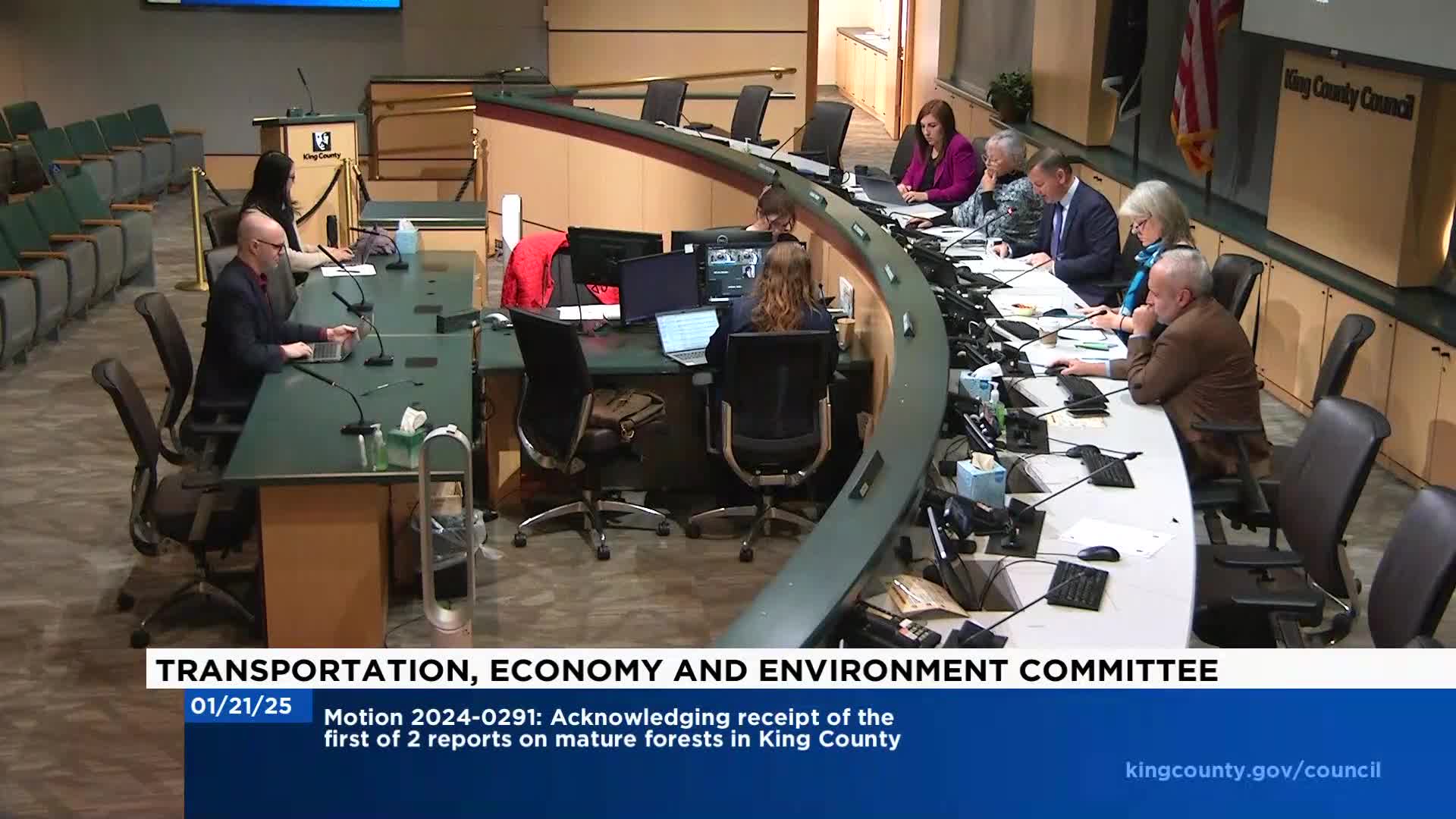
The King County committee on Jan. 21 advanced two executive reports that map mature forests across the county and analyze the fiscal and greenhouse‑gas trade‑offs of restricting timber harvesting on those lands.
The King County Council’s Transportation, Economy and Environment Committee on Jan. 21 advanced two staff reports about the county’s mature forests and potential options for preserving those lands.
Jake Tracy of council staff summarized the two companion reports, which respond to a 2023 council motion requesting analysis of mature‑forest extent, harvestability, greenhouse gas implications and options for reconveyance or trust‑land transfer. Using geospatial structure data and eligibility filters (outside the urban growth boundary, below 1,250 meters elevation, contiguous stands of five acres or more, and excluding stands with greater than 50% deciduous cover), the executive’s mapping identified 153,870 acres of mature forest countywide; of that total, the executive judged 72,311 acres could be legally harvested under the definitions used in the study.
The reports break ownership and harvestability down in more detail. Table 2 in the packet shows that 4,546 acres of mature forest are on lands managed by King County DNRP and could be legally harvested; 16,534 acres of mature forest are on DNR‑owned lands that are potentially harvestable, of which 11,289 acres are state forest trust lands and 4,373 acres are state forest trust lands for which King County is the beneficiary (the reports state those 4,373 acres are eligible for reconveyance). The packet includes maps (Figures 2 and 3) showing locations of mapped mature forests and those subject to harvesting.
The executive’s economic and climate analyses quantified trade‑offs. Extrapolating from 2024 numbers, the executive estimated that foregoing harvests on DNR trust lands could reduce revenue for trust beneficiaries by an amount on the order of tens of millions of dollars: the report estimates a 20‑year revenue impact of roughly $174 million for DNR lands if harvests were discontinued. Foregoing thinning or similar projects on county parks lands would have a smaller fiscal effect (estimated roughly $407,000 to $531,000 annually over 20 years in the report). On greenhouse gases, the report’s 20‑year modeled scenario indicated that a no‑harvest approach for the identified mature forests would reduce net emissions by roughly two‑thirds (the analysis assumes harvest would be displaced elsewhere so emissions would not drop to zero). Using a standard social cost of carbon approach, the staff calculated benefits of foregoing harvest in a range (the packet shows a range driven by discount rate assumptions; staff presented a range of approximately $86 million to $246 million in social‑cost‑of‑carbon benefits over 20 years), while the lost local revenue estimates are shown in a range that overlaps with those benefits; the report therefore concludes it is not possible to state categorically that benefits outweigh costs because the benefits are global while revenue impacts are local to trust beneficiaries.
The reports also examined transfer mechanisms and next steps. The county previously identified 10 parcels as candidates for trust‑land transfer (eight parcels were submitted in the most recent cycle); none of those applications were selected by the state in that round. The reports note that reconveyance is a separate statutory process that county legislative action could pursue but that reconveyance is time‑consuming in practice: one county example cited in discussion took more than five years. Executive staff recommended continued collaboration with Washington Department of Natural Resources (DNR) and enhanced coordination with junior taxing districts, and the reports identify the 4,373 acres of state forest trust land for which King County is beneficiary as eligible for reconveyance.
Council Member Mosqueda asked about timelines; DNR‑affiliated staff said reconveyance examples have in some cases taken more than five years. Committee members asked staff to follow up with examples of prior reconveyance timelines and to track a recent DNR moratorium on cutting in complex structural forests for local impacts. Committee members also expressed interest in continuing discussions about trust‑land transfer and potential reconveyance for the parcels previously identified.
The committee voted to advance both reports to the full council with a due‑pass recommendation. The motion to approve both proposals passed on a recorded roll call with five ayes and no nays. Committee members indicated they expect further staff follow‑up on parcel‑level next steps and on reconveyance options.