
Interim regional health officer: flu season active; outlines avian influenza risks and local guidance
Get AI-powered insights, summaries, and transcripts
Sign Up Free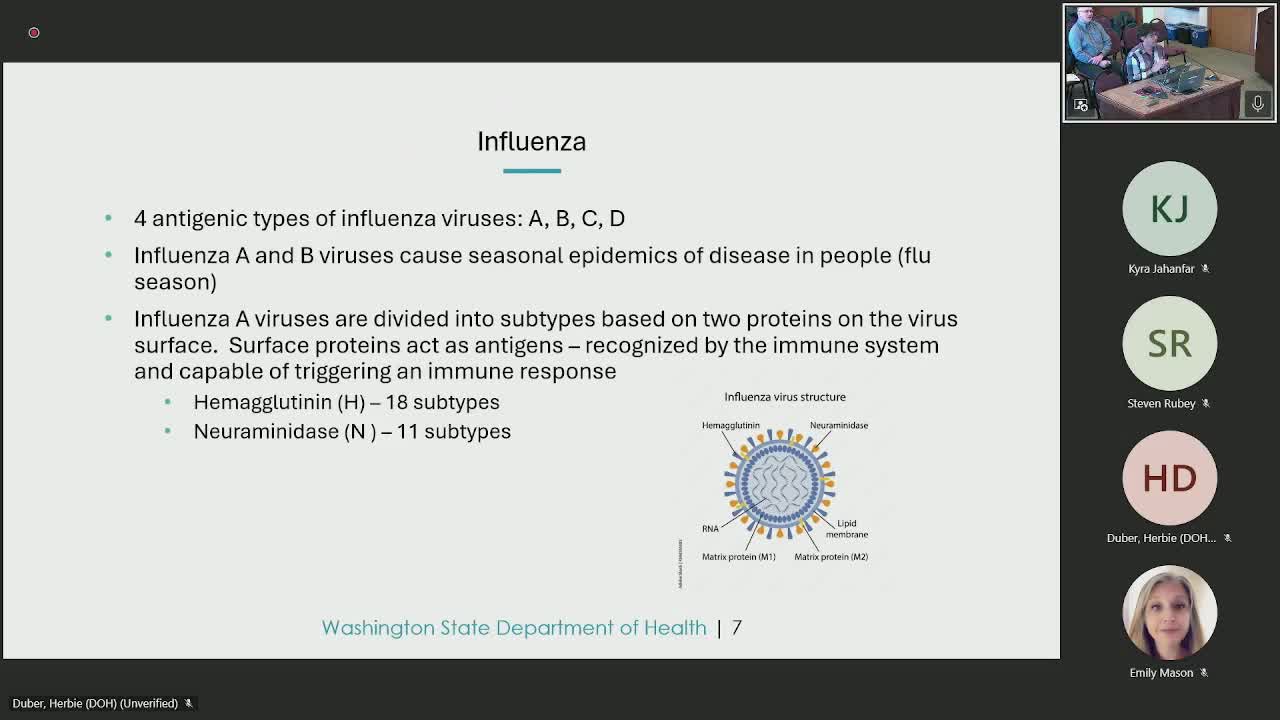
Summary
Herbie Duber, the interim San Juan County health officer and a regional medical officer with the Washington State Department of Health, told the Board of Health that influenza and RSV are circulating above baseline and spent most of his presentation explaining the risks from avian influenza (H5N1), current U.S. detections, and practical steps for residents and workers.
Herbie Duber, the interim health officer for San Juan County and regional medical officer for Northwest Washington at the Washington State Department of Health, told the county Board of Health that influenza and RSV are circulating at levels above seasonal baselines and outlined steps residents and local responders should take to limit risk from both seasonal respiratory viruses and the current avian influenza (H5N1) outbreak.
Duber said influenza ‘‘is out there’’ and that about ‘‘5% of ED visits, so 1 out of 20 individuals who I see in my emergency department likely have influenza.’’ He said COVID activity is relatively low in recent data, but that influenza and RSV have produced notable emergency-department visits and that other respiratory pathogens (for example, metapneumovirus and mycoplasma) are also circulating.
Duber spent most of his briefing on avian influenza, describing how the H5N1 virus currently circulating in wild and domestic birds worldwide is primarily an agricultural and wildlife problem that has produced rare human infections. He summarized the public-health posture: CDC and state health officials consider the current risk to people ‘‘low,’’ but continued multiagency monitoring and protective steps are warranted because influenza A viruses can reassort and, in rare circumstances, adapt to spread more easily among people.
On the current animal outbreak, Duber cited federal and state reporting showing substantial detections in poultry, dairy cattle and wild birds. He said California has reported the highest number of human cases in the United States to date and that Washington state has had the second-highest number of confirmed or probable animal detections in the current outbreak. Duber said Franklin County experienced a large commercial poultry outbreak ‘‘and I think there were about 1,000,000 birds that were culled there’’ (he prefaced the figure as his understanding). He also noted a USDA national bulk-milk-tank testing program and periodic updates on newly affected farms.
Duber said human infections linked to this outbreak have so far been uncommon and, compared with prior avian-influenza events, have produced a range of severity; conjunctivitis (eye redness) has been a common presentation in some exposed people. He cautioned that testing can detect environmental contamination as well as true infection in heavily contaminated agricultural settings, so clinical context and consultation with local public-health staff are important.
On testing availability, Duber said routine rapid tests available in emergency departments, urgent cares and many primary-care clinics detect influenza A and B, RSV and SARS-CoV-2, but more detailed subtype testing (for example, sequencing to identify H5N1 specifically) is not part of standard point-of-care testing and is ordered when exposure history or clinical findings prompt public-health follow-up.
Duber described the local public-health role as supportive and collaborative with agricultural and wildlife authorities. ‘‘This is really an agricultural and wildlife response,’’ he said, adding that lead agencies today include the Washington Department of Agriculture and Department of Fish and Wildlife, and that public health coordinates testing, exposure monitoring and PPE access for first responders and others with potential contact with sick or dead animals.
He gave these practical messages for residents and workers: - Avoid contact with wild birds and backyard or commercial poultry that appear sick or are found dead; observe from a distance and report sick or dead birds to the appropriate authorities. - Do not handle or consume raw milk or raw-milk products; pasteurization inactivates the virus. - Cook poultry, eggs and beef thoroughly; cooking kills influenza viruses. - People working with poultry, dairy or wildlife should use appropriate PPE and coordinate testing and monitoring with the local health jurisdiction if exposure is suspected.
Duber said there have been no confirmed detections of avian influenza in San Juan County during the current season, and he encouraged the Board and community partners to share reporting links and guidance with residents, particularly owners of backyard flocks.
Board members asked about vaccination trends for seasonal respiratory viruses; Duber said flu vaccine uptake has not improved and COVID vaccination levels have declined compared with earlier years, and he emphasized that vaccines reduce severe illness and death even when they do not prevent every infection. He also urged providers to ask about exposure to birds or animal contact when evaluating patients with flu-like illness so public-health partners can decide whether to request specialized testing.
Duber and the health department staff repeated that, at present, the immediate human risk from the current H5N1 outbreak is low but that ongoing surveillance, PPE for exposed workers, reporting of sick or dead birds, and basic precautions—including vaccination, hand hygiene, masking in crowded indoor spaces, and staying home when ill—remain the recommended approach locally.
Ending: Duber closed by thanking local staff and inviting questions; several Board members suggested using upcoming county agricultural events and the county website to increase outreach to backyard flock owners and small-scale producers about detection and reporting procedures.