Get Full Government Meeting Transcripts, Videos, & Alerts Forever!
Get email alerts on the Education Budget topic
No spam. Unsubscribe anytime.
Danvers School Committee advances FY26 budget plan with emphasis on literacy, special education and transportation savings
Summary
At a Feb. 3 budget workshop, Danvers Public Schools leaders presented a proposed FY26 budget that aims to hold a 3.6% increase while prioritizing early‑grade literacy materials and sustaining special‑education gains funded last year; administrators cited possible savings from transportation regionalization and one‑time grants.
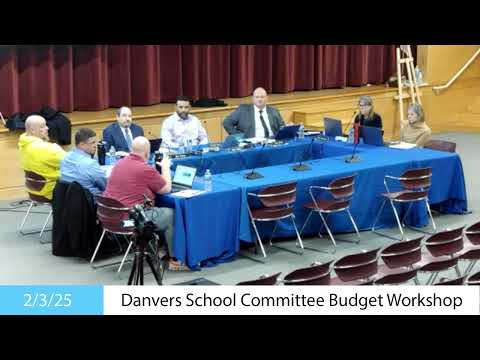
Danvers School Committee Chair Lopes and Superintendent Bauer presented a proposed fiscal year 2026 budget Wednesday that would hold the district's increase near 3.6% while maintaining staff and programs added last year and targeting new investments in early literacy, special education and transportation efficiencies.
The plan, presented at a public budget workshop broadcast on Danvers Community Access Television, would preserve "level services" across the district while shifting some previously grant‑funded software and positions into the operating budget. Superintendent Bauer said the district will return Feb. 24 for a public hearing and hopes to send a final number to the town select board after committee review.
Administrators emphasized why the proposal matters: last year's large one‑time allocations expanded in‑district special‑education supports and early literacy work, and leaders said those gains would be jeopardized by deep cuts. "We can't shortchange this," Bauer said about early‑grade literacy supports and positions added in 2024. The presentation showed a 13‑year average budget increase of 3.87% (including last year's 6.41%), and the current proposal of about 3.6% would rely in part on continued grant support and reimbursement programs.
Most immediately, the budget speakers highlighted four areas:
- Early literacy: Elementary leaders asked to fund decodable classroom texts aligned to the district phonics curriculum. The district proposed starting by funding grade 1 and 2 class sets at about $1,000 per classroom, a decision leaders said is data driven because early decoding gains translate into later reading success. The elementary group said the five schools' combined increase across non‑salaried elementary lines was about $49,000 (roughly under $10,000 per school). Committee members urged considering extending materials into higher grades later if projected savings materialize.
- Special education and student services: Administrators summarized work begun after two audits and last year's town investment. Proposals prioritize creating dedicated team‑chair or case‑management roles, converting some contracted services into in‑district staff over time, and adding targeted specialists (for example, a board certified behavior analyst for autism programming and a school psychologist for therapeutic programs). The student services presentation emphasized these steps are intended to reduce out‑of‑district placements over multiple years and make programming sustainable; staff repeatedly described the plan as a multiyear effort rather than an immediate fix.
- Transportation: Director of Transportation David Pulsipher outlined a strategy to reduce out‑of‑district and contracted transportation costs by consolidating routes, adding district vans, and increasing in‑house drivers. He said the district currently operates four vans, four buses, one spare bus and maintains a contract with SALTA Transportation for 10 buses; the yellow bus contract renewal shows an estimated $24,000 increase. David and the superintendent said a 10% reduction in transportation costs is a reasonable near‑term target, contingent on route consolidation and regional collaboration with an educational collaborative.
- Technology and recurring software: Director of Technology Jim Sullivan presented requests to absorb software and license costs previously paid from grants (for example, Zoom, emergency alert software, certain learning platforms) into the technology operating budget. He also proposed budgeting for maintenance of safety equipment (two‑way radios, access control) rather than relying on ad hoc funds, and noted an ongoing capital warrant article to replace classroom displays and aging lab equipment.
Administrators also reviewed grant awards that will help sustain some services without adding to the operating budget, including a multi‑year career pathway grant (Skills Capital Technology and Equipment Grant), grants for social‑emotional learning and mental health supports, early college grant partnerships with North Shore Community College, a Carnegie curriculum grant and others. The superintendent said the district expects about $684,000 in grant funding used for specific initiatives this year and noted that some emergency newcomer supports are funded outside the operating budget.
Committee members asked for clarifying data and urged staff to highlight where future savings could allow expansion of materials and staffing (for example, expanding decodable texts beyond grades 1–2 if transportation or other savings free up funds). The committee and administration agreed to present a more detailed budget book before the Feb. 24 hearing.
Ending: The committee will take up the formal budget hearing Feb. 24; in the meantime administrators will refine the document, add requested detail on savings and carry forward public feedback to the town presentation cycle.