Get Full Government Meeting Transcripts, Videos, & Alerts Forever!
Get email alerts on the County Finance And Public Health topic
No spam. Unsubscribe anytime.
Butler County reports stable 2024 revenues, outlines lead-abatement target and vows fixes after cryptic water notice
Summary
Butler County administrators reported 2024 revenues largely in line with recent years, flagged a possible plateau in sales tax and rising interest receipts, laid out a county-targeted lead-abatement proposal for owner-occupied homes and pledged changes after a cryptic mailing from the water department prompted customer calls.
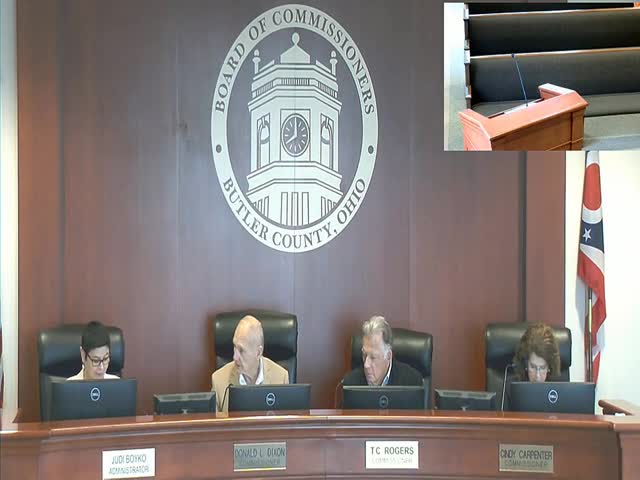
Butler County administrators told the Board of County Commissioners on Jan. 14 that the county closed 2024 with revenues largely consistent with recent years but noted shifts in property-tax collections, sales tax and interest income.
The county administrator said commissioners reduced the general-fund inside millage in recent years and that, “you did save the Butler County taxpayers, the property owners, nearly $25,000,000,” referencing a rebate of inside millage for collection year 2022 and further reductions tied to property-value increases through 2024. The administrator said personnel costs remain the largest general-fund expense and that contracted services were generally steady from 2023 to 2024.
Sales tax grew from about $44.6 million in 2020 to roughly $59.4 million in 2024, the administrator said, and suggested sales-tax collections may have plateaued after several strong post-pandemic years. Finance Director Dave McCormick described the county’s early-2025 requisition activity and noted large items this year include children services and a $23 million auditors’ requisition for 2025 medical and dental premiums.
Administrators highlighted a sharp increase in interest income: “beginning of 2021, it was $2,600,000… in 2023 it was $3,400,000,” the county administrator said, and added that 2024 interest receipts were substantially higher. The administrator said staff expect interest-related receipts to normalize and will monitor the effect into 2026.
The administrator also summarized the Lehi Safe Ohio program, a contractor-administered lead-abatement approach proposed to serve owner-occupied households at or below 80% of area median income. Under the proposal, 40% of program funds would target properties in Hamilton, 40% in Middletown and the remaining 20% elsewhere in the county. Target homes would include those with active lead (LEHI) orders requiring abatement; administrators said the program would work with hospitals to help identify potential candidate homes without sharing protected health information. The administrator said rental-property assistance is not the board’s preference but that, in limited cases, rental owners could participate if they agreed to maintain low-to-moderate rents for at least three years.
Separately, the county addressed a recent customer mailing from Butler County Water and Sewer that drew numerous calls. The administrator said the underlying issue began with a May 2023 sampling event in which one specimen “was held too long so it could not be analyzed.” Ohio EPA notified the county in August 2023 that one analysis was missing, and the county placed a notice on the Ohio EPA consumer-confidence report, the administrator said. The administrator acknowledged a subsequent mailing was terse and confusing to customers, and said she will meet with the water-and-sewer director to revise notification protocols.
The administrator said the department issued a press release, increased phone coverage for customer calls and will bring revised mailing and notification protocols back to the board. Commissioners pressed staff to make customer-facing notices clearer; one commissioner described the department’s notice language as “uncalled for.”
Why it matters: Commissioners use sales-tax and interest trends, and changes to property-tax collections, to judge budget flexibility and to track whether retention and wage adjustments are stabilizing county staffing costs. The Lehi Safe Ohio proposal outlines how county and contractor resources would be targeted to abate lead hazards in owner-occupied homes and notes limited circumstances under which rental properties might receive assistance.
What happened next: Finance staff moved the requisitions and appropriation items on the agenda for approval (see “Votes at a glance”). Administrators said they will monitor sales-tax collections through 2025 and will follow up on Lehi Safe Ohio implementation details and on water-department mailing protocols.