Get Full Government Meeting Transcripts, Videos, & Alerts Forever!
Get email alerts on the Stormwater Infiltration Reservoir topic
No spam. Unsubscribe anytime.
Sequim‑adjacent stormwater infiltration project moves forward to Phase 1 engineering with county‑city interlocal to follow
Summary
Clallam County and the City of Sequim told commissioners Monday they will advance phase‑one engineering and environmental review for a proposed stormwater capture and infiltration facility on county River Road property to capture runoff from the Highland/Main Canal near Happy Valley Road.
Clallam County and the City of Sequim told commissioners Monday they will advance phase‑one engineering and environmental review for a proposed stormwater capture and infiltration facility on recently acquired county River Road property, and staff said they will draft an interlocal agreement describing roles, responsibilities and grant management.
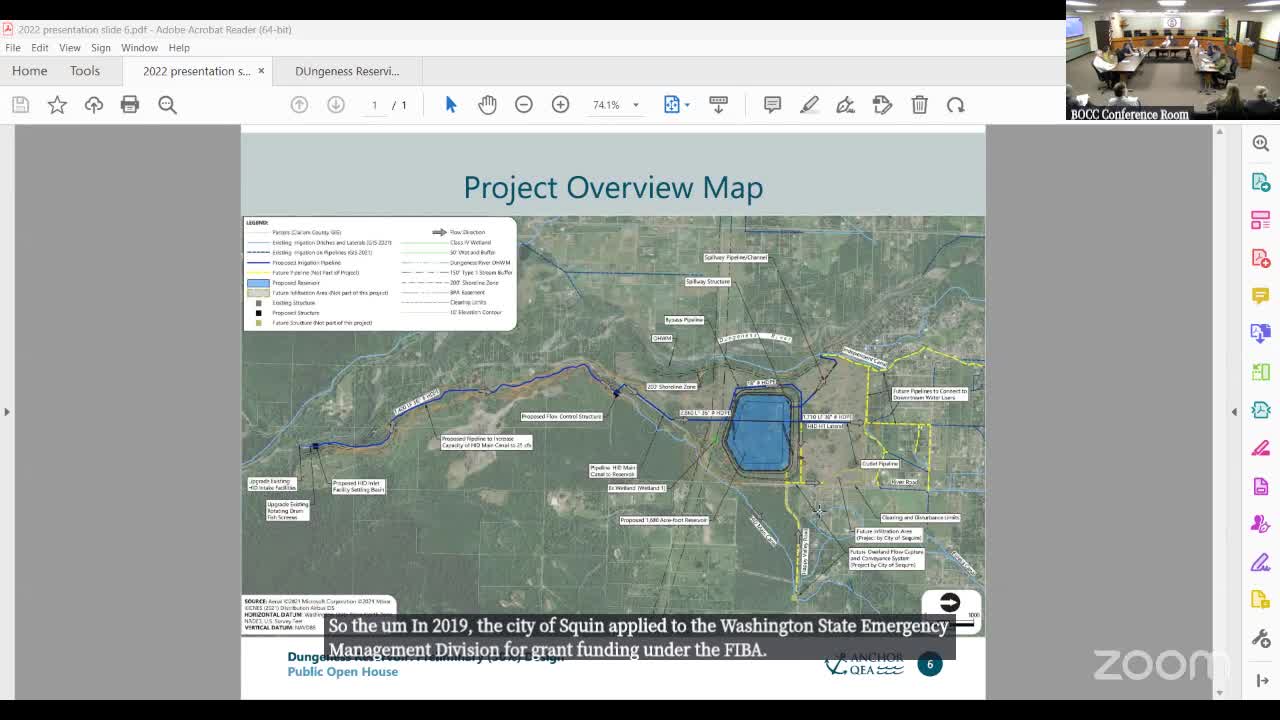
Sequim applied to the Washington State Emergency Management Division for Hazard Mitigation Grant Program funding to capture runoff from the Highland/Main canal near Happy Valley Road and divert it roughly a half‑mile to county property for infiltration and aquifer recharge. City and county presenters told commissioners the phase‑one grant award would fund land‑acquisition costs (already completed), additional site evaluation and up to 30% design and permitting work.
Staff summarized the phase‑one budget: total phase‑one project budget $318,800; local match equivalent $39,850 (the county’s land acquisition value); federal Hazard Mitigation Grant funding $239,100; and state Emergency Management Division funds $39,850. The planned infiltration footprint is preliminary — staff estimated 10–15 acres will likely be needed pending geotechnical investigation, groundwater modeling and design work.
Presenters stressed the project is separate from, but compatible with, the county’s Dungeness/Off‑channel reservoir planning. Recent reservoir flow modeling indicates the reservoir can be filled under a range of scenarios, which could create opportunities to use excess reservoir water for additional aquifer recharge through a future infiltration facility. Staff said Phase‑1 engineering will evaluate whether the reservoir and the infiltration facility can be managed in tandem, including groundwater‑recharge benefits and any hydrologic conflicts.
Project contract deadlines were noted: the city’s Hazard Mitigation Grant contract is active and the current end date is March 4, 2026 (extensions possible); Sequim and Clallam County staff said they will prepare an interlocal agreement for the county to receive grant management support from the city and to coordinate the site evaluation, design and public outreach. County and city staff said they will return to commissioners with a draft interlocal agreement and the results of the Phase‑1 site studies before moving to construction.
Commissioners and public‑works staff agreed the county has sufficient land on River Road to accommodate both projects and that Phase‑1 design is a prudent next step to quantify recharge benefits and permitting requirements.