Get Full Government Meeting Transcripts, Videos, & Alerts Forever!
Get email alerts on the Public Comment Spending Transit Safety topic
No spam. Unsubscribe anytime.
Residents criticize county spending, Cascadia contract and ClallamTrans free-fare safety during public comment
Summary
During public comment at the Jan. 21 meeting residents questioned a county payment to Cascadia Consulting Group, recurring discretionary expenses and safety on Clallam Transit buses funded by the Climate Commitment Act. Commenters also raised concerns about the 'benefit cliff' and processed-food vouchers.
Multiple members of the public used the commission's Jan. 21 public-comment periods to raise concerns about county contracting and spending, the science and intent of a planning contractor, safety on Clallam Transit buses and nutrition concerns tied to voucher programs.
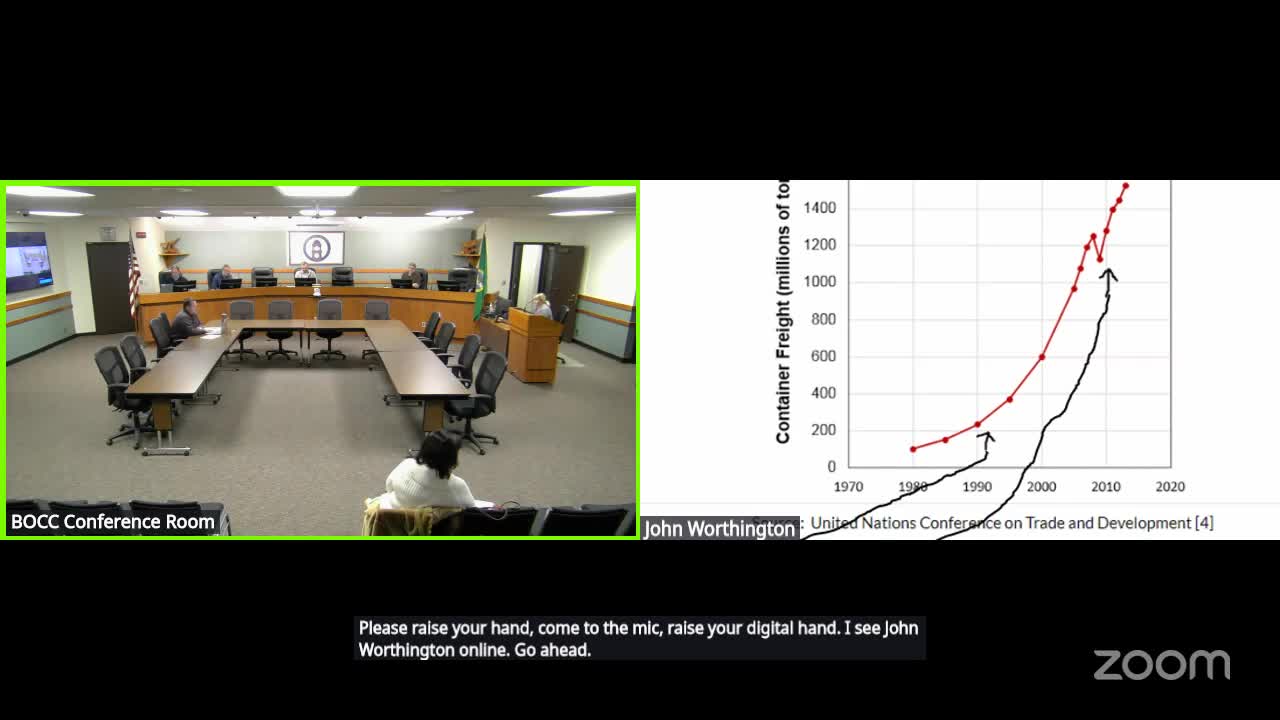
John Worthington of Sequim, who identified himself as executive director of two local groups, objected to county payments to Cascadia Consulting Group and to the contractor's use of a planning tool he described as tied to the United Nations. Worthington said he "oppose[d] the funding for Cascadia Consulting Group because they use ClearPath, the United Nations formula that makes sure Clallam County comes in 3rd place economically," and urged the commission not to fund the contractor.
A resident who identified himself as Jeff from Jamestown Road said county records show a $23,024.05 payment and suggested it was part of a larger $369,000 contract; he questioned the county's prior statements about having no such contract and criticized what he described as recurring discretionary purchases such as weekly pizza and a $1,200 holiday party. "It's just these little [things] in the big grand scheme of things," he said, urging fiscal restraint.
Several commenters addressed transit policy and safety. Jeff Tozer of Jamestown Road said ClallamTrans's zero-fare policy is paid for by the Climate Commitment Act and called it "a hidden gas tax." He described witnessing safety and disorder on buses, including a physical altercation and people riding to stay warm; he said that experience led him to purchase a second car and that he no longer feels safe riding the bus. Commission reports earlier in the meeting noted rising ridership; public commenters tied that policy to both benefits and concerns about onboard behavior.
Eric Farris of Sequim criticized proposed economic-development spending and the idea of using incentives to close a so-called "prime-age employment gap," calling the approach ill-considered and warning against increased public spending. Denise Latvios of Sequim and Karen Cummins of Dungeness used the public-comment period to raise separate concerns: Latvios referenced a state representative's vote and nutrition concerns, while Cummins read a passage about free speech and urged officials to consider citizens' perspectives.
Commissioners did not take formal action on the public comments; several items raised by speakers — including the Cascadia contract amount and specific discretionary spending figures — were assertions by residents and were not verified during the meeting record.