Get Full Government Meeting Transcripts, Videos, & Alerts Forever!
Get email alerts on the Floodplain Regulation topic
No spam. Unsubscribe anytime.
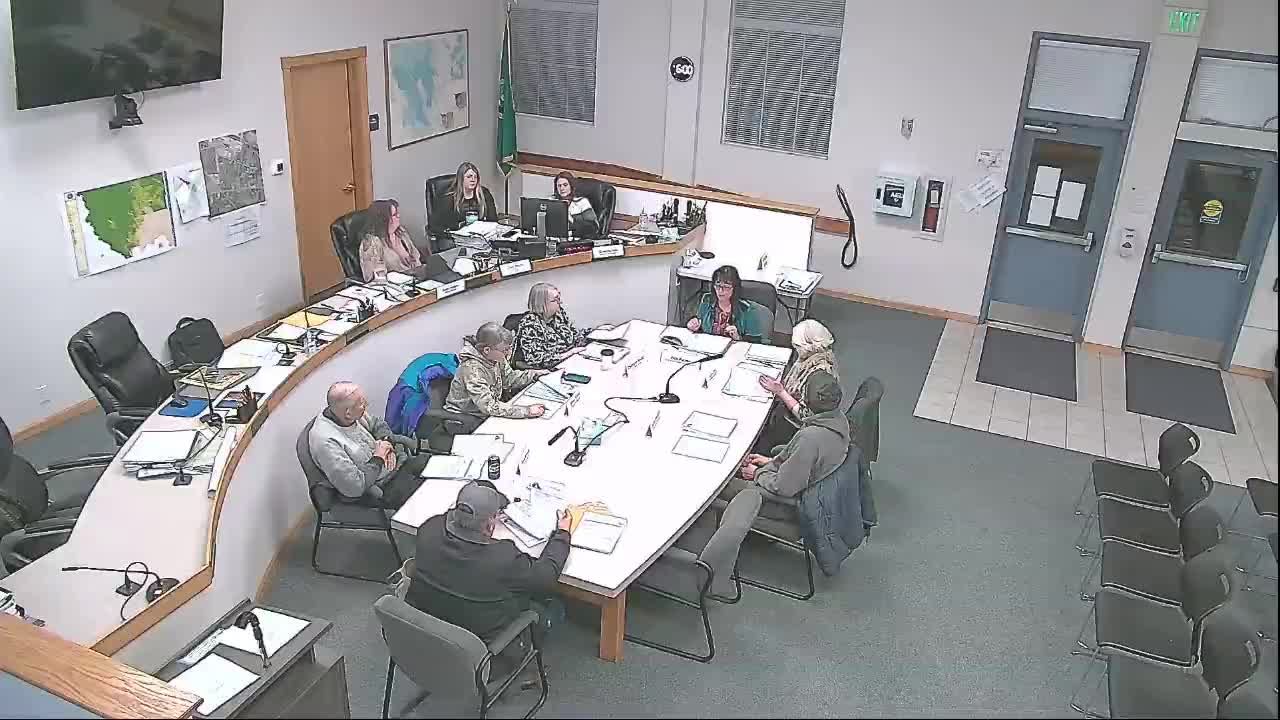
Okanogan County staff advance floodplain code revisions after Ecology compliance review
Summary
Okanogan County planning staff told the commission that a Department of Ecology compliance review and federal flood-insurance requirements have prompted a working draft of floodplain regulation updates and enforcement changes.
Okanogan County planning staff told the commission that a Department of Ecology compliance review and federal flood-insurance requirements have prompted a working draft of floodplain regulation updates and enforcement changes.
The revisions, staff said, are meant to bring county code into alignment with state and federal requirements while shifting enforcement away from immediate misdemeanor penalties and toward department-led mitigation agreements with property owners.
The county has been working on the matter for nearly two years, staff said. Ecology’s compliance list originally identified roughly 15 properties; staff reported the number is now down to two, and they hope to remove those last two from the compliance list if owners sign statements confirming no structural changes were made. “We think we’re gonna be able to get the last 2 sites removed off of the compliance list,” Pete, planning staff, said. Pete said one remaining site is an existing occupied home for which Ecology would remove the listing if the owner signs a statement that no structural changes were made.
Why it matters: maintaining participation in the National Flood Insurance Program (NFIP) affects property owners’ ability to buy flood insurance and reduces county exposure to recovery costs after floods. Planning staff emphasized that much of the proposed text is driven by flood-insurance rating rules and state guidance from Ecology.
What staff described: the draft changes would (1) update floodplain definitions and procedures to match state and FEMA requirements, (2) provide department-level enforcement tools that prioritize written mitigation agreements over immediate criminal prosecution, and (3) preserve the county’s complaint-driven enforcement posture (staff said county staff will not proactively search for violations but will address complaints from neighbors or state agencies). “The commissioners are very adamant that they're not gonna put anybody in jail for illegal development,” Pete said.
Enforcement context and technical limits: staff described how long-standing county code currently ties certain land-use violations to misdemeanor charges and potential jail time. The proposed approach would keep enforcement local and administrative first, with fines or court action used only after mitigation attempts fail. Staff also explained the substantial-development / substantial-improvement threshold used in floodplain management: if a repair or improvement exceeds 51% of a structure’s fair market value, the county must require that the whole structure be brought up to FEMA standards (which can require raising foundations or other major work).
Mapping, grants and post-fire work: staff said two parallel mapping and grant efforts will inform the county’s FIRM (Flood Insurance Rate Map) data. One FEMA-funded team is expected to map post-fire debris flows in burn areas and alluvial fans; another grant would map pre- and post-fire debris flows to build historical records and “best available science” that can be used to update FIRM maps for Okanogan and nearby counties. “Those two projects…are gonna really boost our FIRM maps to show actual data and give us the ability to take hard looks at these areas,” Pete said. Staff listed Douglas and Chelan counties as other participants in the mapping effort.
Timeline and next steps: planning staff asked the commission to review the draft text and provide a recommendation at the next meeting so the Board of County Commissioners (BOCC) can hold a public hearing. Staff said the aim is to have a planning commission recommendation by March so the BOCC workshops and final draft can follow and then be released for a 30-day public comment period.
Local context and common questions: commissioners and members raised concerns about grandfathered properties built decades ago in Oroville and other river towns and asked how the revisions will affect them. Staff said legally preexisting structures remain grandfathered until they are removed or are altered beyond the substantial-improvement threshold; that is the point at which FEMA-compliant upgrades are required. Staff also clarified local rules about recreational vehicles: living in a travel trailer for more than six months is not permitted in many locations without an active building permit and a permanent residential structure.
What was not decided: the planning commission did not adopt the draft at the meeting; it was provided for review and discussion and will return for a formal recommendation at a future meeting.
Ending: staff asked commissioners to read the draft, prepare notes, and return at the next meeting to consider a formal recommendation to the BOCC.