Get Full Government Meeting Transcripts, Videos, & Alerts Forever!
Get email alerts on the Education School Funding topic
No spam. Unsubscribe anytime.
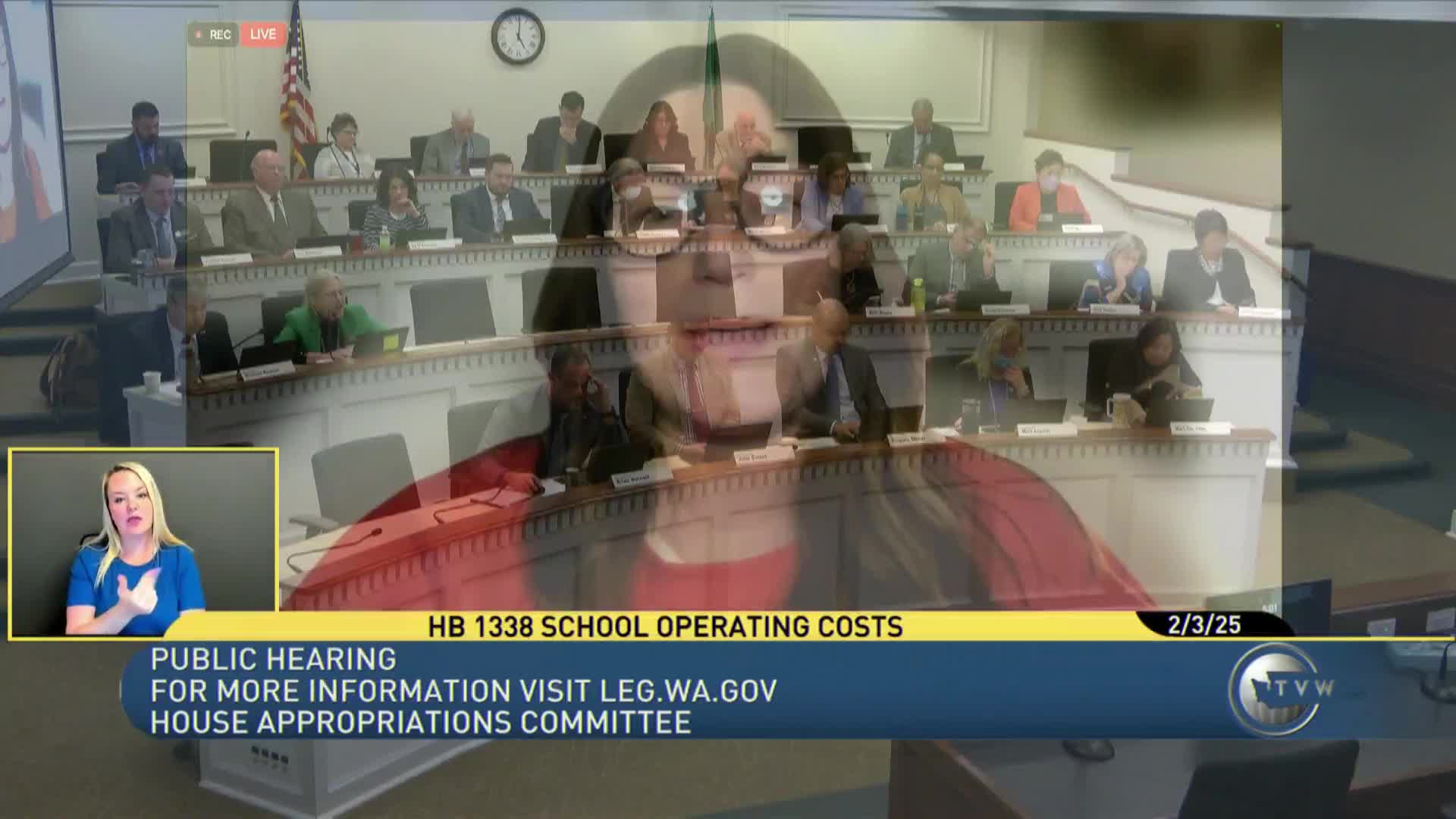
Appropriations Committee hears bill to raise per‑pupil operating allocations by about 20%
Summary
House Bill 1338 would increase Material, Supplies and Operating Costs (MSOC) per‑pupil allocations across multiple categories by roughly 20%, codify some MSOC amounts and rebasing requirements, and reduce skill center class‑size assumptions; committee staff estimated a multi‑hundred‑million dollar state cost in the next biennium.
Committee staff briefed the Appropriations Committee on House Bill 1338, sponsored by Rep. April Berg, which would raise the per‑pupil Material, Supplies and Operating Costs (MSOC) allotments for general education and other categories by approximately 20% beginning in the 2025–26 school year and require periodic rebasing.
Staff briefing and key provisions James Mackson, staff to the committee, told lawmakers the current general education MSOC amount defined in statute is $1,533.20 for the 2024–25 school year and projected to be about $1,570 for 2025–26. The bill would increase general education MSOC to $1,883.70 per pupil; raise the grades 9–12 supplemental MSOC to $250.72 per pupil; increase skill center MSOC to $2,159 per pupil; codify certain MSOC amounts that had been set in the budget; and reduce the skill center class‑size assumption from 19 to 16.67 for funding formulas. The bill also requires the legislature to review and rebase MSOC costs beginning in the 2029–30 school year and every four years thereafter.
Fiscal impact and districts’ testimony Staff reported no fiscal note was in the committee bill file at the time of the briefing but provided an estimate that the proposal would cost about $708 million in the 2025–27 biennium and approximately $1.54 billion over a four‑year outlook, all state funds.
Superintendents, school board members and district leaders provided testimony supporting the bill and describing local MSOC shortfalls. Patrick Murphy, superintendent of Olympia School District, said utilities there rose 10% last year and insurance 15%, and that districts used levies to cover around $4.5 million more than what the state funded. Bellevue, Highline and other large districts described multi‑million dollar MSOC deficits; Highline Superintendent Ivan Duran testified the district has been underfunded in MSOC by about $31.9 million since 2019, with an annual MSOC deficit near $9 million. Smaller districts and skill center representatives said the increases would relieve pressure on local levies and help districts avoid staff cuts.
Policy rationale and implementation details Representative Berg described MSOC as “one of the most student centered investments” and told the committee, “MSOC money literally keeps the lights on in our schools.” Supporters argued the increase would restore purchasing power eroded by inflation and rising insurance and utility costs and would create predictable funding for districts that now rely on local levies to fill gaps.
Technical concerns and requests Skill center and CTE representatives asked for careful treatment of any multi‑year averaging or rolling averages that could unintentionally disadvantage growing programs. The Washington Association for Career and Technical Education asked the committee to consider adjustments so growing CTE programs capture funding in a timely way rather than being penalized by a three‑year rolling average.
Next steps The committee concluded the public hearing after extensive testimony. No formal committee action or vote was recorded in the hearing transcript. The bill’s fiscal estimates and broad testimony will inform future deliberations on K–12 funding and the state budget.