Get Full Government Meeting Transcripts, Videos, & Alerts Forever!
Get email alerts on the Stormwater Infiltration topic
No spam. Unsubscribe anytime.
Experts debate infiltration feasibility for Meadowview; county review finds conservative pond design
Summary
Geotechnical and civil engineers differed over whether Meadowview’s soils support infiltration system credits. Applicant civil engineer said limited infiltration is being implemented; the geotechnical consultant and an independent expert urged further field testing during final engineering before reducing pond sizing.
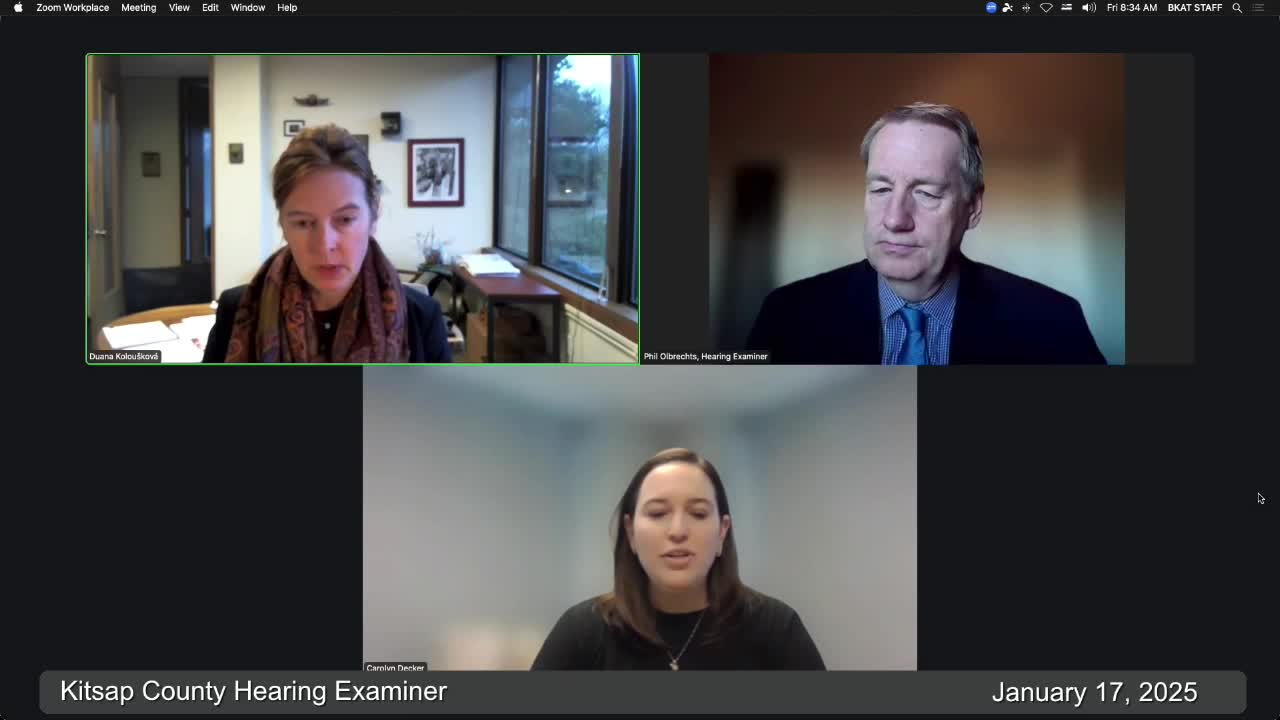
At a Jan. 17 Kitsap County consolidated hearing on the Meadowview preliminary plat SEPA appeal, project geotechnical and civil engineers and outside experts clashed over whether the site can rely on infiltration systems rather than large ponds to meet county stormwater rules.
Miss Decker, a geotechnical engineer for Terra Associates, testified that the Meadowview site contains three broad soil zones and that infiltration is feasible in the northern, outwash-mapped portion of the property but not across the entire site. She said the firm’s preliminary long-term design infiltration rate for candidate northern areas is 1 inch per hour, and that deeper testing and final-engineering site grading will be required to confirm any infiltrative systems.
Why this matters: Kitsap County’s stormwater manual guides a multi-step feasibility check that first looks for measured infiltration rates, then derives a design rate. County guidance and project engineers said Meadowview’s final stormwater design must be conservative at preliminary plat because some portions of the site have low-permeability formations, steep slopes and many planned walls and cuts that could limit infiltration. As a result, the applicant’s drainage team did not take infiltration credits in sizing the ponds and left the ponds large enough to meet flow-control and water-quality requirements without relying on those credits.
Key details and dispute
- Geology and soils: Decker described northern outwash sands that extend off-site and are good candidates for infiltration, contrasted with ice-contact materials and glacial till to the south and west that are less permeable. She identified specific test pits where clean sand was absent and said the site is “more marginal” for infiltration than other mapped outwash settings.
- Manual vs. field testing: Project civil engineer Miss Heffern (project manager and licensed civil engineer) said the team followed Kitsap County’s “list 2” path in Minimum Requirement 5: evaluate BMPs in order, use the first feasible BMP, and then stop. She told the hearing the project implements limited full-dispersion (five small dispersion trenches at the north lakefront) plus bioretention, underdrains on lots, and two ponds sized conservatively without infiltration credits. “We evaluate each surface, evaluate the feasibility of the BMP in the order listed, and then use the first BMP that’s considered feasible,” she said.
- Methodology dispute: Appellants and an independent expert (Dr. Rosin) argued the geotechnical testing and the report’s presentation mixed measured and design rates and relied on grain-size analysis methods that, they said, the manual treats differently for urban sites. Dr. Rosin told the hearing the site’s mapped soils and the geotechnical borings are consistent with high hydraulic conductivity in many areas and that more targeted field infiltration testing (pilot/pit tests) should be done during final engineering rather than relying on averaged grain-size results.
- Practical site-work: Decker and Heffern agreed that final engineering, including additional test pits and infiltration testing at the elevations and locations where systems would actually be built, is the normal next step; that additional data can change a design (adding infiltration later or, if infeasible, keeping larger ponds); and that the county’s final plan review and permit (site development activity permit) is where those details are confirmed and stamped.
What the county reviewer said
County stormwater reviewer Will Sullivan told the hearing he had reviewed the preliminary drainage materials and that the project, as proposed, meets the county manual at the preliminary stage. He also described the manual’s role — the county expects the geotechnical and civil teams to refine infiltration feasibility and to test at final design before credits would be allowed.
Next steps and timeline
The hearing record remains open for the county’s 7-day public comment window; staff and applicant filings will continue through the end of January. Engineers said the next technical milestone that will resolve remaining questions is final engineering and construction-level infiltration testing at proposed facility locations, after grading plans and wall locations are finalized. That testing — pilot infiltration tests or in-situ pit tests at each proposed facility — is required before infiltration design credits are taken and pond sizes reduced.
Ending: For now, Meadowview’s storm system is sized conservatively with no infiltration credits; both applicant and outside experts agreed that additional, location-specific testing during final engineering is the decisive next step for any wider use of infiltration.