Get Full Government Meeting Transcripts, Videos, & Alerts Forever!
Get email alerts on the Victim Services Funding topic
No spam. Unsubscribe anytime.
Senate Bill 5362 would require sustained state funding to backfill sharp federal VOCA declines
Summary
Senate Bill 5362 would direct the legislature to appropriate escalating aggregate annual amounts for victim services in Washington, supplementing declining federal Victims of Crime Act funds; advocates and service providers warned of a 50%+ funding cliff in July 2025 and urged stable, ongoing state commitments
Senate Bill 5362 would require the Washington legislature to appropriate state funds for victim services in the aggregate with federal Victims of Crime Act (VOCA) allocations so that total annual victim‑service funding reaches specified statewide targets over successive biennia.
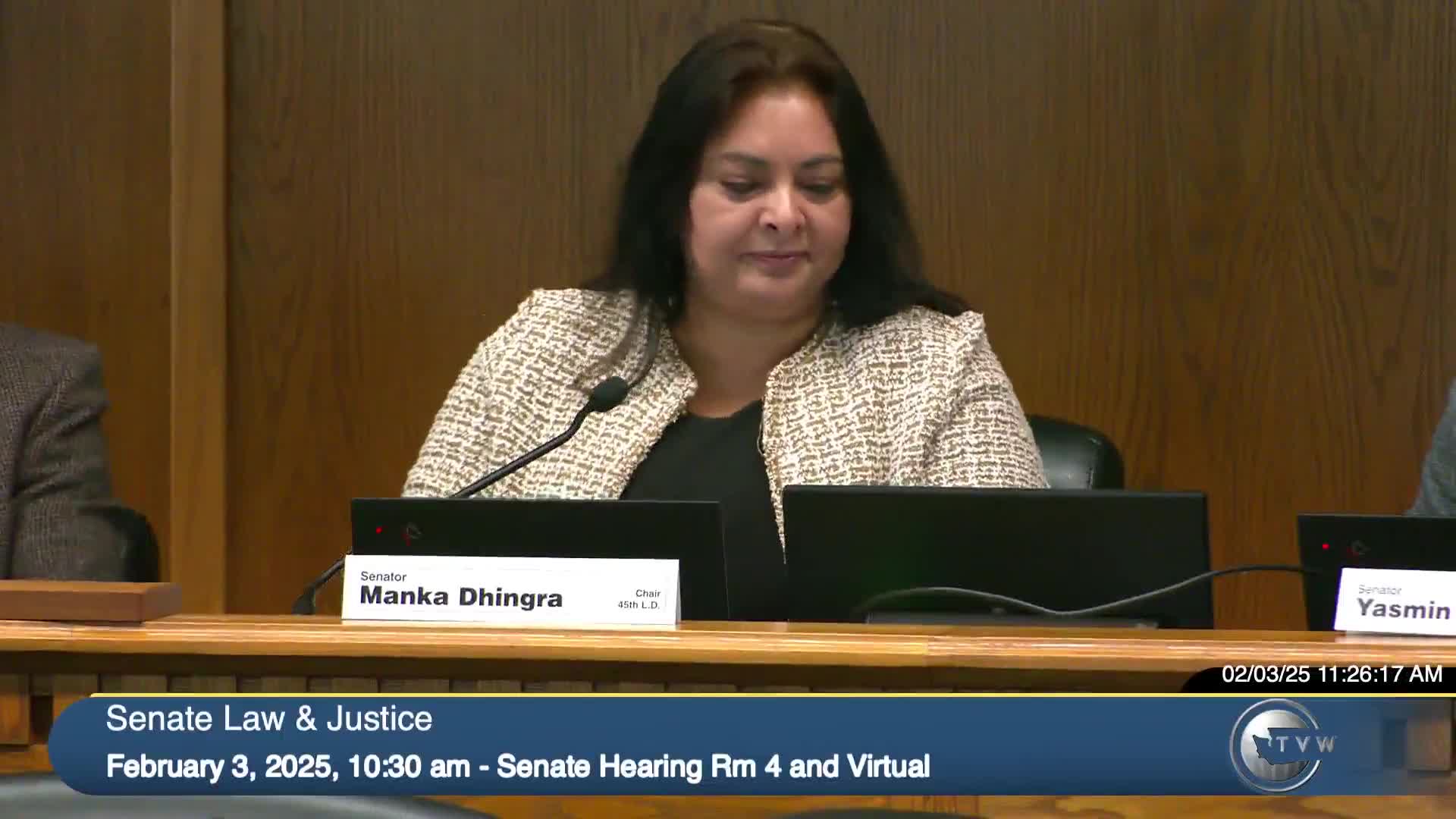
Under the bill’s schedule presented at the Feb. 3 public hearing, aggregate funding (VOCA plus state appropriations) would be $50 million annually for the current and next biennium; $60 million annually in the 2029–2031 and 2031–2033 biennia; and $70 million annually beginning in the 2033–2035 biennium and thereafter. The Office of Crime Victims Advocacy (OCVA) would report to the legislature every five years after aggregate funding reaches $70 million with program data and recommendations for future funding levels. A fiscal note has been requested.
Testimony at the Law & Justice Committee hearing highlighted a rapid federal funding decline and the effect on service providers. Tricia Smith of OCVA said federal VOCA awards dropped from roughly $74.7 million in federal fiscal year 2018 to $17.8 million in FY2024, and that the legislature provided approximately $40 million in supplemental funding in the last biennium. She told the committee the current supplemental funds will expire June 30, 2025, and without state action the sector could face an estimated 55% reduction beginning July 1, 2025.
Advocates and service providers described immediate operational impacts. Sherry Tinoco of the Washington State Coalition Against Domestic Violence said domestic violence shelters and hotlines could face catastrophic cuts; in fiscal 2024, domestic violence programs answered more than 73,000 hotline calls and provided about 166,000 nights of emergency shelter. Annalise Martucci of the Office of Civil Legal Aid highlighted that legal services for survivors currently serve roughly 5,000 households annually and would see staff losses and reduced geographic coverage if funding falls.
Child advocacy centers, prosecutors and community providers urged a sustainable state solution. Lisa Mannion, King County prosecuting attorney, and Russell Brown of the Washington Association of Prosecuting Attorneys said stable funding is necessary to preserve emergency housing, crisis lines, trauma therapy, legal assistance and other services that support victims and complement law enforcement and prosecution.
Multiple tribal, rural and disability‑focused witnesses testified that VOCA declines disproportionately affect tribes, rural communities, and people with disabilities. Survivors and service providers urged the committee to preserve the governor’s proposed $20 million allocation for FY2026 and to adopt SB 5362’s longer‑term stabilization plan. Committee members noted the bill would likely require appropriation language in Ways & Means and planned follow‑up with budget staff; no formal committee vote occurred at the hearing.